
If you have seen someone write “no cap” 🧢 in a text, comment, or social media post, you may wonder what it really means. In slang, cap usually means a lie, false claim, or exaggeration, while no cap means that someone is being honest or telling the truth.
These expressions are common in casual conversations and online communication. You may also see related phrases such as “that’s cap,” “you’re capping,” or “stop capping.” Although they are informal, understanding them can make texting and social media conversations much easier to follow.
Quick Answer: What Does Cap Mean?
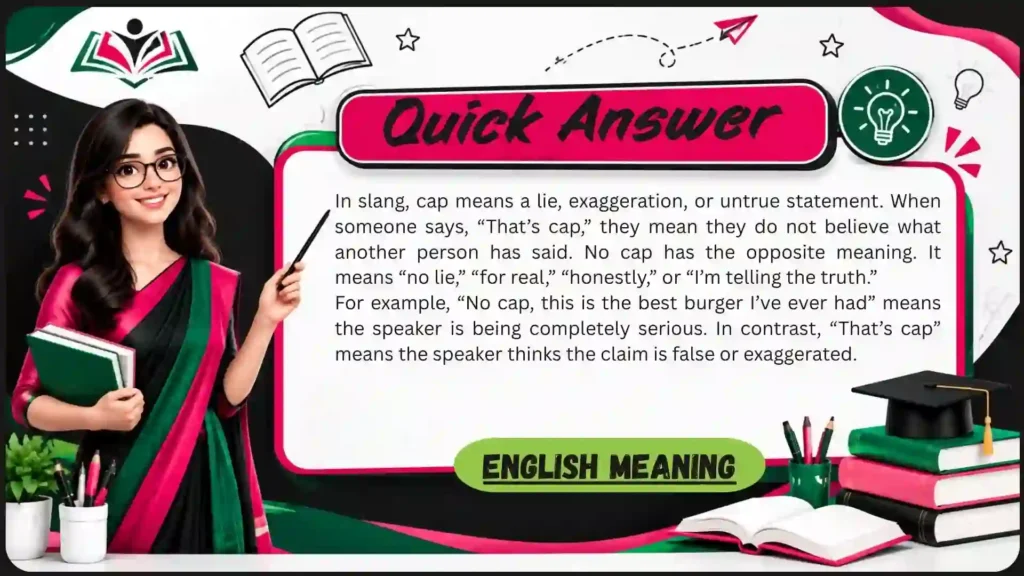
In slang, cap means a lie, exaggeration, or untrue statement. When someone says, “That’s cap,” they mean they do not believe what another person has said. No cap has the opposite meaning. It means “no lie,” “for real,” “honestly,” or “I’m telling the truth.”
For example, “No cap, this is the best burger I’ve ever had” means the speaker is being completely serious. In contrast, “That’s cap” means the speaker thinks the claim is false or exaggerated.
You Might Also Like That: ILY Meaning
No Cap Meaning at a Glance
| Phrase | Meaning |
| Cap 🧢 | A lie, false claim, or exaggeration |
| No cap 🚫🧢 | No lie, honestly, or for real |
| Capping | Lying or exaggerating |
| That’s cap | That’s not true |
| Stop capping | Stop lying or exaggerating |
| You’re capping | You’re not telling the truth |
The main idea is easy to remember: cap means something is not true, while no cap means something is true or said honestly. These expressions are mainly used in informal speech, texting, comments, and online conversations.
What Does “Cap” Mean in Slang?
In slang, cap means a lie or exaggeration. Someone may use it when they believe another person is making a false claim or trying to make a story sound more impressive than it really is. For example, “You said you met five celebrities? That’s cap” means the speaker does not believe the story.
The word can also be used as a verb. If someone says, “You’re capping,” they mean “You’re lying” or “You’re exaggerating.” The exact tone depends on the conversation and the relationship between the speakers.
What Does “No Cap” Mean in Slang?
No cap means “no lie,” “for real,” “honestly,” or “I’m telling the truth.” People often add it to a statement when they want to show that they are serious and are not exaggerating. It can appear at the beginning or end of a sentence.
For example, “No cap, that was an amazing game” means the speaker genuinely believes the game was amazing. Similarly, “That was the best meal ever, no cap” emphasizes that the person is being honest about their opinion.
What Does “Capping” Mean in Texting?
Capping is the -ing form of the slang verb cap. It means lying, exaggerating, or making something up. You might see it in messages when one person does not believe another person’s story or claim.
For example:
- “Bro, you’re capping.” → I don’t believe you.
- “Stop capping.” → Stop lying or exaggerating.
- “I’m not capping.” → I’m telling the truth.
These phrases are casual and are most natural in conversations between friends or online users.
What Does “That’s Cap” Mean?
“That’s cap” means “That’s not true” or “I don’t believe you.” Someone may say it when they think another person is lying or making a claim that sounds unrealistic.
For example, if someone says, “I finished a 500-page book in one hour,” another person might reply, “That’s cap.” The expression can be playful between friends, but it may sound more direct or accusing in a serious conversation. Because of this, the speaker’s tone and the situation matter.
What Does “No Cap” Mean on Social Media?
On social media, no cap is often used to emphasize that a statement is genuine or honest. You may find it in comments, captions, memes, videos, and casual posts. It can also be used when someone strongly agrees with an opinion.
For example:
“This is the best song this year, no cap.”
Here, the writer is saying they genuinely believe the song is the best. Social media has helped make the expression widely recognizable, but no cap is not limited to one platform.
Real Examples of Cap and No Cap
Here are some simple examples showing how the expressions work in everyday communication:
| Example | Meaning |
| “No cap, this pizza is amazing.” | The speaker is being honest. |
| “That’s cap.” | The speaker thinks the claim is false. |
| “You’re capping right now.” | The speaker thinks someone is lying. |
| “No cap, I studied all night.” | The speaker emphasizes that the claim is true. |
| “Stop capping about your score.” | Stop exaggerating or lying about your score. |
These examples show that cap and no cap work almost like opposites in casual slang.
Cap, No Cap, and Capping: How the Forms Relate
These expressions belong to the same slang family. Cap refers to a lie or exaggeration, while capping describes the action of lying or exaggerating. No cap tells someone that the speaker is being truthful.
A quick way to remember them is:
- Cap 🧢 → Lie or exaggeration
- Capping → Lying or exaggerating
- No cap 🚫🧢 → No lie or for real
- That’s cap → That’s not true
- Stop capping → Stop lying
What Does the 🧢 Emoji Mean?
The 🧢 cap emoji can represent the slang meaning of cap in online conversations. When someone sends the emoji by itself, they may be saying that a statement is a lie, exaggerated, or hard to believe.
For example, if someone makes a surprising claim and another person replies with “🧢,” they may mean “That’s cap” or “I don’t believe you.” In some contexts, people may also use 🚫🧢 to suggest “no cap” or “no lie.”
How to Use Cap and No Cap Naturally
Use cap when you want to say that something is untrue or exaggerated. Use no cap when you want to stress that something is true or that you are being honest.
For example:
- “That’s cap.”
- “You’re capping.”
- “No cap, I really enjoyed it.”
- “I’m not capping.”
These expressions sound most natural in casual communication. Avoid adding them simply to make a sentence sound trendy. They work best when the situation is relaxed and the meaning is clear.
Is “No Cap” Appropriate for Formal English?
No cap is informal slang, so it is generally not suitable for formal writing. You would normally avoid it in school essays, professional reports, business emails, applications, or official documents.
Instead, use standard expressions that communicate the same idea:
- No cap → Honestly
- No cap → Truthfully
- No cap → Seriously
- No cap → Without exaggeration
Knowing when not to use slang is just as useful as knowing what the slang means.
Is “That’s Cap” Rude?
“That’s cap” is not automatically rude, but it can sound dismissive or accusing depending on the situation. Among close friends, it may simply be a playful way to say, “I don’t believe you.” In a serious conversation, however, it can sound like you are directly calling someone a liar.
If you want to sound more polite, you can say “Are you sure?”, “I’m not sure that’s accurate,” or “I don’t think that’s true.” The relationship between the speakers and the tone of the conversation usually determine how the phrase is received.
What Does “Cap” Mean Outside Slang?
The word cap has several meanings outside slang. It can refer to a type of hat, a cover placed over something, or a limit/maximum. For example, a spending cap is a maximum amount that can be spent.
This means context is important. In “That’s cap,” the word is usually slang. In “There is a spending cap,” it refers to a limit. Looking at the surrounding words usually makes the intended meaning clear.
Where Did the Slang “Cap” Come From?
The modern slang use of cap has a history connected with African American English and Black American speech. The word has also been linked with older slang uses involving boasting, competition, and exaggeration. Over time, the meaning developed into the idea of making a false or exaggerated claim.
The exact history is not completely simple. Online discussions sometimes give different explanations for where the slang came from, so it is better to separate documented history from theories. Hip-hop and popular culture later helped spread the expression to wider audiences.
Where Did “No Cap” Come From?
No cap developed from the slang meaning of cap. If cap means a lie or exaggeration, then no cap means there is no lie or exaggeration. The phrase became strongly associated with Black American speech and later gained wider attention through hip-hop and online culture.
Its modern popularity grew as people began using it more often in music, social media, texting, and online conversations. Today, many people recognize no cap as a casual way to emphasize honesty or seriousness.
Did Gen Z Invent “No Cap”?
Although no cap became especially popular among younger internet users, that does not mean Gen Z invented the expression. The slang existed before its widespread use on modern social media.
Music, hip-hop, online communities, and social platforms helped introduce the phrase to larger audiences. Today, people from different age groups may recognize or use it, although it remains strongly associated with informal internet and youth slang.
Is the Origin of “Cap” Actually Known?
The history of cap is more complicated than a simple one-line explanation. Some explanations connect it with older uses of words related to boasting, surpassing, or making claims. Other theories appear in online discussions, including the Reddit etymology discussion, but these should not automatically be treated as proven facts.
For readers, the most useful point is that the modern slang meaning is well established: cap means a lie or exaggeration, while no cap means honesty or truth. The exact path by which every earlier use developed is less certain.
Why Is “No Cap” So Popular Online?
The phrase no cap is short, easy to understand, and useful when someone wants to add emphasis to a statement. It works especially well in short messages, comments, captions, and memes because it can communicate “I’m serious” without requiring a long explanation.
Its connection with music and online culture also helped it spread. The phrase can be used at the beginning or end of a statement, making it flexible in casual communication. The 🧢 emoji also gives users a simple visual way to express the idea.
No Cap vs. Similar Slang Terms
Some expressions have a similar function to no cap, but they are not always exact replacements.
| Expression | Common Meaning |
| No cap | No lie / for real |
| FR | For real |
| FRFR | For real, strongly emphasized |
| TBH | To be honest |
| NGL | Not gonna lie |
| Honestly | In an honest way |
| No lie | I am telling the truth |
For example, “No cap, that movie was great” and “TBH, that movie was great” can express similar ideas, but they have different slang styles.
When Should You Avoid Using “Cap” or “No Cap”?
Avoid cap and no cap when you need a formal, professional, or academic tone. Slang can make a formal message sound too casual or unclear.
Use standard wording instead in:
- 🎓 Academic essays
- 💼 Business emails
- 📄 Professional reports
- 📝 Official documents
- 🎤 Formal presentations
In these situations, words such as honestly, genuinely, truthfully, or accurately are usually better choices.
FAQs
What does cap mean in slang?
Cap means a lie, false claim, or exaggeration. If someone says, “That’s cap,” they usually mean they do not believe what another person has said.
What does no cap mean?
No cap means “no lie,” “for real,” “honestly,” or “I’m telling the truth.” It is used to emphasize that a statement is genuine.
What does cap mean in texting?
In texting, cap usually means that someone is lying or exaggerating. “That’s cap” means “That’s not true.”
What does capping mean?
Capping means lying, exaggerating, or making something up. “You’re capping” means “You’re not telling the truth.”
What does the 🧢 emoji mean?
The 🧢 emoji can represent “cap” in internet slang. It may be used to suggest that someone is lying or making an exaggerated claim.
Is no cap formal English?
No. No cap is informal slang and is mainly used in casual speech, texting, social media, and online conversations.
Is “that’s cap” rude?
It can be. Among friends, it may sound playful, but in a serious conversation it can sound like you are accusing someone of lying.
Did Gen Z invent no cap?
No. The expression became very popular among younger internet users, but its slang use existed before its modern social-media popularity.
Final Thought
The meaning of these expressions is simple once you understand how they connect. Cap 🧢 means a lie, exaggeration, or false claim, while no cap 🚫🧢 means no lie, honesty, or “for real.” You may also see capping, that’s cap, and stop capping in casual conversations.
If you see these terms in a text or social media post, look at the context and tone. In most casual situations, they are simply ways of saying that something is not true—or, with “no cap,” completely true.