
A simple sentence is one of the most important parts of English grammar. It helps you share ideas clearly and express a complete thought without making your writing confusing. If you are learning English, improving your writing skills, or helping students understand sentence structure, knowing how simple sentences work can make a big difference. A simple sentence definition is easy to understand: it contains one independent clause that expresses a complete thought. For example, “The baby smiles” is a simple sentence because it has a subject, a verb, and a complete meaning.
Learning how to write a simple sentence also helps you understand other sentence types, including compound, complex, and compound-complex sentences. You can use simple sentences in everyday conversations, school assignments, emails, and professional writing. In this guide, you will discover the meaning of a simple sentence, its basic structure, important grammar rules, and useful simple sentence examples. You will also learn how to identify a simple sentence, avoid common mistakes, and build clear, correct sentences with confidence.
Quick Answer: What Is a Simple Sentence?
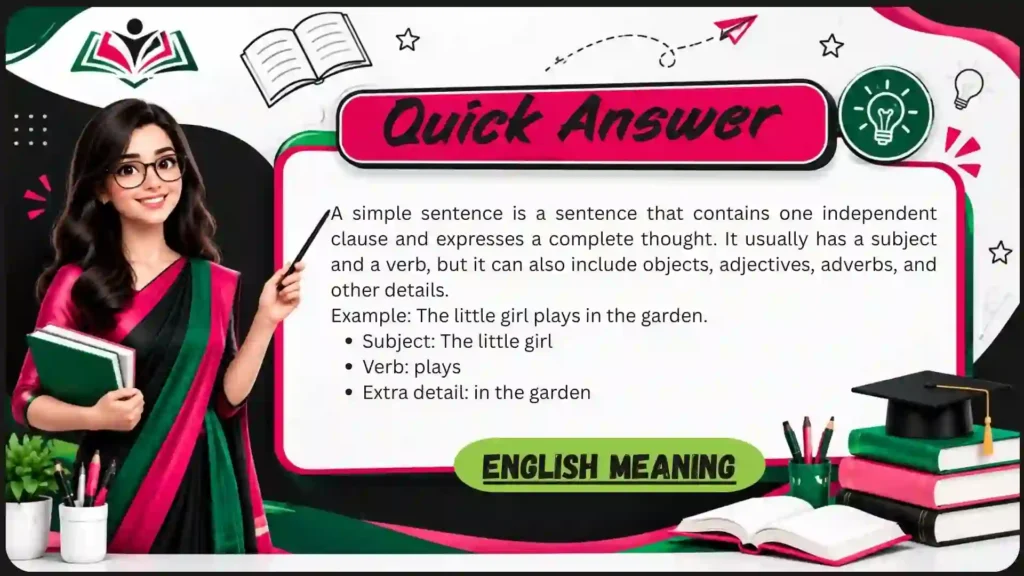
A simple sentence is a sentence that contains one independent clause and expresses a complete thought. It usually has a subject and a verb, but it can also include objects, adjectives, adverbs, and other details.
Example: The little girl plays in the garden.
- Subject: The little girl
- Verb: plays
- Extra detail: in the garden
Even though this sentence has several words, it remains a simple sentence because it contains only one independent clause.
TL;DR: Simple Sentences
- 📘 A simple sentence contains one independent clause.
- ✅ It expresses a complete thought.
- ✍️ It usually includes a subject and a verb.
- 📚 It can contain objects, adjectives, adverbs, and prepositional phrases.
- 🔤 It can have a compound subject or a compound predicate.
- 💡 A simple sentence can be short or long.
- 📝 It differs from compound and complex sentences because of its clause structure.
You Might Also Like That: RSVP Meaning
What Is a Simple Sentence?
A simple sentence is a group of words that expresses a complete thought through one independent clause. An independent clause can stand alone as a complete sentence. For example, “Birds fly” is a simple sentence because it has a subject, a verb, and a complete meaning.
Simple sentences help writers share information clearly. You can use them in everyday conversations, schoolwork, stories, and professional writing. They can describe an action, share a fact, ask a question, or give a command. The main rule is simple: the sentence must contain only one independent clause.
Simple Sentence Definition and Meaning
The simple sentence definition focuses on the number of independent clauses rather than the number of words. A simple sentence has one independent clause and does not contain a dependent clause.
For example, “My brother reads books every night” is a simple sentence. The subject is “my brother,” and the verb is “reads.” The remaining words add useful information without creating another clause. Remember that the word simple describes the grammatical structure, not the length or difficulty of the sentence.
What Are the Parts of a Simple Sentence?
A simple sentence usually contains a subject and a predicate. The subject tells us who or what the sentence discusses, while the predicate tells us something about that subject. The verb shows an action or state.
| Sentence part | Example | Purpose |
| Subject | The cat | Tells who or what |
| Verb | sleeps | Shows an action or state |
| Object | the ball | Receives the action |
| Modifier | small | Adds detail |
For example, “The small cat chased the ball” contains a subject, a verb, an object, and a describing word. Together, these parts form one complete independent clause.
Simple Sentence Structure and Rules
Simple sentence structure depends on how the subject, verb, and other sentence parts work together. A common pattern is subject + verb, as in “Children laugh.” Another pattern is subject + verb + object, as in “Sarah kicked the ball.”
Follow these basic rules when writing a simple sentence:
- Start with a clear subject or an understood subject in a command.
- Use a suitable verb.
- Express a complete thought.
- Check subject–verb agreement.
- Use correct punctuation.
A simple sentence can also include adjectives, adverbs, and prepositional phrases without becoming a different sentence type.
Simple Sentence Examples
The following simple sentence examples show how writers can express different ideas using one independent clause. Some sentences contain only a few words, while others include extra details.
| Example | Subject | Verb |
| Dogs bark. | Dogs | bark |
| Emma sings beautifully. | Emma | sings |
| The baby is sleeping. | The baby | is sleeping |
| My father drives a car. | My father | drives |
| The children play outside. | The children | play |
| Our teacher explained the lesson. | Our teacher | explained |
| The bright stars shine at night. | The bright stars | shine |
| We walked through the park. | We | walked |
Each example expresses a complete thought through one independent clause. The extra details make the sentences more informative without changing their basic structure.
Types of Simple Sentence Structures
Simple sentences can follow different patterns. Some have one subject and one verb, while others contain more than one subject or verb. These changes do not automatically create a compound sentence.
1. Simple Subject and Simple Predicate
Example: “The baby cries.”
The subject is “the baby,” and the predicate is “cries.” This basic pattern makes the sentence easy to understand.
2. Compound Subject
Example: “Tom and Jack play football.”
The sentence has two subjects, Tom and Jack, but only one independent clause.
3. Compound Predicate
Example: “Mia sings and dances.”
The sentence has one subject and two actions. It remains simple because the verbs share the same subject within one independent clause.
Can a Simple Sentence Be Long?
Yes! A simple sentence can be long because it may contain extra details, such as adjectives, adverbs, objects, and prepositional phrases. Sentence length does not decide its grammatical type.
Compare these examples:
- Short: The dog runs.
- Long: The friendly brown dog runs quickly through the large park every morning.
Both sentences contain one independent clause. The longer sentence simply gives the reader more information. To identify a simple sentence, focus on its clauses rather than counting its words.
Simple vs Compound vs Complex Sentences
English grammar has four main sentence structures. The key difference is the number and type of clauses each sentence contains.
| Sentence type | Clause structure | Example |
| Simple | One independent clause | The sun shines. |
| Compound | Two or more independent clauses | The sun shines, and the birds sing. |
| Complex | One independent clause and at least one dependent clause | We stayed inside because it rained. |
| Compound-complex | At least two independent clauses and one dependent clause | We stayed inside because it rained, and we watched a movie. |
A simple sentence vs compound sentence comparison shows that a compound sentence joins independent clauses. A complex sentence includes a dependent clause, while a compound-complex sentence combines both structures.
Common Simple Sentence Mistakes
Writers sometimes confuse sentence length, verbs, and clauses when learning sentence structure. Understanding these differences can help you write more accurate sentences.
Avoid these common mistakes:
- ❌ Confusing a fragment with a sentence: “Because I was tired” does not express a complete thought by itself.
- ❌ Assuming every long sentence is complex: A long sentence can still have one independent clause.
- ❌ Counting verbs instead of clauses: “Jack runs and jumps” remains a simple sentence.
- ❌ Ignoring subject–verb agreement: Write “She walks,” not “She walk.”
Always check whether your sentence expresses a complete thought through one independent clause.
Frequently Asked Questions
1. What is a simple sentence in English grammar?
A simple sentence contains one independent clause and expresses a complete thought. For example, “The children laughed” is a simple sentence.
2. What are five examples of simple sentences?
Here are five examples:
- The sun rises.
- Birds build nests.
- My mother cooks dinner.
- The baby smiles happily.
- We visited the museum.
3. How many clauses does a simple sentence contain?
A simple sentence contains one independent clause. It does not contain a dependent clause.
4. Can a simple sentence have two subjects?
Yes. A sentence such as “Ali and Sara study together” has a compound subject but only one independent clause.
5. Can a simple sentence have two verbs?
Yes. In “The boy runs and jumps,” the subject performs two actions within one independent clause.
6. What is the difference between a simple and compound sentence?
A simple sentence has one independent clause. A compound sentence has at least two independent clauses joined by a suitable conjunction or punctuation.
7. Can a simple sentence be long?
Yes. A simple sentence can contain many descriptive words and phrases while keeping one independent clause.
Final Thoughts
Understanding a simple sentence is an important step toward better English grammar and writing. The main rule is easy to remember: a simple sentence contains one independent clause and expresses a complete thought. It can include subjects, verbs, objects, and extra details without becoming a compound or complex sentence.
Practice identifying the subject and verb in different simple sentence examples. Once you understand the basic structure, you can write clearer sentences, avoid common grammar mistakes, and recognize the differences between the four main sentence structures. Keep practicing, and your writing will become more confident and natural.