

Have you ever wondered whether to write advice or advise in a sentence? These two words look almost identical and sound very similar, so many people confuse them when writing emails, completing school assignments, or having everyday conversations. However, the difference between advice vs advise is simple once you understand how each word works. Advice is a noun that means guidance or a suggestion, while advise is a verb that means to recommend something or guide someone toward a decision.
Understanding the difference between advice and advise can help you improve your grammar and communicate more clearly. For example, you can give someone helpful advice, but you advise them to take a particular action. In this guide, you will learn the meaning of both words, their pronunciation, and how to use them correctly in sentences. You will also discover common mistakes, practical examples, and easy tips to remember which word fits your sentence.
Quick Answer: What Is the Difference Between Advice and Advise?
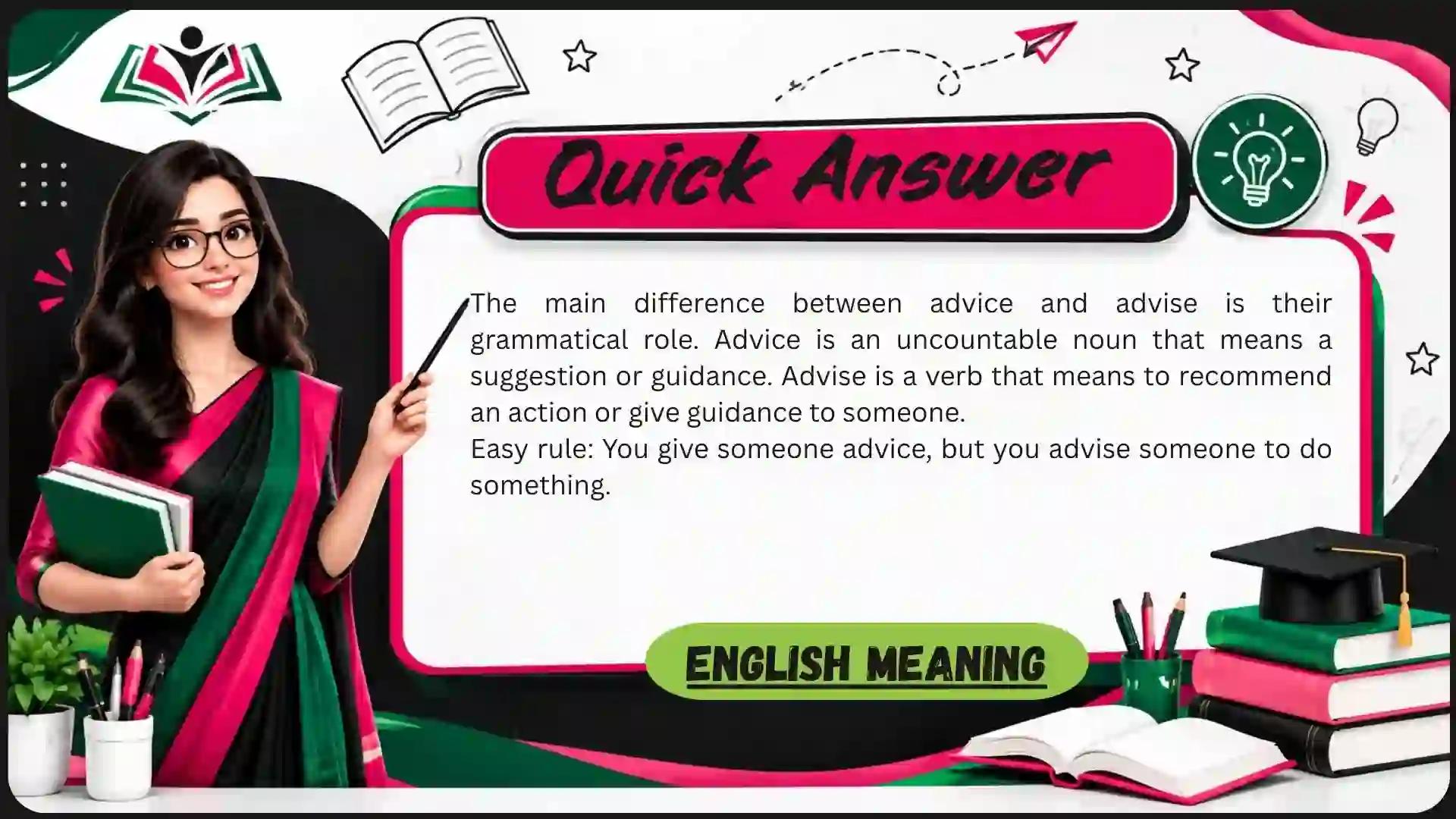
The main difference between advice and advise is their grammatical role. Advice is an uncountable noun that means a suggestion or guidance. Advise is a verb that means to recommend an action or give guidance to someone.
| Word | Part of speech | Meaning | Example |
| Advice | Noun | Guidance or a suggestion | My teacher gave me good advice. |
| Advise | Verb | To recommend or guide | My teacher advised me to practice. |
Easy rule: You give someone advice, but you advise someone to do something.
TL;DR: Advice vs Advise
- 📘 Advice is a noun that means guidance or a suggestion.
- ✍️ Advise is a verb that means to recommend or guide someone.
- 🔊 Advice ends with an /s/ sound, while advise ends with a /z/ sound.
- ✅ Say “Please advise,” not “Please advice.”
- 💡 Say “a piece of advice,” not “an advice.”
- 🎯 Remember: You give advice, but you advise someone.
You Might Also Like That: WYA Meaning
What Does Advice Mean?
Advice means guidance, an opinion, or a suggestion that helps someone decide what to do. People often ask for advice when they face a problem or need help making a choice. For example, a student may ask a teacher for advice about an exam, or a friend may offer advice about a difficult situation.
Advice is an uncountable noun, so you should not usually use a or an directly before it. You can say “some advice,” “helpful advice,” or “a piece of advice.” These expressions are correct in everyday English.
Examples of Advice in a Sentence
- My mother gave me useful advice about saving money.
- I need some advice about my English homework.
- She offered me a piece of advice before the interview.
- His teacher gave him good advice about studying.
Remember, advice names the guidance itself. It does not describe the action of giving that guidance.
What Does Advise Mean?
Advise is a verb that means to recommend something or tell someone what you think they should do. You can use it when offering guidance, warning someone, or suggesting a better choice. Unlike advice, advise describes an action.
You can use advise in patterns such as “advise someone,” “advise someone to do something,” and “advise against something.” For example, “I advise you to read the instructions” means that I recommend reading them. The verb also changes form depending on the sentence, such as advises, advised, and advising.
Examples of Advise in a Sentence
- I advise you to practice English every day.
- The doctor advised him to get more rest.
- My teacher advises students to read carefully.
- We are advising customers to check their details.
- Experts advise against sharing private information online.
Use advise when someone gives guidance or recommends an action.
Advice vs Advise: Key Differences at a Glance
Although advice and advise have similar spellings, they serve different purposes in a sentence. Advice names the guidance someone receives, while advise describes the act of giving that guidance. Their final sounds also differ, which can help you remember the correct spelling.
| Feature | Advice | Advise |
| Part of speech | Noun | Verb |
| Meaning | Guidance or suggestion | To recommend or guide |
| Final sound | /s/ | /z/ |
| Example | I need your advice. | I advise you to wait. |
Advice vs Advise Pronunciation
🔊 Advice and advise sound similar, but their final consonant sounds are different. In American English, advice is pronounced /ədˈvaɪs/, with an /s/ sound like the ending of ice. Advise is pronounced /ədˈvaɪz/, with a /z/ sound like the ending of eyes.
Listen carefully to the final sound when practicing these words. The spelling also gives you a useful clue: advice ends in -ce, while advise ends in -se. Remember that pronunciation helps you recognize the difference, but grammar tells you which word to choose.
How to Use Advice and Advise in Sentences
You can choose between advice and advise by checking how the word works in your sentence. If you need a noun to name guidance, use advice. If you need a verb to describe recommending an action, use advise. This simple rule works in most everyday situations.
Compare these examples:
- My father gave me helpful advice.
- My father advised me to save money.
- She asked for my advice.
- I advised her to speak politely.
Notice that advice stays the same, while advise changes to match the sentence’s tense.
Common Advice vs Advise Mistakes
Many English learners confuse these words because they look alike. However, using the wrong form can make a sentence grammatically incorrect. Review these common mistakes to improve your writing.
| Incorrect | Correct |
| Please advice me. | Please advise me. |
| Thanks for your advise. | Thanks for your advice. |
| She gave me an advice. | She gave me a piece of advice. |
| He gave me two advices. | He gave me two pieces of advice. |
| Can you advice me? | Can you advise me? |
💡 Remember: Advice is an uncountable noun, so use expressions such as some advice or a piece of advice.
Advice vs Advise in Emails and Professional Writing
Professional emails often use advise when asking someone to recommend a next step or provide information. For example, “Please advise me on the next steps” asks someone to guide you. On the other hand, advice refers to the guidance itself.
Compare these sentences:
- “Could you please advise me on how to proceed?”
- “Thank you for your helpful advice.”
- “I would appreciate your advice on this matter.”
All three examples are correct. Choose advise when describing the action and advice when referring to the suggestion or guidance.
Advice, Advise, Adviser, and Advisor: What Is the Difference?
These four words share a common idea, but each has a different role. Advice means guidance, and advise means to give guidance. An adviser or advisor is a person who offers advice, such as a school adviser or financial advisor.
| Word | Meaning | Example |
| Advice | Guidance | Her advice helped me. |
| Advise | To recommend | I advise you to prepare. |
| Adviser | A person who gives guidance | Ask your school adviser. |
| Advisor | A person who gives guidance | He spoke with a financial advisor. |
Both adviser and advisor are accepted spellings.
How to Remember the Difference Between Advice and Advise
A simple memory trick can help you choose the correct word every time. You give advice, but you advise someone. The noun advice names the guidance, while the verb advise describes the action of giving it.
Try this quick test when writing:
- Does the sentence need guidance or a suggestion? Use advice.
- Does the sentence describe recommending an action? Use advise.
For example, “My friend gave me good advice, and I advise you to listen to your friends.” Both words appear in one sentence, making the difference easier to remember.
Frequently Asked Questions
1. Is advice a noun or a verb?
Advice is a noun. It means guidance, a suggestion, or a recommendation. For example, “I need some advice about my studies.” Use advise when you want a verb.
2. Is advise a noun or a verb?
Advise is a verb. It means to recommend an action or give someone guidance. For example, “I advise you to check your work before submitting it.”
3. Is it “please advise” or “please advice”?
The correct phrase is “Please advise.” Here, advise is a verb asking someone to provide guidance or a recommendation. You can also write, “Please give me some advice.”
4. Can advice be plural?
No, advice is generally uncountable in standard English. Instead of saying “three advices,” say “three pieces of advice.” You can also say “some advice” when you do not need to count individual suggestions.
5. Can you say “an advice”?
No. In standard English, advice does not take a or an directly. Say “some advice,” “helpful advice,” or “a piece of advice.”
6. What is the difference between advice and advise in American English?
The grammatical difference is the same in American English: advice is a noun, and advise is a verb. Both words follow the same basic usage rules in everyday American writing.
Advice vs Advise Practice Quiz
Test your understanding by choosing the correct word in each sentence.
- My teacher gave me useful (advice / advise).
- I (advice / advise) you to read the question carefully.
- Please (advice / advise) us about the next step.
- She thanked him for his helpful (advice / advise).
- The doctor (advice / advised) me to rest.
Answers: 1. advice, 2. advise, 3. advise, 4. advice, 5. advised.
Remember, advice is the noun, while advise and its forms are verbs. Practicing with complete sentences will help you use both words naturally.
Final Thoughts
Understanding advice vs advise becomes easy when you remember one basic rule: advice is a noun, and advise is a verb. You give someone advice, but you advise them to take action. Also, remember that advice is uncountable, so expressions such as “a piece of advice” are correct.
Whether you are writing an email, completing an assignment, or improving your everyday English, choosing the right word will make your sentences clearer. Keep practicing with examples, and soon you will know when to use each word without hesitation.