
Then vs than can be confusing because these two words look and sound very similar, but they serve different purposes in English. Than usually appears when you make a comparison, such as “My car is faster than yours.” Then usually refers to time, order, sequence, or a result, as in “We finished dinner, then watched a movie.” Understanding the difference between then and than can help you avoid common grammar mistakes in school, work, emails, and everyday writing.
If you often wonder than or then, you are not alone. This guide explains when to use then or than, shows then vs than examples, and covers common phrases such as better than, more than, rather than, and other than. You’ll also learn a simple way to remember then and than and choose the right word with confidence.
Then vs Than: Quick Answer
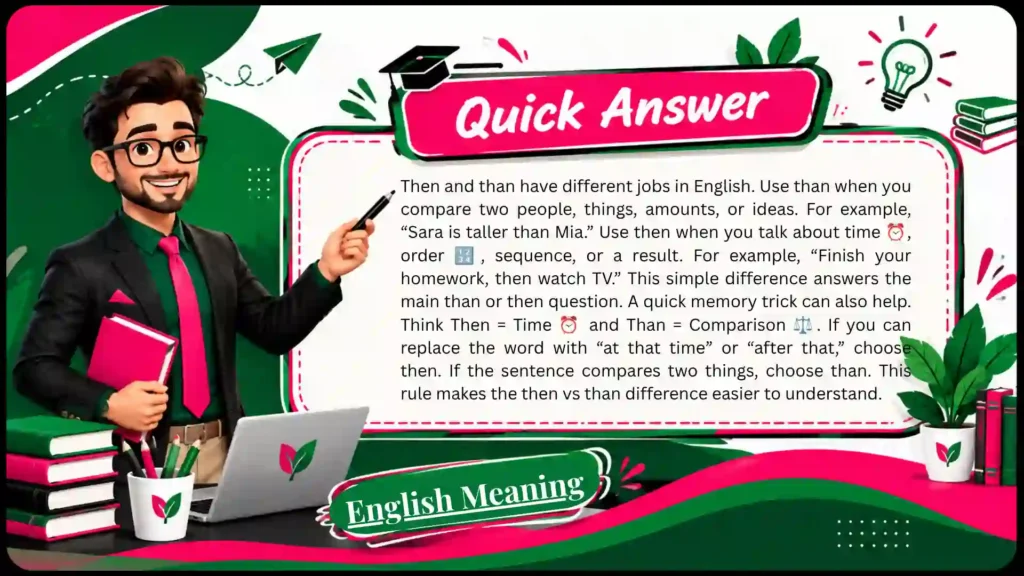
Then and than have different jobs in English. Use than when you compare two people, things, amounts, or ideas. For example, “Sara is taller than Mia.” Use then when you talk about time ⏰, order 🔢, sequence, or a result. For example, “Finish your homework, then watch TV.” This simple difference answers the main than or then question.
A quick memory trick can also help. Think Then = Time ⏰ and Than = Comparison ⚖️. If you can replace the word with “at that time” or “after that,” choose then. If the sentence compares two things, choose than. This rule makes the then vs than difference easier to understand.
You Might Also Like That: YOLO Meaning
Then vs Than Difference at a Glance
The easiest way to understand the difference between then and than is to look at their main jobs. Then usually connects an action to time or order, while than connects two things in a comparison. Although both words often sound similar, you cannot normally use them interchangeably. Knowing their purpose helps you choose the correct word when writing a sentence.
| Word | Main Use | Easy Meaning | Example |
| Then ⏰ | Time | At that time | I lived there then. |
| Then 🔢 | Sequence | After that | Eat first, then leave. |
| Then ➡️ | Result | In that case | If you agree, then we can go. |
| Than ⚖️ | Comparison | In comparison with | Ali is taller than me. |
| Than 📊 | Amount | Compared with | I need more than five minutes. |
When to Use “Then”
Use then when you want to talk about time, order, sequence, or a result. It can describe something that happened at a particular time, something that happens next, or what follows from a condition. For example, “I was younger then” refers to a past time, while “We ate dinner and then left” shows sequence. You can also use then in expressions such as back then, since then, and now and then.
Then for Time
Use then to refer to a particular time. For example, “I lived in New York then” means “I lived there at that time.” You can also use it in phrases such as back then, until then, and since then. These expressions connect an action or situation to a specific point or period. 🕐 When you see a sentence that clearly talks about when something happened, then often fits naturally.
Then for Sequence or Order
Use then when one action happens after another. It often means next or after that. For example, “First, wash the vegetables, then cut them.” You can also say, “She finished her work and then went home.” 🔢 This use makes then common in instructions, stories, and everyday conversations. When you can replace the word with “after that” or “next,” you probably need then.
Then for Consequence
Use then to show a result or consequence, especially after a condition. For example, “If you finish your work, then you can leave.” Here, then means something close to “in that case.” You will often see this structure in if-then statements and everyday speech. ➡️ The first part gives a condition, and the second part gives the result. This use differs clearly from than, which normally introduces a comparison.
Then as a Part of Speech
In most everyday sentences, then works as an adverb. It can describe when something happened, what happens next, or what follows from a condition. In some contexts, then can also act as an adjective or noun, such as “the then president” or “until then.” You do not need to memorize every grammatical label. Focus on its main meanings: time ⏰, sequence 🔢, and consequence ➡️.
When to Use “Than”
Use than when you make a comparison ⚖️. It connects one person, thing, amount, or idea with another. Common examples include taller than, faster than, better than, more than, and less than. For example, “This book is more interesting than that one.” Whenever the sentence asks you to compare two things, than usually provides the correct connection.
Than for Comparisons
Use than when you compare two things or people. For example, “My new phone is faster than my old phone.” You can also compare qualities, amounts, or actions: “She works harder than I do.” 📊 Words such as better, faster, taller, older, more, and less often appear before than. The key idea remains simple: if the sentence shows a comparison, choose than, not then.
Than After Comparative Words
You will often see than after comparative words and phrases. Common examples include more than, less than, better than, worse than, rather than, and other than. For example, “I would rather walk than wait.” You can also say, “She has more experience than I do.” ⭐ Learning these common combinations makes than vs then easier because you begin to recognize familiar patterns instead of guessing which word looks right.
Than as a Conjunction or Preposition
Than can work as a conjunction or preposition depending on how a sentence uses it. You do not need advanced grammar terms to use it correctly. The most important point is that than introduces a comparison. For example, “He runs faster than me” compares two people. You can also see than in phrases such as “more than enough” and “other than English.” Focus first on the comparison rather than the grammar label.
Then vs Than Examples
Examples make the then and than difference much easier to see. Look at what the sentence actually means before choosing the word. If the sentence talks about time, order, or a result, use then. If it compares two things, use than. These examples also show why spelling alone cannot help you decide. Both words are correct English words, but each one has a different job.
| Use | Correct Word | Example |
| Time ⏰ | Then | I lived there then. |
| Sequence 🔢 | Then | Finish this, then call me. |
| Result ➡️ | Then | If you’re ready, then let’s go. |
| Comparison ⚖️ | Than | She is taller than me. |
| Amount 📊 | Than | I need more than five minutes. |
| Preference | Than | I would rather stay than leave. |
Common Then vs Than Mistakes
Many writers confuse then and than because the words look and sound alike. A spell-checker may not catch the problem because both words are spelled correctly. The mistake comes from using the wrong word for the meaning. One useful way to avoid these errors is to check whether the sentence shows time or comparison before you make your final choice.
Common mistakes include:
- ❌ better then → ✅ better than
- ❌ more then → ✅ more than
- ❌ rather then → ✅ rather than
- ❌ other then → ✅ other than
- ❌ no later then → ✅ no later than
- ❌ longer then → ✅ longer than
- ❌ earlier then → ✅ earlier than
Better Than or Better Then?
Better than is correct when you compare two things. For example, “This phone is better than my old one.” Here, than introduces the comparison. However, better then can appear in a sentence when then refers to a particular time. For example, “I felt better then than I do now.” In this sentence, the first then means “at that time,” while than introduces the comparison. 📌 Always check the meaning instead of relying only on the word before it.
More Than or More Then?
Use more than when you compare an amount, number, or degree. For example, “She has more than ten books.” Here, than connects the larger amount to the comparison. More then can sometimes be correct when then refers to a time, such as “I earned more then than I do now.” ⏰ The first phrase refers to a past time, while the second uses than for comparison. This small difference can prevent a common grammar mistake.
Other Than or Other Then?
The standard expression is other than, not other then, when you mean except for or besides. For example, “Everyone came other than James.” You can also say, “I have no choice other than to wait.” ⭐ In these expressions, than does not describe time. It connects the phrase to an exception or alternative. Remember other than as a fixed and common expression. If you mean “except” or “besides,” choose than.
Rather Than or Rather Then?
Use rather than when you mean instead of or when you express a preference. For example, “I would rather walk than drive.” You can also say, “She chose tea rather than coffee.” ☕ The phrase rather than commonly introduces the option someone prefers or chooses. Rather then does not work in this expression because the sentence does not describe time. When you mean instead of, remember the standard phrase rather than.
Than I or Than Me?
Both than I and than me appear in English, but they can serve different grammatical structures. In formal writing, you may see “She is taller than I am.” In everyday speech, many people say, “She is taller than me.” The complete form than I am makes the comparison clear because it includes the verb. ✍️ When writing formally, use a complete comparison when possible. In casual conversation, than me remains common and natural.
How to Remember Then vs Than
A simple memory trick can make then vs than much easier. Think of Then = Time ⏰ and Than = Comparison ⚖️. If you can replace the word with “at that time” or “after that,” choose then. If you are comparing two things, choose than. For example, “We ate, then left” means “We ate, after that left.” “She is taller than me” clearly compares two people.
A Simple Test for Choosing Then or Than
When you are unsure about than or then, stop and ask what the sentence means. First, check whether you are talking about time or order. If yes, choose then. Next, check whether you are showing a comparison. If yes, choose than. You can also use a replacement test: then → at that time/after that and than → in comparison with. 🧠 This quick method can help you choose the right word without memorizing complicated grammar rules.
Ask “Is This About Time or Order?”
If the sentence describes when something happened or shows what happens next, use then. For example, “We finished dinner and then watched a movie.” You can replace then with “after that,” and the meaning stays clear. 🔢 This test also works for instructions: “First open the file, then check the information.” When the sentence follows a timeline or sequence, then usually fits.
Ask “Am I Comparing Something?”
If the sentence compares two people, things, amounts, or ideas, use than. For example, “My sister is younger than me.” You can think of than as connecting the two sides of a comparison. ⚖️ Words such as better, faster, taller, more, less, older, and stronger often signal this type of sentence. When you see a clear comparison, choose than rather than then.
Try the Replacement Test
The replacement test gives you another quick way to decide. Try replacing the word with “at that time” or “after that.” If the sentence still makes sense, use then. If the sentence needs a comparison, try “in comparison with.” For example, “He is older than me” clearly compares two people. 🧠 With practice, this test becomes almost automatic and helps you avoid common then vs than errors.
Then vs Than in Everyday Writing
You can find then and than in many types of everyday writing. You might use then in a text message such as, “Call me then,” or in instructions such as, “Read this, then reply.” You might use than in an email such as, “The new plan is better than the old one.” 💬 The rule stays the same whether you write a text, school assignment, email, social media post, or professional message.
Then vs Than FAQs
What is the difference between then and than?
Then usually relates to time, order, sequence, or consequence, while than usually introduces a comparison. For example, “Finish your work, then rest” shows sequence. “This book is better than that one” shows comparison. ⭐ Remembering this basic difference can help you answer most then vs than questions correctly.
When should I use then or than?
Use then when you mean at that time, after that, next, or in that case. Use than when you compare two things or ideas. For example, “We ate, then left” uses then for sequence. “She is taller than me” uses than for comparison. 🧠 Ask yourself whether the sentence focuses on time or comparison.
Is it better than or better then?
Use better than when you compare two things. For example, “This option is better than the other one.” You can use better then only when then refers to a particular time, as in “I was better then than I am now.” In the second sentence, then means “at that time,” while than still introduces the comparison.
Is it more than or more then?
Use more than when you compare an amount or degree, such as “I need more than five minutes.” More then can appear when then refers to a specific time, such as “I had more then than I have now.” 📊 Check whether then means “at that time.” If it does, the spelling can be then; otherwise, comparison normally requires than.
Is it rather than or rather then?
The standard expression is rather than when you mean instead of or express a preference. For example, “I would rather read than watch TV.” 📚 Rather then does not work when you mean “instead of.” Remember the phrase rather than as a common combination, and use it whenever the sentence compares or chooses between alternatives.
Is it other than or other then?
Use other than when you mean except for or besides. For example, “No one other than Maria knew the answer.” Other then does not normally work with this meaning. ⭐ A simple way to remember it is to treat other than as a common fixed phrase. If the sentence means “except” or “besides,” choose than.
How can I remember then vs than?
Use the simple rule Then = Time ⏰ and Than = Comparison ⚖️. If the sentence tells you when something happened, what happened next, or what happens as a result, choose then. If the sentence compares two things, choose than. You can also use the replacement test: then → after that, than → in comparison with.
Is “than I” or “than me” correct?
Both forms can appear in English, depending on the sentence and style. “She is taller than I am” uses a complete comparison and works well in formal writing. “She is taller than me” is also common in everyday English. ✍️ When you want maximum clarity, use the complete form than I am when the grammar calls for it.
Can then and than ever be interchangeable?
No, then and than normally have different meanings and functions. Then focuses on time, sequence, order, or consequence, while than focuses on comparison. However, a sentence can contain both words, such as “I was happier then than I am now.” Here, then refers to a past time, while than introduces the comparison.
How do I know which word to use in a sentence?
Look at the meaning first. If you describe time, order, or a result, choose then. If you compare people, things, amounts, or ideas, choose than. 🔍 You can also use the replacement test: try “at that time/after that” for then or “in comparison with” for than. This simple process works for most everyday sentences.
Final Thoughts
Understanding then vs than becomes much easier when you focus on meaning instead of spelling. Remember the basic rule: then = time, order, sequence, or consequence ⏰, while than = comparison ⚖️. Use then in sentences such as “We finished dinner, then left,” and use than in sentences such as “This car is faster than mine.” If you still feel unsure, use the replacement test. Ask whether you mean “after that” or “in comparison with.” With regular practice, you can use then and than correctly in everyday writing.