
Many writers use “revising,” “editing,” and “proofreading” as if they mean the same thing. They don’t. Each term describes a different stage of improving a piece of writing, and each one focuses on a different level of the text.
Revising vs editing vs proofreading comes down to scope: revising reworks your ideas and structure, editing sharpens your sentences and word choice, and proofreading catches the small surface errors that remain once the writing is otherwise finished. Doing them in that order — big picture first, small details last — saves time, because there’s no point polishing a sentence you might delete during revision.
Understanding where one stage ends and the next begins helps you know what to look for at each pass, instead of trying to fix everything at once.
Quick Answer
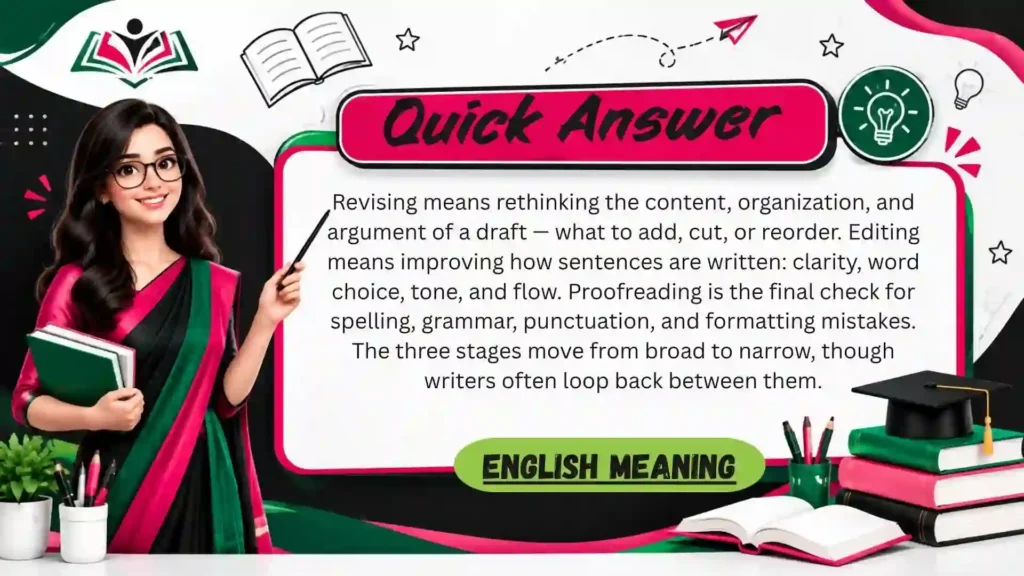
Revising means rethinking the content, organization, and argument of a draft — what to add, cut, or reorder. Editing means improving how sentences are written: clarity, word choice, tone, and flow. Proofreading is the final check for spelling, grammar, punctuation, and formatting mistakes. The three stages move from broad to narrow, though writers often loop back between them.
TL;DR
- Revising changes ideas, structure, and content — the “big picture.”
- Editing improves sentence-level clarity, word choice, and flow.
- Proofreading catches spelling, grammar, punctuation, and formatting slips.
- Do them in that order: revise, then edit, then proofread.
- A person can do all three, but professional editing and proofreading are distinct paid services with different scopes.
You Might Also Like That: Pronoun Cases Explained
At a Glance: The Three Stages
| Stage | What It Changes | Typical Timing |
| Revising | Ideas, structure, argument, content | Early, after the first full draft |
| Editing | Sentences, word choice, tone, flow | Middle, once content is stable |
| Proofreading | Spelling, grammar, punctuation, formatting | Last, right before publishing or submitting |
What Revising Actually Means
Revising is the stage where you step back from your draft and ask whether it does what it’s supposed to do. This is developmental work, not line-by-line polishing.
When you revise, you might:
- Reorder paragraphs or sections so ideas build logically
- Cut material that doesn’t support your main point
- Add missing information, evidence, or context
- Rewrite a weak introduction or conclusion
- Rethink your argument if it isn’t convincing
Example: A student’s essay has a strong final paragraph making the real argument. Revising means moving that argument to the introduction and restructuring the body paragraphs around it — not fixing commas.
Revising often happens more than once. A writer might revise for organization, set the draft aside, then revise again for content gaps after getting feedback.
What Editing Actually Means
Editing narrows the focus to how the writing is expressed, once you’re satisfied with what it says. Editing improves sentences without changing the underlying ideas.
You Might Also Like That: What Does WYF Mean
Editing tasks include:
- Rewriting awkward or wordy sentences
- Replacing vague words with precise ones
- Fixing sentence structure and variety
- Smoothing transitions between sentences and paragraphs
- Adjusting tone so it fits the audience (formal for a report, conversational for a blog)
Example: “The reason why the meeting was postponed was because of the fact that the venue was unavailable” edits down to “The meeting was postponed because the venue was unavailable.” The idea hasn’t changed — the sentence just says it more clearly.
Some professional editors work at different depths. Developmental editing overlaps with revising and looks at structure and content. Copyediting works at the sentence level, closer to what most people mean by “editing.” Line editing sits between the two, focusing on style and flow paragraph by paragraph.
What Proofreading Actually Means
Proofreading is the last, narrowest pass. By this point, the content and sentences are set. Proofreading exists to catch what’s left: typos, misused words, and formatting inconsistencies that would otherwise embarrass a finished piece.
Proofreading covers:
- Spelling errors and typos
- Grammar mistakes (subject-verb agreement, verb tense, pronoun agreement)
- Punctuation errors (misplaced commas, missing apostrophes)
- Formatting consistency (heading styles, spacing, capitalization)
- Commonly confused words (their/there/they’re, affect/effect)
Example: A finished report is proofread and a reviewer catches “the companies policy” (missing apostrophe), a doubled word (“the the”), and an inconsistent heading style. Nothing about the argument or wording changes — only the surface-level accuracy.
Proofreading is not the time to rewrite a paragraph. If a sentence is confusing enough to need rewriting, that’s a sign editing wasn’t finished.
You Might Also Like That: IYKYK Meaning
Why the Order Matters
Working from big to small saves effort. If you proofread a paragraph for commas and then cut that paragraph during revision, the proofreading time was wasted.
A practical sequence looks like this:
- Finish a complete first draft.
- Revise for structure, content, and argument.
- Edit for sentence clarity, word choice, and tone.
- Proofread as the final pass before sharing or submitting.
Writers rarely move through these steps in a straight line. It’s normal to revise a section, edit it, notice a structural problem, and go back to revising. The order is a general direction, not a rigid checklist — but proofreading should always come last, right before the writing goes out.
Common Signs You’re in the Wrong Stage
- If you’re still asking “does this paragraph belong here?” — you’re revising, not editing.
- If you’re rewriting a sentence for the third time to sound more natural — that’s editing, not proofreading.
- If you’re fixing a missing apostrophe — that’s proofreading, and it should wait until content and wording are settled.
Mixing these up is the main reason self-editing feels inefficient. Fixing commas in a paragraph you later delete, or restructuring an essay the night before it’s due, both come from skipping the right stage at the right time.
Revising vs. Editing: The Core Difference
The clearest way to separate revising from editing is to ask what would change. Revising changes what the writing says or how it’s organized. Editing changes how it’s said, sentence by sentence, without altering the underlying content.
A useful test: if removing or rewriting something would change the reader’s understanding of the argument, that’s revision. If it only changes the wording, that’s editing.
Editing vs. Proofreading: The Core Difference
Editing and proofreading both work at the sentence level, which is why they’re the two most often confused. The difference is depth. Editing asks whether a sentence is clear, well-built, and appropriately toned — it can involve rewriting. Proofreading asks only whether the sentence, as written, is free of mechanical errors. Proofreading doesn’t rewrite; it corrects.
You Might Also Like That: Then vs Than
Who Does Each Stage
In publishing and academic writing, these stages are sometimes split among different people:
- A developmental editor works with revising — content, structure, and argument.
- A copyeditor works with editing — sentence clarity, consistency, and style.
- A proofreader works with proofreading — final surface errors before publication.
For everyday writing — emails, essays, blog posts — one person usually does all three, ideally as separate passes rather than one blended read-through.
Tools Can Help, But Don’t Replace Judgment
Grammar and style checkers are useful for proofreading and some editing tasks, such as catching typos or flagging wordy sentences. They’re far less reliable for revising, since they can’t judge whether your argument makes sense or your evidence is sufficient. Treat automated suggestions as a second opinion, not a final verdict, especially for word choice and tone.
Frequently Asked Questions
Is proofreading part of editing?
Not exactly. Proofreading is often described as the final step within the broader editing process, but it’s narrower than editing. Editing can involve rewriting sentences; proofreading only corrects errors in the sentences as they stand.
Can I skip revising and go straight to editing?
You can, but you risk polishing sentences or paragraphs that later need to be cut or restructured. Even a quick revision pass — checking that the piece makes sense and covers what it should — saves editing time later.
How many times should I revise a draft?
There’s no fixed number. Revise until the structure and content hold up on their own, then move to editing. Some drafts need one revision pass; others, especially longer or more complex ones, need several.
Should I proofread my own writing, or ask someone else?
Both work, but a second reader often catches more, since it’s easy to read past your own mistakes because you know what you meant to write. Reading your draft aloud or waiting a day before proofreading it yourself can help close that gap.
Does proofreading include checking facts?
No. Proofreading checks spelling, grammar, punctuation, and formatting — not accuracy. Fact-checking is usually treated as a separate task, often done during revising or editing when content is still being verified.
What’s the difference between a line edit and a copyedit?
A line edit focuses on style, flow, and voice at the sentence and paragraph level. A copyedit focuses more narrowly on grammar, consistency, and correctness. In practice, many editors blend the two.
Test Your Understanding
1. A writer reorganizes the sections of a report so the conclusion comes before the background information. This is an example of: A. Proofreading B. Editing C. Revising D. Formatting
2. Which stage would catch a missing apostrophe in “the teachers lounge”? A. Revising B. Editing C. Proofreading D. Drafting
You Might Also Like That: Effect vs Affect
3. Rewriting “Due to the fact that it was raining, we left” as “Because it was raining, we left” is an example of: A. Revising B. Editing C. Proofreading D. Outlining
4. What is the recommended general order for these three stages? A. Proofread, edit, revise B. Edit, proofread, revise C. Revise, edit, proofread D. Proofread, revise, edit
5. A developmental editor primarily works on which stage? A. Proofreading B. Revising C. Formatting D. Publishing
Answer Key
- C — Reorganizing sections changes the structure of the piece, which is a revising task.
- C — A missing apostrophe is a mechanical error, which proofreading is designed to catch.
- B — The idea stays the same; only the sentence’s wording and clarity improve, which is editing.
- C — The general sequence moves from big-picture changes to fine details: revise, edit, proofread.
- B — Developmental editing overlaps with revising, focusing on structure and content rather than sentence-level correctness.
Conclusion
Revising, editing, and proofreading each solve a different problem: revising fixes what the writing says, editing fixes how it says it, and proofreading fixes what’s left on the surface. Treating them as separate passes, done in that order, makes each one faster and more effective than trying to fix everything in a single read-through.