
A conjunction 🔗 is a word that connects words, phrases, or clauses in a sentence. It helps your ideas flow naturally instead of making every thought sound separate. Common examples include and, but, or, because, although, and if.
In this guide, you will learn the conjunction definition, its meaning, the main types of conjunctions, and how to use them correctly. We will also cover conjunction examples, punctuation rules, common mistakes, and useful tips for writing clearer sentences.
Quick Answer
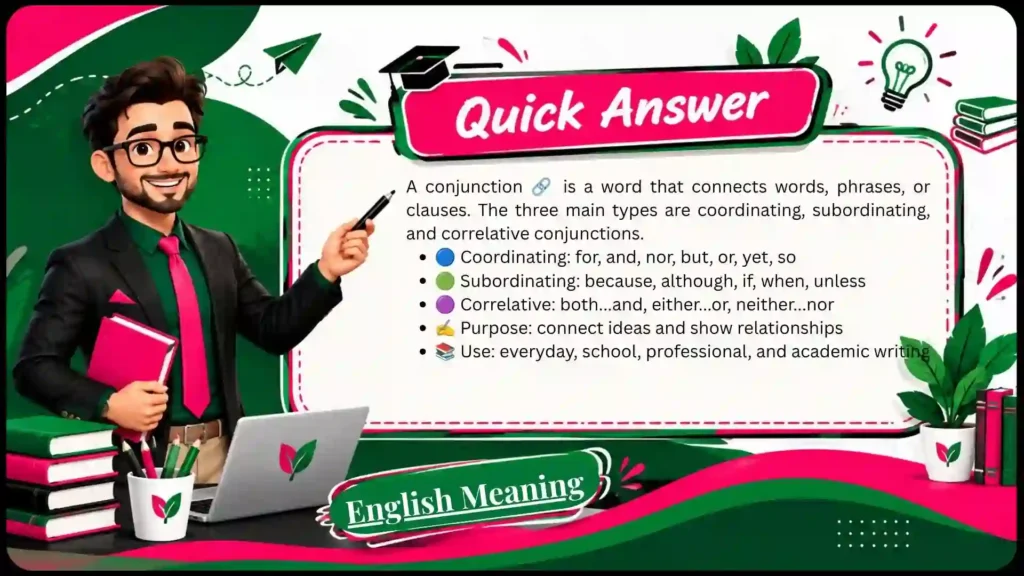
A conjunction 🔗 is a word that connects words, phrases, or clauses. The three main types are coordinating, subordinating, and correlative conjunctions.
- 🔵 Coordinating: for, and, nor, but, or, yet, so
- 🟢 Subordinating: because, although, if, when, unless
- 🟣 Correlative: both…and, either…or, neither…nor
- ✍️ Purpose: connect ideas and show relationships
- 📚 Use: everyday, school, professional, and academic writing
Learning these types, examples, and punctuation rules will help you use conjunctions correctly.
TL;DR
- 🔗 Conjunction = connects words, phrases, or clauses
- 📚 3 main types = coordinating, subordinating, and correlative
- ⭐ FANBOYS = for, and, nor, but, or, yet, so
- 🎯 Subordinating conjunctions show reason, time, condition, or contrast
- 🤝 Correlative conjunctions work in pairs like both…and
- ✏️ Correct punctuation helps prevent grammar mistakes
- ⚠️ Avoid comma splices, run-on sentences, and poor parallel structure
- 💡 Bottom line: Use the right conjunction to make your sentences clear, smooth, and connected.
You Might Also Like That: Revising vs. Editing vs. Proofreading
What Is a Conjunction?
A conjunction ✨ is a part of speech that joins different parts of a sentence. It can connect words, such as “tea and coffee,” or join larger parts, such as “I stayed home because it rained.” In both cases, the conjunction creates a clear connection between ideas.
The simple conjunction meaning is a connecting word. Conjunctions can show different relationships, including addition, contrast, choice, reason, time, and condition. Once you understand these relationships, it becomes much easier to choose the right conjunction for your sentence.
Conjunction Examples
Here are some simple examples:
- 🍎 I bought apples and oranges.
- ☕ I wanted tea, but I ordered coffee.
- 🏠 I stayed home because it rained.
- 🎯 You can stay or come with us.
These examples show how conjunctions make sentences smoother and easier to understand.
Is Conjunction a Noun?
Yes, conjunction is a noun 📚 when you use it to name this grammatical category. For example, in the sentence “And is a conjunction,” the word conjunction names the type of word that and represents. This explains searches such as conjunction noun and is conjunction a noun.
However, the individual words that act as conjunctions can belong to different grammatical categories in other situations. Words such as and, but, because, and although perform the job of connecting ideas when they work as conjunctions.
Simple Example
“And” is a conjunction.
Here, conjunction works as a noun because it names a grammatical term.
You Might Also Like That: TS Meaning in Text
What Are the Types of Conjunctions?
English grammar has three main types of conjunctions: coordinating, subordinating, and correlative conjunctions. Each type connects ideas in a different way. Learning these three groups gives you a strong base for understanding conjunctions in English grammar.
- 🔵 Coordinating conjunctions connect equal elements.
- 🟢 Subordinating conjunctions connect a dependent clause to a main clause.
- 🟣 Correlative conjunctions work in pairs.
These types of conjunctions appear in everyday conversations, schoolwork, essays, emails, and academic writing. Understanding their purpose helps you create sentences that sound natural and clear.
Quick Comparison
| Type | Main Purpose | Examples |
| 🔵 Coordinating | Joins equal elements | and, but, or |
| 🟢 Subordinating | Shows a relationship | because, if, although |
| 🟣 Correlative | Works in pairs | either…or, both…and |
Coordinating Conjunctions
Coordinating conjunctions 🔗 connect words, phrases, or clauses that have equal grammatical importance. The seven common coordinating conjunctions are known as FANBOYS: for, and, nor, but, or, yet, and so.
For example, “I wanted to go, but I was busy.” Here, but connects two complete ideas. You can also use coordinating conjunctions to connect words, such as “bread and butter.” These conjunctions make sentences more natural and prevent you from writing many short sentences when you can combine related ideas.
FANBOYS
Remember FANBOYS with this simple list:
- F — For → gives a reason
- A — And → adds information
- N — Nor → adds a negative choice
- B — But → shows contrast
- O — Or → shows a choice
- Y — Yet → shows contrast
- S — So → shows a result
Subordinating Conjunctions
Subordinating conjunctions 🟢 connect a dependent clause with an independent clause. They show relationships such as reason, time, condition, contrast, and place. Common examples include because, although, if, when, before, after, since, unless, while, and until.
For example, “I stayed inside because it was raining.” The phrase “because it was raining” depends on the main clause to make complete sense. You can place a dependent clause before or after the main clause. If the dependent clause comes first, you usually place a comma after it.
Common Subordinating Conjunctions
- ⏰ Time: when, before, after, until, while
- 💡 Reason: because, since, as
- 🎯 Condition: if, unless
- ⚖️ Contrast: although, though, whereas
- 📍 Place: where, wherever
Correlative Conjunctions
You Might Also Like That: What Does SMH Mean in Text
Correlative conjunctions 🟣 work in pairs. They connect words, phrases, or clauses that have a similar role in a sentence. Common pairs include both…and, either…or, neither…nor, and not only…but also.
For example, “Both Sara and Ali joined the class.” Another example is, “You can either call me or send a message.” These pairs make the relationship between ideas clear. When you use correlative conjunctions, make sure the connected parts follow the same grammatical pattern. This rule is called parallel structure.
Common Correlative Pairs
- 🤝 both…and
- 🔀 either…or
- 🚫 neither…nor
- ⭐ not only…but also
Conjunction Examples in Sentences
Good conjunction examples make grammar easier to understand. Consider how each conjunction changes the relationship between ideas.
- ➕ I bought bread and milk.
- ⚖️ I wanted to leave, but it was raining.
- 🔀 You can call me or send a message.
- 💡 I stayed home because I felt sick.
- ⏰ Call me when you arrive.
- 🎯 If you study, you can improve.
- 🤝 Both Ali and Ahmed attended.
These examples show that conjunctions can connect words, phrases, and clauses. They also help readers understand whether ideas show addition, contrast, choice, reason, time, or condition.
Conjunctions and Sentence Structure
Conjunctions play an important role in sentence structure ✍️. They allow writers to connect related ideas instead of presenting every thought as a separate sentence. A conjunction can connect two words, two phrases, or two clauses.
For example, “Sara and Ahmed studied” joins words. “Sara studied because she had a test” connects an independent clause with a dependent clause. Coordinating conjunctions can help form compound sentences, while subordinating conjunctions can help form complex sentences.
Independent and Dependent Clauses
An independent clause can stand alone as a complete sentence. A dependent clause cannot usually stand alone.
- ✅ I went home. — independent clause
- ❌ Because I was tired. — dependent clause
- ✅ I went home because I was tired. — complete sentence
Conjunction Punctuation Rules
Correct conjunction punctuation ✏️ depends on how you use the conjunction. When a coordinating conjunction joins two independent clauses, you generally place a comma before the conjunction.
Example: “I wanted to go, but I was busy.”
You usually do not need a comma when a conjunction simply joins words or phrases: “I bought apples and oranges.” With subordinating conjunctions, punctuation depends on the order of the clauses. If the dependent clause comes first, use a comma: “Although it rained, we went outside.”
Quick Punctuation Guide
| Situation | Example |
| Two independent clauses | I called, but nobody answered. |
| Two words | I bought apples and oranges. |
| Dependent clause first | Although it rained, we went out. |
| Dependent clause second | We went out although it rained. |
Can You Start a Sentence With a Conjunction?
Yes, you can start a sentence with a conjunction 🔤. Starting a sentence with and or but does not automatically make the sentence grammatically wrong. Writers often use this style to connect a new sentence closely with the previous idea.
You Might Also Like That: Effect vs Affect
For example: “The weather looked bad. But we continued our trip.” However, avoid using this structure too often, especially in formal writing. In academic writing, you should focus on clarity and consistency. The most important thing is to make sure your sentence expresses a complete and clear thought.
Conjunctions vs. Conjunctive Adverbs
Conjunctions and conjunctive adverbs can both connect ideas, but they do not perform the same grammatical job. Words such as however, therefore, moreover, nevertheless, and consequently often act as conjunctive adverbs.
For example: “I was tired; however, I continued working.” Here, however connects related ideas but does not work like a coordinating conjunction. Understanding this difference helps you avoid punctuation problems. QuillBot also highlights this distinction when explaining conjunctive adverbs and related sentence structures.
Common Conjunctive Adverbs
- however → contrast
- therefore → result
- moreover → addition
- therefore → conclusion/result
- nevertheless → contrast
- consequently → result
Common Conjunction Mistakes
Writers often make simple conjunction mistakes ⚠️ when they connect clauses incorrectly. One common problem occurs when someone joins two independent clauses with only a comma. This creates a comma splice. Another problem occurs when a writer forgets the comma before a coordinating conjunction joining two independent clauses.
Correlative conjunctions can also cause errors when writers forget parallel structure. For example, “She likes both reading and to write” does not use a balanced structure. A better sentence is “She likes both reading and writing.”
Mistakes to Avoid
- ❌ Using a comma alone between complete sentences
- ❌ Forgetting a comma before a coordinating conjunction
- ❌ Breaking parallel structure
- ❌ Using the wrong conjunction
- ❌ Adding unnecessary conjunctions
- ❌ Creating a run-on sentence
Conjunctions for Different Relationships
Conjunctions help readers understand the relationship between ideas 💡. Choosing the right word can make your sentence much clearer.
For addition, use words such as and. For contrast, use but, although, or whereas. For reason, use because, since, or as. For condition, use if or unless. For time, use when, before, after, or until.
Relationship Examples
- ➕ Addition: I bought tea and coffee.
- ⚖️ Contrast: I was tired, but I worked.
- 💡 Reason: I stayed home because I was sick.
- 🎯 Condition: If you study, you can improve.
- ⏰ Time: Call me when you arrive.
Conjunctions in Academic Writing
Conjunctions in academic writing 📚 help writers connect evidence, reasons, results, and contrasting ideas. Students can use conjunctions in essays, research papers, reports, and dissertations to make their writing easier to follow.
For example, because can introduce a reason, while although can introduce a contrasting idea. Words such as however and therefore can also connect ideas, but they usually work as conjunctive adverbs rather than traditional conjunctions. In academic writing, always choose words that clearly show the relationship between your ideas.
You Might Also Like That: TS Meaning in Text
Academic Writing Tip
Don’t add conjunctions simply to make sentences longer. Choose a word that shows the exact relationship between your ideas. Clear connections make your writing more logical and easier to read.
FAQs
What is a conjunction?
A conjunction is a word that connects words, phrases, or clauses.
What are the three types of conjunctions?
The three main types are coordinating, subordinating, and correlative conjunctions.
What are FANBOYS?
FANBOYS stands for, and, nor, but, or, yet, and so.
Is conjunction a noun?
Yes, conjunction is a noun that names a grammatical category.
Can you start a sentence with a conjunction?
Yes, you can start a sentence with and or but when it fits the context.
Final Thoughts
Understanding the conjunction definition, types, rules, and examples can make your English writing much clearer. Conjunctions may be small words, but they play an important role in connecting ideas, words, phrases, and clauses.
Remember the three main types: coordinating, subordinating, and correlative conjunctions. Use the right conjunction for the relationship you want to show, follow basic punctuation rules, and watch for common mistakes such as comma splices and poor parallel structure. With regular practice, you can use conjunctions naturally and confidently in both everyday and academic writing.