
A preposition is a word that shows a relationship between one part of a sentence and a noun, pronoun, or noun phrase. Words such as in, on, at, to, from, and with can tell us about place, time, direction, method, or other relationships. For example, in “The keys are on the desk,” on connects the keys with the desk and shows location.
Prepositions are small words, but they can change meaning quickly. Compare “The cup is on the table” with “The cup is under the table.” Learning the basic patterns helps you choose the right word, build clear prepositional phrases, and avoid common mistakes.
Quick Answer
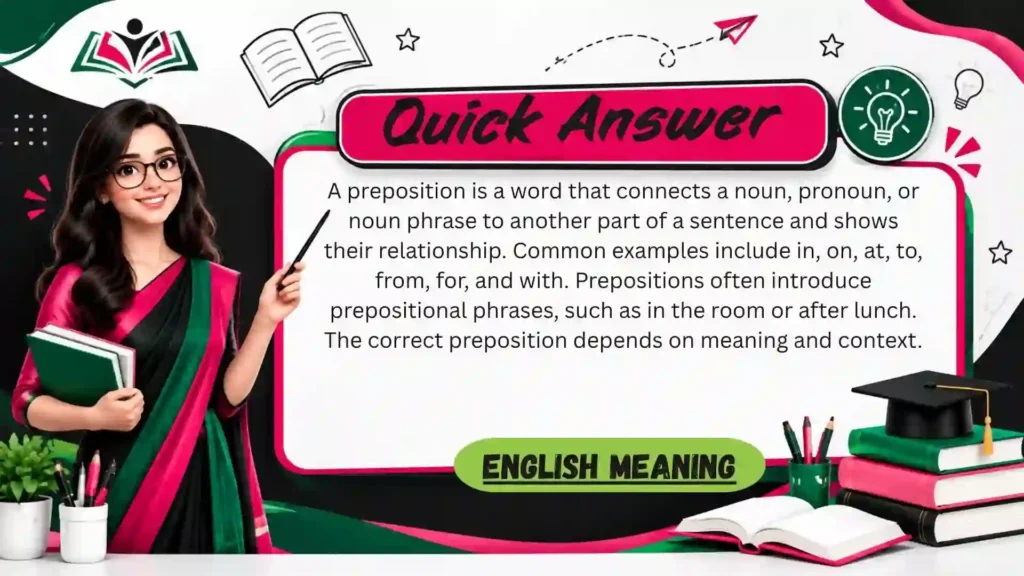
A preposition is a word that connects a noun, pronoun, or noun phrase to another part of a sentence and shows their relationship. Common examples include in, on, at, to, from, for, and with. Prepositions often introduce prepositional phrases, such as in the room or after lunch. The correct preposition depends on meaning and context.
TL;DR
- Prepositions show relationships such as place, time, direction, and method.
- A preposition usually introduces an object and forms a prepositional phrase.
- In, on, and at often differ by location or time.
- To, into, onto, and toward express different movement ideas.
- Some words require particular prepositions, such as interested in.
- A sentence can grammatically end with a preposition.
You Might Also Like That: What Does SMH Mean in Text
Preposition at a Glance
| Preposition | Main meaning | Example |
| in | inside or within | The keys are in the drawer. |
| on | surface or day | The phone is on the desk. |
| at | point or specific place/time | Meet me at noon. |
| to | destination or direction | We drove to Chicago. |
| from | source or starting point | She came from Texas. |
| with | company, tool, or means | He wrote with a pencil. |
| for | purpose, recipient, or duration | This gift is for Maya. |
| by | means or deadline | We traveled by train. |
What Is a Preposition?
A preposition is a grammatical word that shows how something relates to something else. That relationship may involve physical space, time, movement, cause, method, source, or another connection.
For example:
- The dog slept under the bed.
- We arrived after lunch.
- She walked through the park.
- He sent the file by email.
- They talked about the problem.
The meaning is not limited to physical location. In “She is interested in art,” in does not describe a physical place. Instead, it is part of a fixed grammatical pattern. Prepositions therefore work best when you learn them in context rather than as a list of isolated words.
What does the word “preposition” mean?
The name preposition comes from a Latin term meaning roughly “placing before.” In traditional descriptions, the word usually appears before its object. However, English allows a preposition to appear later in a sentence in structures such as “Who are you talking to?”
You Might Also Like That: IYKYK Meaning
How Prepositional Phrases Work
A prepositional phrase normally contains a preposition followed by its object. The object is usually a noun, pronoun, or noun phrase.
The basic pattern is:
Preposition + object = prepositional phrase
Examples:
- in the kitchen
- under the old bridge
- with her friends
- after the meeting
- to the store
In “The children played in the yard,” in is the preposition, the yard is its object, and in the yard is the full prepositional phrase. That phrase gives information about where the children played. Prepositional phrases can modify nouns, verbs, adjectives, and other parts of a sentence.
The object does not have to be a single noun
A preposition can be followed by a pronoun or a noun phrase:
- The message is for her.
- We waited for the new manager.
- They talked about changing the schedule.
A gerund can also appear after a preposition:
- She left without saying goodbye.
- He improved by practicing every day.
That last pattern matters because a preposition is normally followed by a noun-like form. This is why “She is good at swim” is incorrect in standard English, while “She is good at swimming” works.
What Do Prepositions Express?
Prepositions do not form one perfectly rigid list of “types.” Instead, grammarians often group them by the relationship they express. The same preposition can belong to different functional groups depending on the sentence.
You Might Also Like That: Effect vs Affect
Place and position
These prepositions tell us where something is:
- The laptop is on the table.
- The shoes are under the bed.
- The café is near the station.
- The students are inside the classroom.
Time
These prepositions tell us when something happens or how long it lasts:
- The meeting starts at 9 a.m.
- We have class on Monday.
- She was born in July.
- He has lived here since 2020.
You Might Also Like That: IFG Meaning
Direction and movement
These describe movement toward, into, across, or away from something:
- We walked to the park.
- The cat jumped onto the couch.
- She ran into the room.
- They drove toward the coast.
Method, means, or instrument
These explain how something happens:
- We traveled by train.
- He opened the package with a knife.
- She paid by credit card.
Cause, purpose, or connection
Some prepositions introduce a reason, purpose, or abstract relationship:
- The game was canceled because of rain.
- They apologized for the delay.
- He spoke about the new policy.
This broad meaning-based approach is more useful than trying to memorize dozens of rigid categories. Purdue OWL, for example, organizes common prepositions around relationships involving time, place, and objects, while other grammar references use broader functional groupings.
In, On, and At for Place
For location, in, on, and at are among the most common prepositions in English. Their choice depends on how you view the location.
Use “in” for an enclosed area or larger area
- The children are in the room.
- She lives in California.
- There is milk in the refrigerator.
Think of in as being inside a space or area.
You Might Also Like That: What Does WYF Mean
Use “on” for a surface
- The book is on the desk.
- There is a note on the wall.
- She left her phone on the counter.
The object touches or occupies a surface.
Use “at” for a point or general location
- We met at the station.
- He is waiting at the door.
- She is at work.
Here, the speaker treats the location as a point or general place rather than focusing on its interior or surface.
A useful memory rule is:
In = inside an area.
On = on a surface.
At = a point or general location.
This is a practical guideline, not a formula that explains every expression in English. Established expressions can depend on convention, so learn common combinations as units too.
To, Into, Onto, and Toward
These prepositions are often confused because they all relate to movement.
“To” shows a destination
Use to when something moves toward a destination:
- We drove to the airport.
- She walked to the library.
- Send the package to my office.
The important idea is the destination.
“Into” shows movement toward the inside
Use into when something enters an interior space:
- The boy ran into the house.
- She put the keys into her bag.
- The water flowed into the pipe.
“Onto” shows movement toward a surface
Use onto when something moves to a surface:
- The cat jumped onto the bed.
- He stepped onto the platform.
- The ball rolled onto the sidewalk.
You Might Also Like That: IYKYK Meaning
“Toward” shows direction, not necessarily arrival
Use toward when something moves in the direction of a goal:
- The car headed toward the bridge.
- She walked toward the door.
- The hikers moved toward the mountain.
You Might Also Like That: IYKYK Meaning
A useful decision rule is:
Destination → to
Inside → into
Surface → onto
General direction → toward
Purdue OWL specifically distinguishes to, into, and onto by the type of goal or movement involved and explains how toward can indicate direction without necessarily implying arrival.
Prepositions of Time
Time expressions can be easier when you picture the time as a scale.
“At” for a specific time
- The class starts at 8:30.
- We met at noon.
- She works at night.
“On” for days and dates
- The test is on Tuesday.
- Her birthday is on May 12.
- We arrived on Friday morning.
“In” for longer periods
Use in with months, years, seasons, and broader parts of the day:
- He was born in 2001.
- School begins in September.
- We travel more in summer.
- I usually study in the evening.
“For” and “since” are different
Use for for a duration:
- She has worked here for five years.
- We waited for two hours.
Use since for the starting point:
- She has worked here since 2021.
- We have been waiting since noon.
“By” and “until” are not the same
By gives a deadline:
- Please finish the report by Friday.
Until means something continues up to a certain time:
- The office is open until Friday.
Purdue OWL gives the same core distinctions for at, on, and in, as well as since, for, by, during, and within.
Prepositions After Verbs, Adjectives, and Nouns
Sometimes you cannot choose a preposition by physical logic. Instead, English uses established combinations.
For example:
- interested in
- good at
- afraid of
- depend on
- listen to
- agree with
- apologize for
- responsible for
These combinations are often called collocations or fixed patterns. Changing the preposition can make the sentence wrong or change its meaning.
You Might Also Like That: What Does SMH Mean in Text
Compare:
- Correct: She is interested in photography.
- Incorrect: She is interested on photography.
- Correct: We depend on accurate information.
- Incorrect: We depend at accurate information.
The best strategy is to learn these combinations with the word that requires them. Grammarly also notes that many English words and phrases take particular prepositions and that changing the preposition can alter meaning, especially in phrasal verbs and collocations.
A practical learning method
Instead of memorizing:
interested = in
learn:
be interested in something
Then practice a complete sentence:
Maya is interested in marine biology.
This makes the grammatical pattern easier to recall when you write or speak.
Multi-Word Prepositions and Preposition vs. Particle
Not every preposition is a single word. English also uses multi-word expressions such as:
- because of
- in front of
- in spite of
- according to
- out of
- next to
Different grammar references may call these multi-word, compound, or complex prepositions. The labels vary, so the important point is how the expression functions in the sentence.
Another source of confusion is to.
In “We walked to the store,” to is a preposition because it introduces the noun phrase the store.
In “We wanted to leave,” to introduces the base verb leave. This is part of the infinitive construction, not the same grammatical use as the preposition in to the store.
Phrasal verbs create another challenge:
- Please pick up the box.
- I looked after the child.
- She ran into an old friend.
Here, words such as up, after, and into may function as parts of a verb construction. Context matters, so identifying a word from its spelling alone is not always enough.
Can You End a Sentence With a Preposition?
Yes. Ending a sentence with a preposition is grammatical in standard English.
For example:
- Who are you talking to?
- What are you waiting for?
- That is the issue we were arguing about.
- I do not know where she came from.
The older idea that English sentences must never end with prepositions does not describe normal modern English grammar. Merriam-Webster, Dictionary.com, and EnglishClub all explicitly recognize sentence-final prepositions as normal English usage.
Why does the myth still exist?
The restriction became associated with attempts to model English on Latin grammar. English does not behave like Latin, so the supposed universal rule does not work.
However, formal writing may sometimes use a different structure for stylistic reasons:
- Conversational: Who are you speaking to?
- More formal: To whom are you speaking?
Both are grammatical. The second simply has a more formal tone.
The key lesson is to separate grammar from style. A sentence is not automatically wrong because a preposition appears at the end.
Common Preposition Mistakes
Many preposition mistakes happen because learners translate directly from another language or assume similar-looking choices must mean the same thing.
You Might Also Like That: What Does WYF Mean
Mistake 1: Choosing a preposition by translation
- Incorrect: She arrived to the office.
- Better: She arrived at the office.
English often uses fixed patterns that cannot be predicted from another language.
Mistake 2: Confusing place and movement
- The children are in the room.
- The children walked into the room.
In describes location. Into highlights movement from outside to inside.
Mistake 3: Using “in” instead of “on” for a surface
- Incorrect: The keys are in the table.
- Correct: The keys are on the table.
Of course, if the keys are physically inside a drawer built into the table, in may be correct. Meaning controls the choice.
Mistake 4: Using the wrong fixed combination
- Incorrect: He is married with Sarah.
- Correct: He is married to Sarah.
- Incorrect: I am good in math.
- Common standard form: I am good at math.
You Might Also Like That: IYKYK Meaning
Mistake 5: Adding an unnecessary preposition
Some verbs already contain the required relationship:
- Incorrect: Where are you going to?
- Correct: Where are you going?
However, do not remove prepositions simply because they “sound unnecessary.” Some are required by the verb or expression:
- Correct: Who are you talking to?
- Correct: She depends on her team.
The question is not “Can I remove this word?” The better question is “Does this construction require it?”
How to Identify the Right Preposition
When you are unsure, use this four-step method.
1. Ask what relationship you mean
Is the sentence describing:
- place?
- time?
- movement?
- method?
- cause?
- purpose?
- connection?
2. Check the basic pattern
For place, start with the simple contrast:
in = inside
on = surface
at = point/general location
For movement:
to = destination
into = inside
onto = surface
toward = direction
3. Check whether the word has a fixed partner
Look for patterns such as:
- interested in
- listen to
- depend on
- proud of
- responsible for
4. Read the whole sentence
Do not choose a preposition from one word alone. Context can change the meaning.
Compare:
- The bird flew over the house.
- The bird flew into the house.
The first describes movement above or across the house. The second describes movement inside it.
You Might Also Like That: What Does SMH Mean in Text
Preposition Practice: Correct or Incorrect?
Use these examples to check your understanding:
- The meeting starts at 10 a.m.
Correct. At identifies a specific time. - The meeting is on Monday.
Correct. On works with a day. - She walked into the classroom.
Correct. Into emphasizes movement inside. - The picture is on the wall.
Correct. On identifies the surface. - He is interested in history.
Correct. Interested in is a standard fixed pattern. - We have lived here since five years.
Incorrect. Use for with a duration: “We have lived here for five years.” - We have lived here for 2021.
Incorrect. Use since with a starting point: “We have lived here since 2021.” - Who are you waiting for?
Correct. A sentence can end with a preposition. - The package was delivered by the driver.
Correct. By can identify the agent in a passive construction. - She opened the door with a key.
Correct. With identifies the instrument.
A helpful habit is to study each preposition inside a complete sentence. That approach teaches both meaning and grammar pattern at the same time.
FAQs
What is a preposition in simple words?
A preposition is a small grammar word that shows the relationship between a noun, pronoun, or noun phrase and another part of the sentence. Common examples include in, on, at, to, from, with, and for.
What are some common prepositions?
Common English prepositions include about, above, after, at, before, behind, between, by, during, for, from, in, into, of, on, over, through, to, under, with, and without. This is not a complete list.
What is a prepositional phrase?
A prepositional phrase usually contains a preposition and its object, along with any words that modify that object. Examples include under the bed, after lunch, and with my friends.
What is the difference between “in” and “into”?
In usually describes location, while into emphasizes movement toward the inside of something. Compare “The dog is in the house” with “The dog ran into the house.”
Is “to” always a preposition?
No. In “We went to school,” to is a preposition. In “We want to leave,” to is part of the infinitive construction. Context determines its grammatical role.
Is it wrong to end a sentence with a preposition?
No. Sentence-final prepositions are grammatical and common in natural English. A more formal version may move the preposition earlier, but that is a style choice rather than a universal grammar requirement.
Why are prepositions difficult for English learners?
Prepositions often depend on fixed patterns and context. A direct translation from another language may not match standard English. Reading, listening, and learning common word combinations can make the patterns easier to recognize.
Test Your Understanding
1. Which sentence uses a preposition of location correctly?
A. The keys are at the drawer.
B. The keys are in the drawer.
C. The keys are to the drawer.
D. The keys are toward the drawer.
2. Which sentence correctly uses “into”?
A. She is into the classroom.
B. She waited into the classroom.
C. She walked into the classroom.
D. She sat into the classroom.
You Might Also Like That: What Does WYF Mean
3. Which sentence uses the correct fixed preposition?
A. He is interested on science.
B. He is interested at science.
C. He is interested in science.
D. He is interested to science.
4. Which sentence is grammatically acceptable?
A. Who are you talking?
B. Who are you talking to?
C. Who to are you talking?
D. To who talking are you?
5. Which sentence correctly uses “since”?
A. I have worked here since five years.
B. I have worked here since Monday.
C. I worked here since two weeks.
D. I have worked here since three hours.
Answer Key
1. B — In describes the keys as being inside the drawer.
2. C — Into shows movement from outside to the inside of the classroom.
3. C — The standard pattern is interested in something.
4. B — A sentence can naturally and correctly end with a preposition.
5. B — Since introduces a starting point, while for introduces a duration.
Conclusion
A preposition shows a relationship between words, often involving place, time, direction, method, or another connection. The best way to choose one is to focus on meaning first, then check whether English uses a fixed pattern. Remember the core contrasts: in, on, at for common location and time choices, and to, into, onto, toward for movement. Most importantly, learn prepositions through real sentence patterns rather than memorizing isolated lists.