
Speaking is the act of using spoken words to express ideas, thoughts, feelings, and information to another person or group. In simple words, speaking means communicating through language in a way that helps a listener understand your message. It forms an important part of oral communication and verbal communication and works closely with listening, reading, and writing as one of the four main language skills. People use speaking every day in conversations, classrooms, workplaces, interviews, presentations, and social situations.
Quick Answer
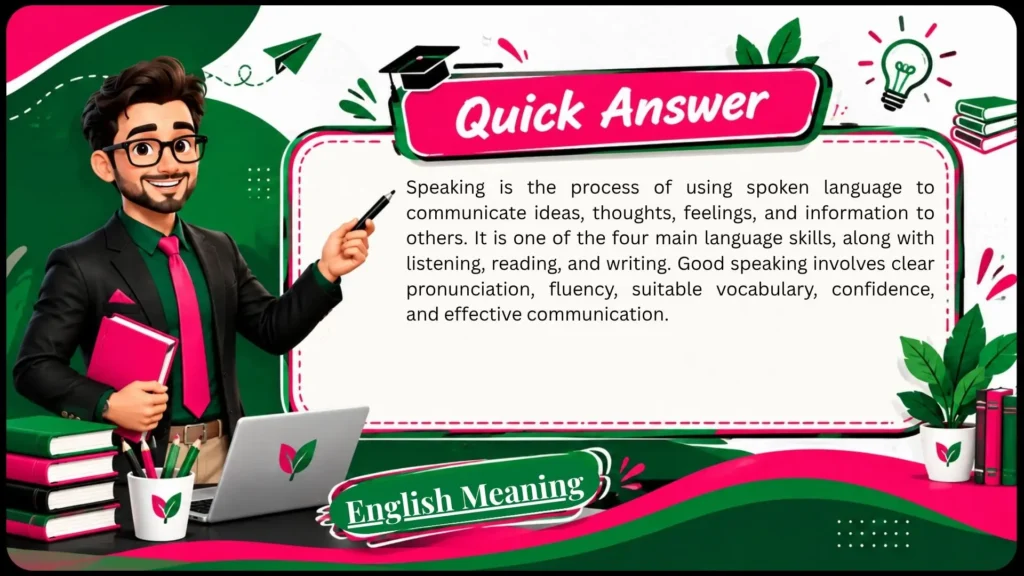
Speaking is the process of using spoken language to communicate ideas, thoughts, feelings, and information to others. It is one of the four main language skills, along with listening, reading, and writing. Good speaking involves clear pronunciation, fluency, suitable vocabulary, confidence, and effective communication.
TL;DR
- 🗣️ Speaking means using spoken language to communicate ideas, thoughts, feelings, and information.
- 📚 It is one of the four main language skills: speaking, listening, reading, and writing.
- 🎯 Good speaking requires clarity, fluency, pronunciation, vocabulary, and confidence.
- 💬 People use speaking in conversations, classrooms, meetings, interviews, and presentations.
- 🎤 Public speaking is one type of speaking.
- 👂 Effective speaking also involves listening and responding to others.
- 📈 Regular speaking practice can improve fluency and communication skills.
- 💡 Anyone can develop better speaking skills through practice, feedback, and confidence.
You Might Also Like That: GOAT Meaning
How Does Speaking Work?
Speaking follows a simple process that turns a person’s thoughts into a message that another person can understand. First, the speaker forms an idea, chooses suitable words, and organizes the message. Next, the speaker uses their voice, pronunciation, tone, and pace to deliver it. The listener then receives and understands the message and may respond.
The Basic Speaking Process
The basic speaking process includes:
- 💭 Thinking: Form an idea or message.
- 🗣️ Choosing words: Select clear and suitable language.
- 🔊 Producing speech: Use the voice and correct pronunciation.
- 👂 Receiving: Allow the listener to hear and understand.
- 💬 Responding: Continue the conversation through feedback.
This process shows that speaking involves both language and interaction.
Why Is Speaking Important?
Speaking is important because it helps people share information, express feelings, solve problems, and build relationships. People use speaking in almost every part of life, from a simple conversation with a friend to a formal presentation at work. Strong speaking skills can also improve confidence and help people take part in discussions, interviews, meetings, and classroom activities.
Good speaking supports effective communication because it allows people to explain their ideas clearly. In education, speaking helps students participate and ask questions. In professional life, it supports teamwork and leadership. In social life, it helps people create and maintain meaningful connections.
Is Speaking a Language Skill?
Yes, speaking is one of the four main language skills, along with listening, reading, and writing. It is often called a productive language skill because the speaker produces language to communicate a message. Speaking also works closely with listening because a good conversation requires people to speak, listen, understand, and respond.
For English learners, speaking as a language skill helps them use vocabulary and grammar in real situations. Regular speaking practice can improve fluency, pronunciation, confidence, and overall language ability.
You Might Also Like That: Elicit vs Illicit
| Language skill | Main purpose |
| 🗣️ Speaking | Producing spoken language |
| 👂 Listening | Understanding spoken language |
| 📖 Reading | Understanding written language |
| ✍️ Writing | Producing written language |
What Are the Different Types of Speaking?
People use different types of speaking depending on the situation, purpose, audience, and level of formality. For example, someone may speak casually with a friend but use more careful language during a job interview. Understanding these differences helps people choose the right words and tone.
Common types include:
- Informal speaking: Used with friends, family, and people we know well.
- Formal speaking: Used at work, school, meetings, or official events.
- Conversational speaking: Used during everyday dialogue and interaction.
- Public speaking: Used when addressing a larger audience.
- Academic speaking: Used in classrooms, discussions, and educational settings.
- Professional speaking: Used in workplaces, interviews, and business meetings.
- Planned speaking: Prepared before delivery, such as a presentation.
- Spontaneous speaking: Happens naturally without much preparation.
What Are the Characteristics of Effective Speaking?
Effective speaking allows a listener to understand a message without unnecessary confusion. A good speaker does not simply use many words. Instead, the speaker chooses suitable words, explains ideas clearly, and adjusts their delivery to the audience and situation.
Important characteristics of effective speaking include:
- 🎯 Clarity: Express ideas in an understandable way.
- 🗣️ Fluency: Speak smoothly without too many pauses.
- 🔤 Accuracy: Use suitable grammar and words.
- 🔊 Pronunciation: Say words clearly.
- 🎵 Tone and pace: Match the voice to the message.
- 💪 Confidence: Speak with a calm and positive manner.
- 👥 Audience awareness: Consider who is listening.
You Might Also Like That: OMP Meaning
What Are Some Examples of Speaking?
We use speaking in many everyday situations. A short conversation with a family member is speaking, just as a formal presentation to hundreds of people is speaking. The purpose and setting may change, but the basic goal remains the same: to communicate a message through spoken language.
Examples of speaking include:
- 💬 Talking with friends or family
- 🏫 Taking part in a classroom discussion
- 💼 Answering questions in a job interview
- 🤝 Speaking during a business meeting
- 🎤 Giving a speech or presentation
- 📞 Talking on a phone call
- 💻 Joining an online voice or video conversation
- 🛍️ Speaking with a customer or service worker
These situations show how speaking skills support both personal and professional communication.
What Is the Difference Between Speaking and Talking?
Speaking and talking have similar meanings, but people often use them in different situations. Talking usually sounds more casual and often refers to everyday conversation. Speaking has a wider use and can describe casual communication as well as formal activities such as giving a speech, presentation, or interview.
For example, you might say, “I am talking with my friend,” while you might say, “She is speaking at a conference.” In many everyday sentences, the two words can replace each other. However, speaking often highlights the act or skill of using spoken language, while talking usually emphasizes conversation.
How Can You Improve Your Speaking Skills?
You can improve your speaking skills through regular practice and simple daily activities. You do not need to wait until you become an expert before you start speaking. Small, repeated efforts can gradually improve your fluency, pronunciation, vocabulary, confidence, and speaking ability.
Try these practical methods:
- 🗣️ Speak every day: Practice even for a few minutes.
- 📖 Read aloud: Improve pronunciation and fluency.
- 🎙️ Record yourself: Notice unclear words and repeated mistakes.
- 👥 Have conversations: Speak with friends, teachers, or language partners.
- 📚 Build vocabulary: Learn useful words and phrases.
- 👂 Listen carefully: Notice how skilled speakers use language.
- 💡 Ask for feedback: Use helpful comments to improve.
- 🎤 Practice different situations: Try interviews, presentations, and informal conversations.
You Might Also Like That: Delulu Meaning
Common Barriers to Effective Speaking
Several problems can make speaking difficult. Some people know what they want to say but struggle to express their thoughts clearly. Others may understand a language well but feel nervous when they need to speak. These barriers can affect speaking fluency, confidence, pronunciation, and communication.
Common barriers include:
- 😟 Fear of making mistakes
- 🧠 Difficulty organizing thoughts
- 📚 Limited vocabulary
- 🔤 Poor pronunciation
- 😰 Lack of confidence
- ⏸️ Too many pauses
- 👥 Fear of speaking in front of others
- 🏋️ Lack of regular practice
Recognizing the problem makes it easier to choose the right speaking practice and improve step by step.
Speaking vs. Other Communication Skills
Speaking is only one part of successful communication. People also need to listen, read, write, and understand nonverbal signals. These skills work together, especially during conversations and professional situations. For example, a good speaker must also listen to the other person and respond appropriately.
| Skill | What it does |
| 🗣️ Speaking | Expresses ideas through spoken language |
| 👂 Listening | Understands spoken messages |
| 📖 Reading | Understands written information |
| ✍️ Writing | Expresses ideas in written form |
| 👀 Nonverbal communication | Uses gestures, facial expressions, and body language |
Strong communication usually comes from using these skills together rather than relying on speaking alone.
You Might Also Like That: Discreet vs Discrete
Frequently Asked Questions About Speaking
What Is Speaking in Simple Words?
Speaking means using spoken words to communicate thoughts, ideas, feelings, or information. It can happen during a casual conversation, classroom discussion, interview, meeting, presentation, or public speech. In simple terms, speaking allows one person to send a message to another person through spoken language.
What Are Speaking Skills?
Speaking skills are the abilities people use to communicate effectively through spoken language. They include pronunciation, vocabulary, grammar, fluency, clarity, tone, pace, confidence, and listening.
Why Is Speaking Important?
Speaking is important because it helps people share information, express feelings, explain ideas, build relationships, and solve problems. Strong speaking skills can also increase confidence and improve performance at school and work. People who communicate clearly can take part in discussions, give presentations, answer questions, and work more effectively with others.
What Are the Types of Speaking?
The main types include formal speaking, informal speaking, conversational speaking, public speaking, academic speaking, professional speaking, planned speaking, and spontaneous speaking.
What Makes Speaking Effective?
Effective speaking combines clarity, fluency, accuracy, pronunciation, suitable vocabulary, confidence, tone, pace, and audience awareness. A good speaker organizes ideas before or while speaking and uses language that the listener can understand.
How Can I Improve My Speaking Skills?
You can improve your speaking skills by practicing regularly, reading aloud, recording yourself, learning useful vocabulary, listening to skilled speakers, and having real conversations. You should also practice pronunciation and ask others for feedback. Most importantly, do not let mistakes stop you. Regular practice helps build speaking fluency, confidence, and communication ability over time.
Is Speaking a Productive Language Skill?
Yes. Speaking is generally considered a productive language skill because it requires a person to produce spoken language. Listening and reading are usually viewed as receptive skills because they involve understanding language. Writing is another productive skill. Together, speaking, listening, reading, and writing form the four main language skills used in language learning.
Conclusion:
Speaking is a basic but powerful communication skill that people use every day to share ideas, feelings, information, and opinions. It plays an important role in education, work, relationships, and language learning.