
Have you ever wondered what the Oxford comma is or why some writers place a comma before the final “and” in a list? The Oxford comma, also called the serial comma or Harvard comma, appears before the final conjunction in a list of three or more items. For example, you can write, “I bought apples, oranges, and bananas.” That small comma may look unimportant, but it can make a sentence easier to understand and sometimes help prevent confusion.
The Oxford comma can also raise questions about grammar, punctuation, and writing style. Is the Oxford comma necessary? Should you always use it? Does it change the meaning of a sentence? The answer depends on the style you follow and the context of your writing. In this guide, you’ll learn the Oxford comma definition, see clear Oxford comma examples, and discover when and how to use the Oxford comma correctly.
Quick Answer
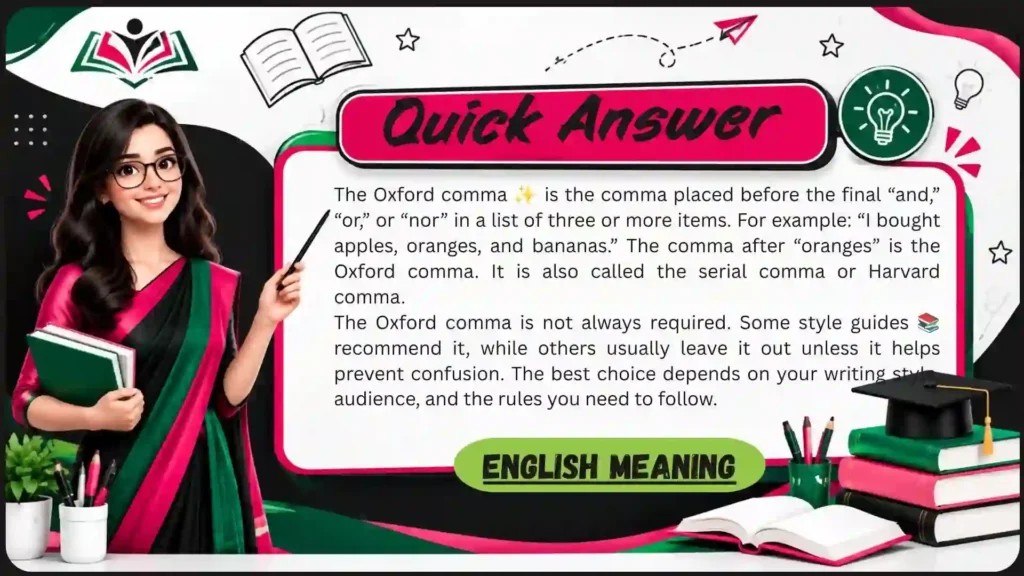
The Oxford comma ✨ is the comma placed before the final “and,” “or,” or “nor” in a list of three or more items. For example: “I bought apples, oranges, and bananas.” The comma after “oranges” is the Oxford comma. It is also called the serial comma or Harvard comma.
The Oxford comma is not always required. Some style guides 📚 recommend it, while others usually leave it out unless it helps prevent confusion. The best choice depends on your writing style, audience, and the rules you need to follow.
TL;DR
- ✨ Oxford comma: The comma before the final conjunction in a list.
- 📋 Example: Apples, oranges, and bananas.
- 🔤 Also called: Serial comma or Harvard comma.
- 📚 Used in: Lists with three or more items.
- ❗ Not always required: Style guides differ.
- 💡 Main benefit: It can make some lists easier to understand.
- 🔄 Best practice: Follow your required style guide and stay consistent.
- ✍️ For confusing sentences: Consider rewriting instead of relying only on punctuation.
- 🚫 Two-item lists: You normally do not need an Oxford comma.
- ✅ Key rule: Use punctuation to support clarity and easy reading.
You Might Also Like That: What is a Preposition
What Is the Oxford Comma?
The Oxford comma ✏️, also called the serial comma or Harvard comma, is the comma placed before the final “and” or “or” in a list of three or more items. For example: “I bought apples, oranges, and bananas.” The comma after “oranges” is the Oxford comma. It separates the final two parts of the list and can make the sentence easier to read.
The Oxford comma is mainly a style choice ⚙️, so writers do not always use it. Some style guides recommend it, while others usually leave it out unless it helps prevent confusion. The most important rule is to follow the style required for your writing and remain consistent ✅.
What Does an Oxford Comma Look Like?
The easiest way to spot an Oxford comma is to look at a list containing three or more items. It appears directly before the final conjunction 🔎, such as “and,” “or,” or “nor.”
| Without Oxford comma | With Oxford comma |
| I need bread, milk and eggs. | I need bread, milk, and eggs. |
| She chose tea, coffee or juice. | She chose tea, coffee, or juice. |
Both versions can be correct depending on the style guide 📚 you follow. The difference is simply whether the comma appears before the final conjunction.
Oxford Comma Examples
Simple examples make the rule easy to understand. Consider this sentence: “We visited London, Paris, and Rome.” The comma before “and” is the Oxford comma. You can use the same pattern with names, foods, activities, places, and other items.
- 🍎 Apples, oranges, and pears
- 📚 Grammar, spelling, and punctuation
- ✈️ London, Paris, and Rome
- 🎵 Singing, dancing, and reading
- ☕ Tea, coffee, or juice
The key idea is simple: when a list has three or more separate items, the Oxford comma comes before the final conjunction when your chosen style uses it.
How to Use the Oxford Comma
Using the Oxford comma is straightforward. First, identify a list containing three or more items. Separate the items with commas, then place another comma before the final “and,” “or,” or “nor” if your style requires the serial comma.
For example: “The course covers grammar, vocabulary, and pronunciation.” The comma before “and” marks the final item clearly. Remember that the Oxford comma is different from the comma used to join two independent clauses. It belongs specifically to a series or list 📝.
When Should You Use the Oxford Comma?
You should use the Oxford comma when your style guide 📖 recommends it or when it makes a list easier to understand. It can be especially useful when list items are long, contain several words, or could otherwise seem connected.
For example, “The speakers were Sarah, a teacher, and Mark, a writer” may need careful punctuation because the items contain extra information. In these situations, punctuation can improve clarity 💡. If your style does not normally require the Oxford comma, you can still use it when needed to prevent confusion, depending on the rules you follow.
Is the Oxford Comma Necessary?
The Oxford comma is not universally required ❗. English allows different style choices, and major style guides do not all give the same advice. Some recommend using the comma consistently, while others generally omit it unless leaving it out could create confusion.
So, there is usually no simple answer that says the Oxford comma is always right or always wrong. The best approach is to check the requirements for your school, workplace, publication, or organization. Most importantly, choose one approach and use it consistently ✅ throughout the same piece of writing.
Oxford Comma vs. No Oxford Comma
The main difference is the comma before the final conjunction:
| Style | Example |
| ➖ No Oxford comma | I bought apples, oranges and bananas. |
| ➕ Oxford comma | I bought apples, oranges, and bananas. |
Both forms can communicate the same basic idea. The choice depends on writing style 📚, audience, and the rules you need to follow. The Oxford comma may improve clarity in some sentences, but adding it does not automatically make every sentence better. Good writers also consider sentence structure and may rewrite a sentence when punctuation alone cannot make the meaning clear.
Can the Oxford Comma Change the Meaning of a Sentence?
An Oxford comma can sometimes affect how readers understand a list. Without it, two items may appear connected, especially when the items contain names, titles, or descriptions. Adding the comma can make the intended boundaries clearer.
For example, “I invited my parents, Taylor Swift and Harry Styles” could make readers wonder whether Taylor Swift and Harry Styles are the parents. A carefully placed comma may help separate the items, although rewriting 🔄 the sentence can sometimes provide even greater clarity. The Oxford comma is useful, but it is not a complete solution for every ambiguous sentence.
When Can the Oxford Comma Create Confusion?
Although the Oxford comma often improves clarity, it does not solve every punctuation problem. In some sentences, the comma can interact with appositives 🧩 or other sentence structures and make the meaning harder to follow.
For example, if a list contains an item that already includes identifying information, readers may still need to interpret the sentence carefully. In such cases, the best solution may be to rephrase ✍️ the sentence rather than depend on one comma. Good punctuation supports clear writing, but clear sentence structure should always come first.
Oxford Comma in Complex Lists
Long or complicated lists can become difficult to read when individual items already contain commas. In these cases, adding more commas may not be enough to show where one item ends and another begins.
Using Semicolons
Semicolons 🔹 can separate complex list items more clearly. For example: “We visited Paris, France; Rome, Italy; and Madrid, Spain.” Here, the semicolons divide the main items, while the commas remain inside each item.
You can also use bullet lists 📋 or rewrite a long sentence into two shorter sentences. The goal is always the same: make each item easy for the reader to identify.
Oxford Comma Before “And,” “Or,” and “Nor”
The Oxford comma can appear before different coordinating conjunctions. The most common example uses “and”, as in “apples, oranges, and bananas.” It can also appear before “or”: “Choose tea, coffee, or juice.”
What About “Nor”?
It may also appear before “nor” in a series: “The plan involved no meetings, emails, nor phone calls.” However, the exact punctuation can depend on sentence structure and style. Do not add a comma simply because a conjunction appears. First make sure you are dealing with a list 📋, not two independent clauses joined by a conjunction.
Oxford Comma in American vs. British English
The Oxford comma is often associated with American English 🇺🇸, where many style guides and organizations recommend or favor it. However, American writers do not all use it in every context.
In British English 🇬🇧, the comma is often omitted unless it helps prevent confusion. Still, there is no absolute rule that every American writer uses it or every British writer avoids it. Individual publishers, universities, newspapers, and organizations can follow their own style. Your best guide is always the specific style rules 📚 required for your audience or publication.
What Do Major Style Guides Say About the Oxford Comma?
Different style guides take different approaches to the Oxford comma. For example, MLA 📘 generally supports the serial comma, while the Oxford University style guide 🎓 generally omits the comma before the final “and” or “or” unless it is needed for clarity. Other organizations, including some technical-writing style guides, recommend consistent serial-comma use.
| Style guide | General approach |
| MLA | Generally uses the serial comma |
| Oxford University | Usually omits it unless needed |
| Microsoft | Uses the serial comma |
| Recommends it for clarity |
Always check the current rules of the style guide you are required to follow.
Common Oxford Comma Mistakes
Writers often make a few simple mistakes when learning the Oxford comma. Avoid these common problems:
- ❌ Using it with only two items: “Tea, and coffee” is normally unnecessary.
- ❌ Changing styles: Do not use the comma in some lists and omit it randomly.
- ❌ Assuming it is always required: Style guides differ.
- ❌ Using it to fix every unclear sentence: Sometimes rewriting is better.
- ❌ Confusing it with other comma rules: A serial comma belongs to a list.
The goal is not to add as many commas as possible. The goal is clear writing 💡 that follows the correct style.
How to Decide Whether to Use the Oxford Comma
When you are unsure, use this simple decision process:
- 🔎 Count the items. Is the sentence listing three or more things?
- 📚 Check your style guide. Does it recommend the Oxford comma?
- 💡 Consider clarity. Could the sentence be misunderstood without it?
- ✍️ Check consistency. Are you using the same style elsewhere?
- 🔄 Rewrite if needed. A clearer sentence may be better than adding punctuation.
This approach helps you make a practical choice without treating the Oxford comma as an absolute grammar rule.
Frequently Asked Questions About the Oxford Comma
What is another name for the Oxford comma?
The Oxford comma is also called the serial comma or Harvard comma. These terms generally refer to the same comma used before the final conjunction in a list.
Do you use an Oxford comma with two items?
Usually, no. A two-item list does not need a serial comma. For example: “I bought bread and milk.”
Is the Oxford comma grammatically correct?
Yes. Using the Oxford comma is grammatically acceptable. Omitting it can also be correct when the chosen style allows omission.
Does the Oxford comma always prevent confusion?
No. It can improve clarity 💡, but some sentences need to be rewritten to remove ambiguity completely.
Why is it called the Oxford comma?
The name comes from its long association with Oxford University Press 📚 and its publishing style.
Final Takeaway
The Oxford comma ✨ is the comma placed before the final “and,” “or,” or “nor” in a list of three or more items. For example: “I bought apples, oranges, and bananas.” Its main purpose is to separate list items clearly.
There is no universal rule that says every writer must use it. Different style guides 📖 make different choices. The best approach is to follow the style required for your writing, use punctuation consistently, and focus on clarity 💡. When a sentence remains confusing, consider rewriting it instead of relying on the Oxford comma alone.