
Idioms are common expressions that make English more natural and interesting. But their meanings can sometimes confuse learners because the words do not always mean exactly what they say. For example, “break the ice” does not mean breaking real ice. It means starting a friendly conversation. In this guide, you’ll learn the idiom definition, what an idiom means, how to identify one, common examples, types, and how to use idioms correctly.
Quick Answer: What Is an Idiom?
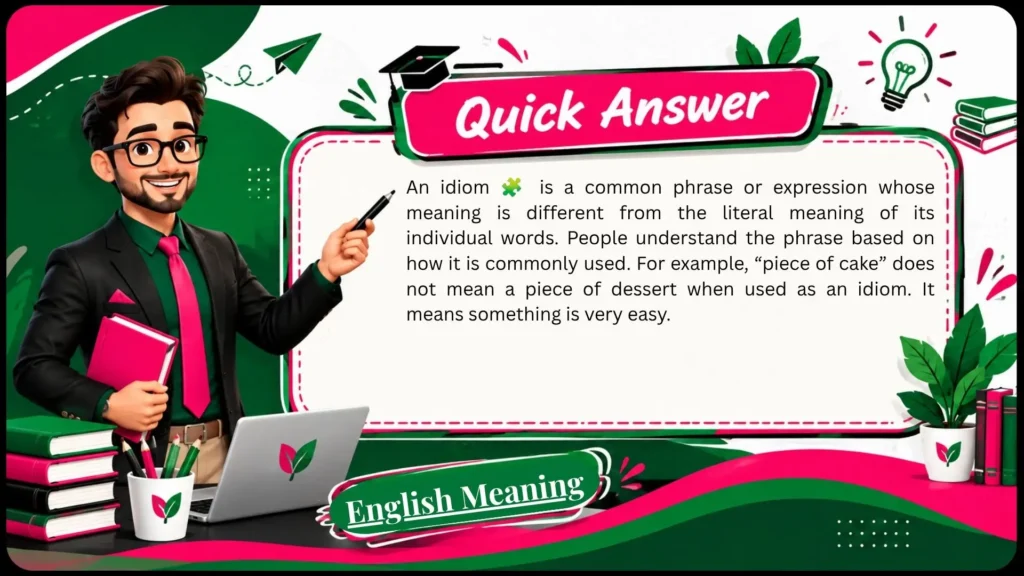
An idiom 🧩 is a common phrase or expression whose meaning is different from the literal meaning of its individual words. People understand the phrase based on how it is commonly used. For example, “piece of cake” does not mean a piece of dessert when used as an idiom. It means something is very easy.
Idioms are common in everyday conversations, books, movies, and informal writing. They help people express ideas in a short and colorful way. Once you understand the meaning of an idiom as a whole, it becomes much easier to understand the sentence.
TL;DR 📌
- 🧩 Idiom: A common expression whose meaning is different from the literal meaning of its words.
- 💡 Example: “Break the ice” means to start a conversation, not to break real ice.
- 🎯 Key feature: Idioms usually have a figurative meaning.
- 🗣️ Common examples: “Piece of cake,” “spill the beans,” and “under the weather.”
- 📚 Types: Pure, binomial, partial, and prepositional idioms.
- 🔎 How to identify one: Check whether the phrase means something different from its individual words.
- ✍️ Usage: Idioms work well in everyday conversation and informal writing, but use them carefully in formal or technical content.
- 🧠 Best way to learn: Study idioms with their meaning, context, and example sentences.
You Might Also Like That: Discreet vs Discrete
Idiom Definition in Simple Words
A Simple Definition of an Idiom
In simple words, an idiom 💡 is a fixed or commonly used expression with a special meaning. You usually cannot understand its true meaning by looking at each word separately. For example, “spill the beans” literally sounds like dropping beans, but its idiomatic meaning is to reveal a secret.
The key point is that the whole expression has a meaning that people recognize. Idioms can make speech sound more natural, friendly, and expressive. They are especially common in everyday English, where speakers often use them without thinking about their literal meanings.
What Does an Idiom Mean?
An idiom means an expression that has a non-literal meaning. The exact meaning often depends on common language use and the situation in which the expression appears. For example, if someone says, “I’m feeling under the weather,” they usually mean they are feeling sick, not that they are physically under the weather.
The meaning of an idiom becomes easier when you look at the context. Instead of translating every word, try to understand what the speaker is trying to say as a whole. This approach is especially helpful when learning English.
Examples of Idioms and Their Meanings
Here are some common English idioms 🗣️ and their simple meanings:
| Idiom | Meaning | Example |
| Break the ice 🧊 | Start a conversation | She told a joke to break the ice. |
| Piece of cake 🍰 | Very easy | The test was a piece of cake. |
| Spill the beans 🫘 | Reveal a secret | Ali spilled the beans about the surprise. |
| Under the weather 🌧️ | Feeling sick | I’m under the weather today. |
| Once in a blue moon 🌙 | Very rarely | We eat out once in a blue moon. |
| Hit the nail on the head 🔨 | Be exactly right | You hit the nail on the head. |
| Bite the bullet 💪 | Face something difficult | I decided to bite the bullet and apologize. |
| Call it a day 🛑 | Stop working | We finished the project and called it a day. |
These examples show why idioms can be confusing at first. Their figurative meaning is different from what the words seem to say. Learning the phrase together with its meaning and an example sentence can make it much easier to remember.
You Might Also Like That: Elicit vs Illicit
Literal Meaning vs. Idiomatic Meaning
Understanding the Difference
The literal meaning 📖 is the normal meaning of the words. The idiomatic meaning 🎯 is the special meaning people understand when the words are used together as an expression.
| Expression | Literal Meaning | Idiomatic Meaning |
| Break the ice | Break physical ice | Start a conversation |
| Spill the beans | Drop beans | Reveal a secret |
| Piece of cake | A piece of cake | Something easy |
| Hit the sack | Hit a bag | Go to bed |
This difference is one of the most important things to understand about idioms. If you take an idiom literally, the sentence may sound strange or even impossible. When you learn its common meaning, however, the sentence becomes clear.
How Can You Tell If Something Is an Idiom?
Simple Ways to Identify an Idiom
You can often identify an idiom 🔎 by asking a few simple questions:
- Does the phrase have a meaning beyond its individual words?
- Does the literal meaning sound strange in the sentence?
- Is the expression commonly used in the same form?
- Do native speakers use the phrase to express a particular idea?
- Does the surrounding context help explain its meaning?
For example, “He let the cat out of the bag” may sound strange if you imagine a real cat. In context, however, it usually means he revealed a secret. Looking at the complete sentence is often the easiest way to recognize an idiom.
How Do Idioms Work in Everyday English?
Idioms are widely used in everyday English 🗣️. You may hear them in conversations, movies, books, social media posts, stories, and informal messages. A friend might say, “Let’s call it a day,” when they want to stop working. Someone might say, “You’re on the right track,” to tell another person they are doing something correctly.
Idioms can make communication feel more natural and expressive. However, not every audience knows every idiom. Some expressions may be common in one country or region but less familiar somewhere else. That is why context and audience matter when using them.
You Might Also Like That: Rizz Meaning
Why Do People Use Idioms?
Making Communication More Expressive
People use idioms ✨ because they can express an idea in a short and memorable way. Instead of saying, “We should start talking and make everyone feel comfortable,” someone can simply say, “Let’s break the ice.”
Idioms can also add personality, humor, emotion, and color to communication. They are common in storytelling and casual conversations because they can make language more engaging. Still, clear communication should come first. If an audience may not understand an idiom, a simple literal expression can sometimes work better.
Types of Idioms
Idioms can be grouped into different types based on how they are formed and used. Some common categories include pure idioms, binomial idioms, partial idioms, and prepositional idioms.
- Pure idioms: Their overall meaning is difficult to understand from the individual words.
- Binomial idioms: They often join two words or ideas, such as “safe and sound.”
- Partial idioms: Only part of the expression has an idiomatic meaning.
- Prepositional idioms: They commonly include a preposition, such as “in charge of.”
You do not need to memorize these categories to understand everyday idioms. The most important skill is learning the meaning and context of each expression.
Idiom vs. Phrase: What’s the Difference?
A phrase 🧩 is a group of words that work together in a sentence. An idiom is a type of expression with a special meaning that is not usually understood from the individual words.
For example, “in the morning” is a phrase, but it is not normally an idiom because its meaning is clear from the words. “Spill the beans,” however, is an idiomatic expression because its intended meaning is reveal a secret, not literally spill beans. So, while idioms are expressions made from words, not every phrase is an idiom.
Idiom vs. Metaphor, Proverb, and Cliché
These terms can look similar, but they are not exactly the same.
| Term | Main Idea | Example |
| Idiom 🧩 | Fixed expression with a special meaning | Break the ice |
| Metaphor 🎨 | Direct comparison | Time is a thief |
| Proverb 📜 | Common saying that gives advice or wisdom | Actions speak louder than words |
| Cliché 🔄 | Expression used so often it may feel unoriginal | Better late than never |
Some expressions can overlap in how people use them, so the categories are not always perfectly separate. The easiest way to remember the difference is to focus on the purpose and meaning of the expression.
You Might Also Like That: OMP Meaning
When Should You Use an Idiom?
Idioms work especially well in casual conversations, storytelling, creative writing, and informal communication. They can make your language sound natural and help you connect with people who understand the same expression.
For example, saying “I’m feeling under the weather” in a casual conversation sounds natural. Idioms can also make stories more interesting by adding emotion or personality. Before using one, think about your audience and situation. A familiar idiom can improve communication, while an unfamiliar one may confuse the reader.
When Should You Avoid Using an Idiom?
Choose Clarity When It Matters Most
You should be careful with idioms ⚠️ in academic writing, technical instructions, formal documents, and situations where exact meaning is important. Readers may interpret an unfamiliar expression differently or fail to understand it.
For example, a technical guide should clearly explain what a user needs to do instead of relying on an expression such as “bite the bullet.” Idioms are useful when they add value, but simple language is often better when your main goal is accuracy and clarity.
Common Mistakes People Make With Idioms
Learners often make mistakes when they try to use idioms without understanding their complete meaning. Common problems include:
- ❌ Changing words inside a fixed expression
- ❌ Taking an idiom too literally
- ❌ Mixing two different idioms
- ❌ Using an idiom in the wrong context
- ❌ Using too many idioms in one paragraph
- ❌ Choosing an expression the audience may not understand
The best way to avoid these mistakes is to learn an idiom as a complete expression. Study its meaning, read several examples, and notice how people naturally use it.
You Might Also Like That: OMP Meaning
Why Are Idioms Difficult for English Learners?
Idioms can be challenging 🌍 because their meanings are often not literal. A learner may know every word in “break the ice” but still not understand what the whole expression means.
Culture can also make idioms difficult. Some expressions are connected to history, traditions, humor, or regional language. A phrase that is common in one English-speaking community may be unfamiliar in another. Instead of translating each word, learners should study the whole expression in context and pay attention to how native speakers use it.
How to Learn and Remember Idioms
Learn Idioms Through Context
The easiest way to remember an idiom 🧠 is to learn it with a meaning, situation, and example sentence. Do not only memorize a definition. For example, learn “call it a day” with the idea of finishing work for the day.
Helpful methods include:
- 📚 Read idioms in real sentences
- 🎧 Listen for them in conversations and videos
- ✍️ Write your own example sentences
- 🗂️ Group idioms by topic
- 🔁 Review them regularly
- 🗣️ Practice using them naturally
This helps you remember both the meaning and the correct context.
Frequently Asked Questions About Idioms
What Is an Idiom in Simple Words?
An idiom is a common expression whose meaning is different from the literal meaning of its words. For example, “piece of cake” means something is easy.
What Is an Example of an Idiom?
“Break the ice” is a common example. It means to start a conversation or make people feel more comfortable.
What Are the Four Types of Idioms?
Common categories include pure idioms, binomial idioms, partial idioms, and prepositional idioms.
Are Idioms Always Figurative?
Most idioms are understood through a figurative meaning, but some expressions can also have a literal meaning depending on the context.
How Can I Identify an Idiom?
Look for a phrase whose meaning cannot be understood fully from its individual words. Context can help you identify its intended meaning.
Final Thoughts
An idiom 🧩 is a common expression with a meaning that is different from its literal words. Expressions such as “break the ice,” “spill the beans,” and “piece of cake” show how English can communicate ideas in short and memorable ways.
The best way to understand idioms is to learn them in context. Pay attention to their meaning, examples, and situations where people use them. Once you become familiar with common expressions, you will find everyday English much easier to understand and use.