
Quotation marks are punctuation marks that help readers understand when a writer has used someone’s exact words, shown dialogue, or highlighted a particular word or phrase. You may already know them as quotation marks, quote marks, or speech marks. In English writing, they usually appear as double quotation marks (“ ”) or single quotation marks (‘ ’). Learning the basic quotation marks rules can make your writing clearer and help you avoid common punctuation mistakes.
But when should you use quotation marks, and where should other punctuation marks go? This guide explains what quotation marks are, what they are used for, and how to use them correctly in everyday and academic writing. You’ll also learn about single vs. double quotation marks, direct quotations, dialogue, titles, nested quotations, and common quotation mark mistakes through simple examples.
Quick Answer: What Are Quotation Marks Used For?
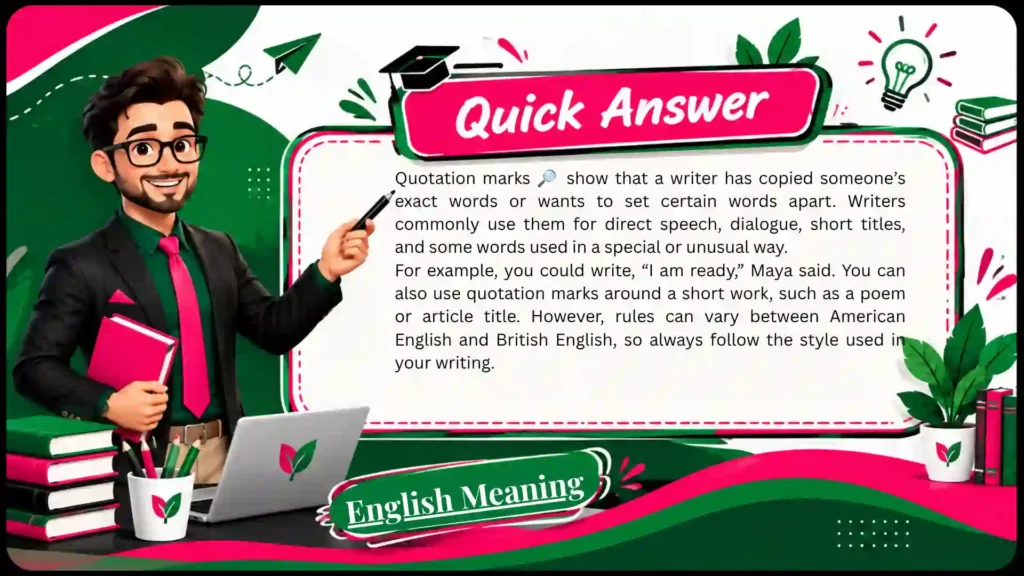
Quotation marks 🔎 show that a writer has copied someone’s exact words or wants to set certain words apart. Writers commonly use them for direct speech, dialogue, short titles, and some words used in a special or unusual way.
For example, you could write, “I am ready,” Maya said. You can also use quotation marks around a short work, such as a poem or article title. However, rules can vary between American English and British English, so always follow the style used in your writing.
TL;DR: Quotation Marks at a Glance
- 📝 Use quotation marks for exact words from another speaker or source.
- 💬 Use them to show dialogue in many types of writing.
- 📚 Use them for many short works and titles.
- 🔤 Choose between single and double quotation marks based on your English or style guide.
- ❗ Check punctuation carefully when it appears near quotation marks.
- 🔗 Use different quotation marks for nested quotations.
- 🚫 Do not add quotation marks simply to emphasize ordinary words.
- 🇺🇸🇬🇧 Remember that American and British English can follow different quotation conventions.
You Might Also Like That: Coomer Meaning
What Are Quotation Marks?
Quotation marks ✏️ are punctuation marks that show a reader that certain words come from another person or source. Writers commonly use them for direct quotations, dialogue, and some titles or special terms. The two common forms are double quotation marks (“ ”) and single quotation marks (‘ ’). The opening mark starts the quotation, while the closing mark shows where it ends.
In simple terms, quotation marks help separate quoted words from the writer’s own words. You may also hear them called quote marks, speech marks, or inverted commas. Although the names can differ, their main purpose remains the same: to make quoted or specially marked language clear.
What Do Quotation Marks Look Like?
The most common quotation mark symbols are double quotation marks “ ” and single quotation marks ‘ ’. Double quotation marks usually appear as a pair, with one opening the quoted material and the other closing it. Single quotation marks work in the same basic way.
You may also see straight quotation marks (” “), curly quotation marks (“ ”), and smart quotes in digital writing. Word processors often change straight quotation marks into curly ones automatically. The meaning usually stays the same, but formal writing should follow the required style.
When to Use Quotation Marks
To Show Direct Quotations
Use quotation marks when you repeat someone’s exact words 🗣️. A direct quotation keeps the original wording instead of changing it into your own words.
For example:
Sarah said, “I finished my homework.”
The quotation marks tell readers that Sarah said those exact words. If you only explain the idea in your own words, you normally have an indirect quotation instead. For example: Sarah said that she had finished her homework. This sentence reports the idea without directly quoting Sarah.
For Dialogue
Writers often use quotation marks for dialogue 💬 to show what characters or people say. Each speaker’s words normally appear inside quotation marks.
For example:
“Where are you going?” Tom asked.
“I’m going to the store,” Mia replied.
Quotation marks make conversations easier to follow. In fiction, writers also use paragraph breaks when a new person speaks. The exact dialogue rules can vary by writing style, but the main purpose remains clear: quotation marks show the reader which words represent spoken language.
For Titles of Short Works
Writers often use quotation marks for titles of short works 📚, such as articles, poems, short stories, songs, chapters, and television episodes. For example, you might write “The Raven” when referring to Edgar Allan Poe’s poem.
Longer or standalone works, such as books and many films, often use italics instead. However, title rules can vary by style guide. When you write for school, work, or publication, check the required style. The key point is to use one consistent system throughout your writing.
For Words Used in a Special Sense
Quotation marks can sometimes show that a word has a special meaning or that the writer does not use it in the usual sense. Writers often call these scare quotes ⚠️.
For example:
The company offered a “solution” that created more problems.
Here, the quotation marks suggest that the writer questions whether the word solution truly fits. Avoid using quotation marks simply for emphasis. Too many scare quotes can make your writing unclear or suggest a meaning you did not intend.
Single vs. Double Quotation Marks
Single quotation marks (‘ ’) and double quotation marks (“ ”) can both show quoted material. However, different English conventions use them differently. American English generally uses double quotation marks for ordinary quotations, while British English often uses single quotation marks.
For example, American English commonly writes:
“I understand,” she said.
A British English style may write:
‘I understand,’ she said.
The important rule is consistency. If your school, workplace, publisher, or style guide gives a specific rule, follow that system throughout the article.
Quotation Marks Within Quotation Marks
Sometimes a quotation contains another quotation. This situation is called a nested quotation 🔗. Writers usually switch from double quotation marks to single quotation marks, or from single to double, to make the two levels easy to identify.
For example:
“John said, ‘I will call you later.’”
The outer quotation uses double marks, while the quotation inside it uses single marks. British English may commonly reverse this pattern. When using quotation marks within quotation marks, make sure every opening mark has a matching closing mark.
Where Does Punctuation Go With Quotation Marks?
Periods and Commas
The position of periods and commas near quotation marks depends partly on the English convention you follow. American English commonly places periods and commas inside closing quotation marks.
Example:
She said, “I am ready.”
British styles can follow different punctuation patterns, especially when the punctuation does not belong to the quoted words. Always follow your chosen style guide rather than mixing rules from different systems.
Question Marks and Exclamation Marks
Question marks and exclamation marks ❗ can appear inside or outside quotation marks depending on which part of the sentence they apply to.
If the quoted words form the question, place the question mark inside:
She asked, “Are you ready?”
If the entire sentence asks the question but the quoted words do not, the mark can appear outside:
Did he really say “I am leaving”?
The meaning of the punctuation determines its position.
Colons and Semicolons
Colons and semicolons usually do not follow the same placement rule as commas and periods in American English. They normally appear outside closing quotation marks when they introduce or connect quoted material.
For example:
She described the plan as “too risky”; however, the team continued.
Style guides can differ, so writers should check their required system for formal work. The main goal is to keep punctuation clear and consistent rather than placing every punctuation mark automatically inside quotation marks.
Quotation Marks in American vs. British English
American English and British English use quotation marks in slightly different ways. American writing generally prefers double quotation marks for direct quotations and often places commas and periods inside the closing quotation mark.
British English often uses single quotation marks for ordinary quotations and may place punctuation according to whether it belongs to the quoted material. Neither approach automatically makes the other incorrect. 🌎 The important thing is to follow the conventions of your chosen variety and remain consistent throughout your writing.
Quotation Marks vs. Italics: What’s the Difference?
Quotation marks and italics can both help identify titles, but they usually serve different purposes. Writers commonly use quotation marks for short works, such as articles, poems, songs, short stories, and chapters.
They often use italics for larger or standalone works, such as books, newspapers, magazines, albums, and films. For example:
- 📖 Book: The Great Gatsby
- 📰 Article: “How Language Changes”
- 🎵 Song: “Imagine”
Always check your style guide because specific title rules can vary.
Direct Quotation vs. Indirect Quotation
A direct quotation repeats another person’s exact words, so quotation marks show the copied language:
Maria said, “The test was difficult.”
An indirect quotation reports the same idea without copying the exact words:
Maria said that the test was difficult.
Because the second sentence uses the writer’s own wording, it does not normally need quotation marks. This difference matters in academic writing because writers must clearly show when they use a source’s exact words and when they paraphrase or summarize information.
How to Capitalize Words Inside Quotation Marks
Capitalization depends on how you use the quotation. If you quote a complete sentence, capitalize its first word:
He said, “The meeting starts at nine.”
When you include only part of a sentence, you may not need to capitalize the first quoted word:
The report called the result “unexpected.”
The goal is to preserve the original wording while fitting the quotation naturally into your sentence. In academic writing, follow the relevant style guide when you change capitalization or make other necessary adjustments to quoted material.
Common Quotation Marks Mistakes
Many writers make simple mistakes when using quotation marks. Watch for these common problems:
- ❌ Using quotation marks only for emphasis.
- ❌ Forgetting the closing quotation mark.
- ❌ Mixing single and double quotation styles without a reason.
- ❌ Adding quotation marks to a paraphrase.
- ❌ Using quotation marks when italics are required for a title.
- ❌ Placing punctuation incorrectly.
- ❌ Confusing quotation marks with apostrophes.
Reading the sentence aloud can help you spot some problems. For formal writing, also check the style guide you need to follow.
Quotation Marks Examples in Sentences
The following examples show several common uses:
| Use | Example |
| 🗣️ Direct quotation | She said, “I need some help.” |
| 💬 Dialogue | “Where are you going?” he asked. |
| 📚 Short title | I read “The Lottery.” |
| ⚠️ Scare quotes | He called it a “perfect” plan. |
| 🔗 Nested quotation | She said, “Tom told me, ‘Wait here.’” |
| ❗ Question | Did she really say “I quit”? |
These quotation marks examples show how context affects their use. When you understand the purpose behind each example, the rules become much easier to remember.
How to Type Quotation Marks on a Keyboard
You can type quotation marks ⌨️ directly from a standard keyboard. Most keyboards provide a key for straight double quotation marks, while word-processing programs may automatically convert them into curly or smart quotation marks.
For example:
- Straight: “Hello”
- Curly: “Hello”
- Single: ‘Hello’
The visual form may change, but the basic purpose remains the same. For professional or academic writing, follow the formatting requirements of the platform or style guide. Digital tools can also change quotation marks automatically, so review your text before publishing.
Opening vs. Closing Quotation Marks
Opening quotation marks show where quoted material begins, while closing quotation marks show where it ends. In curly quotation marks, the two marks point in different directions:
“This is a quotation.”
A common mistake involves using the wrong mark at the beginning or end, especially when typing manually. Straight quotation marks look identical on both sides, while curly quotation marks have separate opening and closing forms. Always check that your quotation has both parts and that the closing mark appears after the appropriate quoted material.
Frequently Asked Questions
What are quotation marks?
Quotation marks are punctuation marks that show exact quoted words, dialogue, or certain special uses of language. Writers commonly use double or single quotation marks.
What are quotation marks used for?
They commonly show direct quotations, dialogue, titles of short works, and words used in a special sense.
What is the difference between single and double quotation marks?
Both can mark quoted material. The choice depends on English variety, style guide, and context.
Do commas go inside quotation marks?
In American English, commas commonly go inside closing quotation marks. Other styles may follow different conventions.
What is a quotation within a quotation?
It is a nested quotation 🔗, where quoted words appear inside another quotation.
Should indirect quotes have quotation marks?
Usually not. An indirect quotation reports an idea in the writer’s own words rather than repeating the exact wording.
Are quotation marks and speech marks the same?
They generally refer to the same punctuation marks. Speech marks is a term commonly used in British English.
Final Thoughts
Learning quotation marks rules becomes easier when you focus on their purpose instead of memorizing every rule at once. Use them to identify exact words, dialogue, certain short titles, and specific special uses. Pay close attention to punctuation, capitalization, and the difference between direct and indirect quotations.
Remember that American English and British English can use different conventions. If you write for school, work, or publication, follow the required style guide. With regular practice and clear examples, you can use single quotation marks, double quotation marks, nested quotations, and quotation punctuation with confidence.