

Accept and except look and sound similar, but they have completely different meanings. This common confusion can lead to mistakes in everyday English, school assignments, emails, and professional writing. Accept usually means to receive, agree to, or approve something, while except means to leave someone or something out. Knowing this basic difference can help you choose the correct word with confidence.
In this guide, you’ll learn the difference between accept and except, when to use each word, and how to use them correctly in sentences. We’ll also cover accept vs except examples, common mistakes, pronunciation, and a simple memory trick to help you remember which word fits your sentence. Whether you’re a student, writer, or English learner, these clear explanations will make accept vs except much easier to understand.
Accept vs Except: Quick Answer
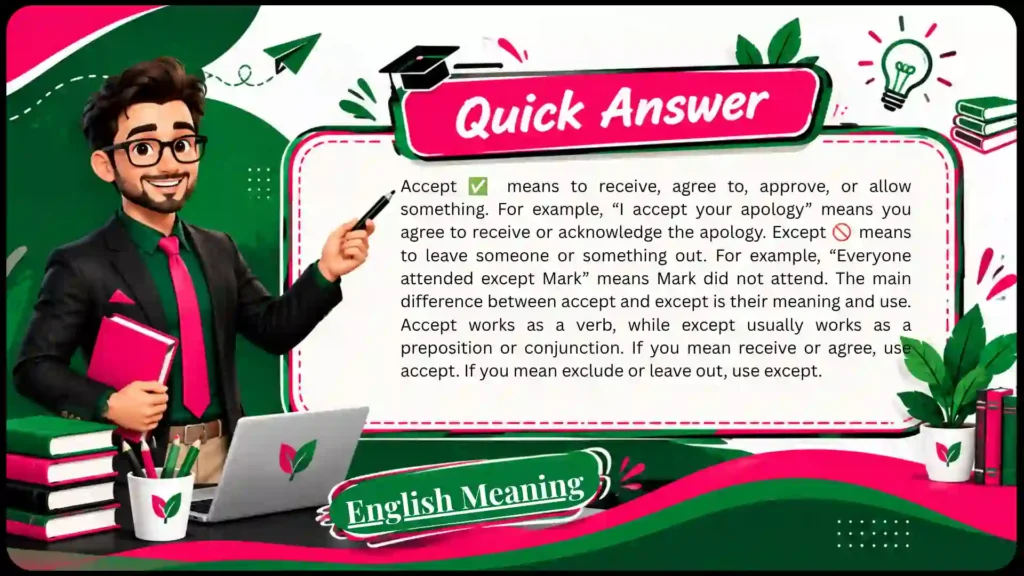
Accept ✅ means to receive, agree to, approve, or allow something. For example, “I accept your apology” means you agree to receive or acknowledge the apology. Except 🚫 means to leave someone or something out. For example, “Everyone attended except Mark” means Mark did not attend.
The main difference between accept and except is their meaning and use. Accept works as a verb, while except usually works as a preposition or conjunction. If you mean receive or agree, use accept. If you mean exclude or leave out, use except.
TL;DR
- Accept ✅ means to receive, agree to, approve, or acknowledge something.
- Except 🚫 means to exclude or leave something out.
- Accept is a verb.
- Except commonly works as a preposition or conjunction.
- Use accept when you mean receive or agree.
- Use except when you mean excluding or apart from.
- A simple memory trick is accept = take it and except = leave it out.
- Always check the meaning of the sentence before choosing the word.
You Might Also Like That: ASL Meaning
Accept vs Except: The Key Difference
The easiest way to understand accept vs except is to focus on the action. Accept describes taking, receiving, agreeing to, or approving something. Except shows that someone or something does not belong in a group or situation. Although these words look and sound similar, you cannot normally replace one with the other.
| Word | Meaning | Main Use | Example |
| Accept ✅ | Receive, agree, or approve | Verb | I accept your offer. |
| Except 🚫 | Leave out or exclude | Preposition/Conjunction | Everyone came except Sam. |
This simple comparison can help you understand accept and except before you use either word in your writing.
What Does Accept Mean?
Accept ✅ means to receive something willingly, agree to something, or approve something. You can accept a gift, accept an invitation, accept an offer, or accept responsibility. The word can also describe recognizing a fact or situation, such as “She accepted the decision.” In each case, the person receives, agrees with, or acknowledges something.
In grammar, accept works as a verb. Common forms include accepts, accepted, and accepting. You may also see related words such as acceptance and acceptable. Understanding these forms makes it easier to recognize the word when you read or write different types of sentences.
What Does Except Mean?
Except 🚫 means excluding, apart from, or leaving someone or something out of a group. For example, “I eat every fruit except bananas” means that bananas are not included. This meaning makes except useful when you want to identify an exception to a general statement.
In grammar, except can work as a preposition or conjunction, and it can also appear as a less common verb. You may also see phrases such as except for. Understanding the meaning of exclusion gives you a simple way to recognize except in everyday English.
When to Use Accept
Use accept ✅ when you mean receive, agree to, approve, or acknowledge something. You can accept a present, accept an invitation, accept a job offer, or accept someone’s apology. You can also accept a fact or situation when you recognize it as true or real.
Examples of Accept
- I accept your invitation.
- She accepted the gift.
- We accept your decision.
- He accepted responsibility for the mistake.
- They accepted the new offer.
A useful rule is: if you can replace the word with receive, agree to, or approve, accept may be the correct choice.
When to Use Except
Use except 🚫 when you want to show that someone or something is excluded. It often appears when you describe a group and then identify the person or thing that does not belong to it. For example, “Everyone passed except James” means James did not pass.
Common Uses of Except
You can use except with people, objects, places, days, and situations:
- Everyone came except Lisa.
- I work every day except Sunday.
- The store sells everything except fresh bread.
- We enjoyed the trip except for the weather.
When your sentence means excluding or apart from, except is usually the right word.
Accept vs Except Examples
Seeing accept vs except examples can make the difference much easier to understand. The two words may look similar, but their meanings become clear when you place them in normal sentences.
| Accept ✅ | Except 🚫 |
| I accept your offer. | Everyone came except Tom. |
| She accepted the invitation. | I like all colors except yellow. |
| He accepted the gift. | The shop opens every day except Sunday. |
| We accept your apology. | All students passed except Mia. |
| They accepted the decision. | Nothing was missing except the key. |
These accept and except examples show that accept involves receiving or agreeing, while except creates an exclusion.
Accept or Except: Which One Should You Use?
If you are asking, “Is it accept or except?”, first look at the meaning of your sentence. Do you mean receive, agree, or approve? Choose accept ✅. Do you mean exclude, leave out, or apart from? Choose except 🚫.
Try this quick test:
- I ___ the invitation. → I accept the invitation.
- Everyone ___ Sarah attended. → Everyone except Sarah attended.
- He ___ the offer. → He accepted the offer.
- All the students ___ Ben passed. → All the students except Ben passed.
This simple meaning test can help you choose between accept or except without guessing.
Accept and Except as Different Parts of Speech
The grammatical roles of these words also help explain their difference. Accept is a verb because it describes an action, such as receiving or agreeing to something. Except most commonly works as a preposition or conjunction, although it can also function as a verb in less common situations.
How Their Grammar Differs
Accept → verb: “I accept your offer.”
Except → preposition: “Everyone came except John.”
Except → conjunction: “I would go, except I am busy.”
Knowing these basic parts of speech can make the correct word easier to identify.
Common Mistakes With Accept and Except
People often confuse accept and except because they look and sound alike. However, using the wrong word can completely change the meaning of a sentence. A common mistake is writing, “I except your apology,” when the intended meaning is receiving or acknowledging the apology. The correct sentence is, “I accept your apology.”
Another common mistake appears in sentences about exclusion. For example, “Everyone accept John came” is incorrect when you mean John was left out. The correct sentence is, “Everyone except John came.” Checking the meaning before choosing the word can prevent these common grammar mistakes.
How to Remember Accept vs Except
A simple memory trick can help you remember accept vs except. Think of accept ✅ as “take it” or “agree to it.” Think of except 🚫 as “leave it out.” If you can replace the word with receive or agree, choose accept. If you can replace it with excluding or apart from, choose except.
You can also connect the “ex” in except with exclusion. This is not a complete grammar rule, but it can serve as a helpful reminder when you need to choose between the two words quickly.
Accept vs Except Pronunciation
Accept and except can sound very similar, which contributes to their confusion. Their first syllables differ in spelling and pronunciation, but some accents may make the difference less noticeable in fast speech. This makes it especially important to focus on meaning and spelling, rather than sound alone.
When learning accept vs except pronunciation, say each word slowly and notice the beginning: ac-cept and ex-cept. More importantly, remember their meanings. Accept means to receive or agree, while except means to exclude. This meaning-based approach helps you use them correctly even when their sounds seem similar.
Accepted vs Excepted: Are They Different?
Accepted ✅ and excepted 🚫 come from different words, so they also have different meanings. Accepted is the past form of accept and means received, approved, or agreed to. For example, “The school accepted her application” means the school approved it.
Excepted comes from except and means excluded from something. For example, “Certain cases were excepted from the rule” means those cases were left out. Remembering accept → accepted and except → excepted can help you avoid another common word-choice mistake.
Accept vs Expect: Are They Also Confused?
Accept, except, and expect may look or sound similar, but they have three different meanings. Accept ✅ means to receive, agree to, or approve. Except 🚫 means to exclude or leave out. Expect 🔎 means to think something will happen or to anticipate something.
For example, “I accept your offer,” “Everyone came except John,” and “I expect rain tomorrow” use the three words correctly. If you remember these three core meanings—accept = receive, except = exclude, and expect = anticipate—you can avoid confusing them in everyday writing.
Accept vs Except FAQs
What is the difference between accept and except?
Accept means to receive, agree to, approve, or acknowledge something. Except means to exclude or leave someone or something out.
Is it accept or except?
It depends on the meaning. Use accept for receiving or agreeing. Use except for excluding or leaving out.
When should I use accept?
Use accept when someone receives, approves, agrees to, or acknowledges something.
When should I use except?
Use except when you want to show that someone or something does not belong in a group or situation.
Can except be a verb?
Yes. Except can work as a verb, although this use is less common than its use as a preposition or conjunction.
What is the easiest way to remember accept and except?
Remember: accept = receive or agree ✅, while except = exclude or leave out 🚫.
What are synonyms for accept and except?
Common synonyms for accept include receive, approve, agree, and allow. Common synonyms for except include excluding, apart from, other than, and barring.
Are accept and except homophones?
They can sound very similar, and some speakers may pronounce them alike depending on accent. However, their meanings and spellings remain different.
Final Thought
The difference between accept ✅ and except 🚫 becomes simple when you focus on what the sentence means. Accept deals with receiving, agreeing, approving, or acknowledging something. Except deals with excluding someone or something from a group or statement. Their similar appearance can cause confusion, but their meanings give you a clear way to tell them apart.
When you are unsure, ask yourself one quick question: Am I receiving or agreeing to something? Choose accept. Am I leaving something or someone out? Choose except. With regular practice and simple examples, you can use both words correctly and confidently.