
Have you ever wondered whether its vs it’s is correct in a sentence? You are not alone. Many writers confuse its or it’s because both words sound the same, but they have different meanings and uses. Its shows possession, while it’s is a contraction of “it is” or “it has.” Understanding this small difference can help you avoid common grammar mistakes and make your writing clearer.
In this guide, we’ll explain the difference between its and it’s with simple rules, clear examples, and practical tips. You’ll learn when to use its or it’s, how to use the it is / it has test, and how to remember it’s vs its without confusion. Whether you are a student, writer, or English learner, these easy guidelines will help you choose the correct form with confidence.
Quick Answer: Its vs It’s
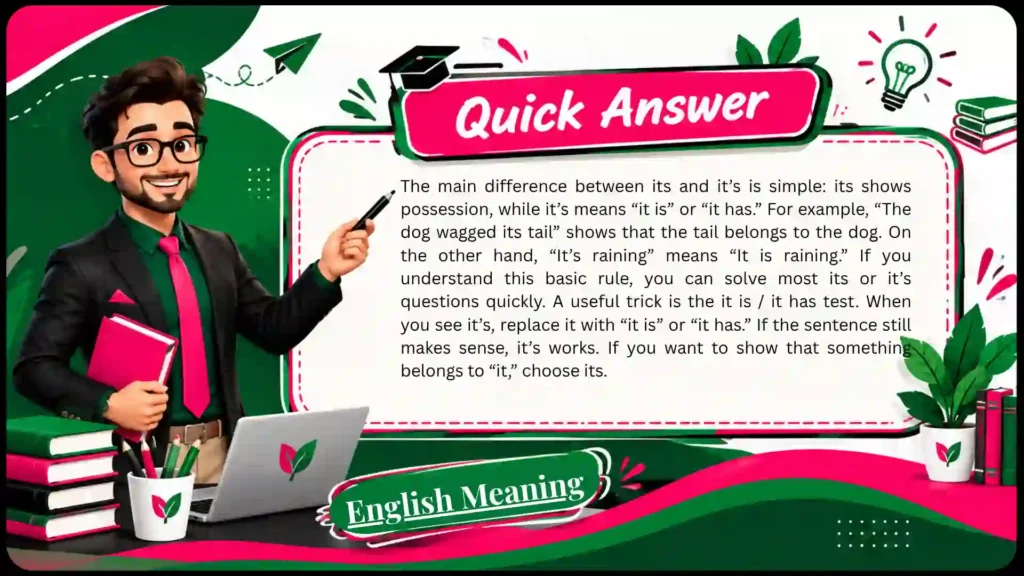
The main difference between its and it’s is simple: its shows possession, while it’s means “it is” or “it has.” For example, “The dog wagged its tail” shows that the tail belongs to the dog. On the other hand, “It’s raining” means “It is raining.” If you understand this basic rule, you can solve most its or it’s questions quickly.
A useful trick is the it is / it has test. When you see it’s, replace it with “it is” or “it has.” If the sentence still makes sense, it’s works. If you want to show that something belongs to “it,” choose its.
TL;DR: Its vs It’s
- 🔑 Its = shows possession or belonging.
- ✏️ It’s = means “it is.”
- ✏️ It’s = can also mean “it has.”
- 🧠 Use the it is / it has test when you are unsure.
- ❌ Its’ is not the standard correct form.
- 📚 Its usually comes before a noun, such as its name or its color.
- ✅ Remember: its = belonging to it; it’s = it is / it has.
You Might Also Like That: ASL Meaning
Its vs It’s at a Glance
| Word | Meaning | Grammar Use | Example |
| Its 🔑 | Belonging to it | Possessive form | The cat cleaned its paws. |
| It’s ✏️ | It is | Contraction | It’s cold today. |
| It’s ✏️ | It has | Contraction | It’s been a long day. |
The key difference between its and it’s comes down to possession and contraction. Its does not use an apostrophe because it already works as a possessive form. It’s needs an apostrophe because it combines two words: “it” and “is” or “it” and “has.” Once you learn this pattern, it’s vs its becomes much easier to recognize in everyday writing.
What Does “Its” Mean?
Its shows that something belongs to, relates to, or connects with something already mentioned. It works as a possessive form and usually comes before a noun. For example, “The company changed its name” tells us that the name belongs to the company. Similarly, “The bird spread its wings” shows possession.
You can use its with many things, including animals, objects, organizations, and ideas. Remember this simple rule: if you mean “belonging to it,” use its. This rule helps you understand the correct use of its without relying on difficult grammar terms.
When to Use “Its”
Use its when you want to show possession 🔑 or a connection between something and another noun. For example, “The phone lost its signal,” “The school updated its website,” and “The tree lost its leaves.” In each sentence, its tells us which thing the noun belongs to or relates to. You can also use its before words such as name, color, shape, purpose, and owner. If you can naturally say “belonging to it,” choose its.
Why “Its” Has No Apostrophe
Many writers ask why its does not have an apostrophe when other possessive words sometimes do. English uses apostrophes differently with possessive nouns and possessive pronouns. For example, we write “Sarah’s book” and “the dog’s collar,” but we write “its tail,” “his phone,” and “her bag.” The word its already serves as the possessive form, so adding an apostrophe creates a different form. Therefore, its is correct for possession, while it’s means “it is” or “it has.”
What Does “It’s” Mean?
It’s is a contraction ✏️, which means it combines two words into a shorter form. It can mean “it is” or “it has.” For example, “It’s cold” means “It is cold,” while “It’s been fun” means “It has been fun.” The apostrophe shows that letters have been removed from the original words.
When you ask, “What does it’s mean?”, always check which expanded form fits the sentence. This simple approach can help you understand the meaning of it’s and avoid confusing it with the possessive word its.
“It’s” Means “It Is”
Use it’s when you can replace it with “it is.” For example, “It’s important to practice” becomes “It is important to practice.” You can also say, “It’s a beautiful day,” which means “It is a beautiful day.” This use appears often in everyday English, conversations, emails, and general writing. When checking it’s vs its, try expanding it’s to “it is.” If the sentence remains natural and correct, you have found the right form.
“It’s” Means “It Has”
It’s can also mean “it has.” You often see this use before a past participle, such as “been,” “changed,” or “started.” For example, “It’s been a busy week” means “It has been a busy week.” Likewise, “It’s changed a lot” means “It has changed a lot.” When deciding its or it’s, remember that the apostrophe can represent the missing letters in either “it is” or “it has.”
When Should You Use “Its” or “It’s”?
Choosing between its or it’s becomes easier when you ask what the sentence means. Use its when you show possession 🔑 or something belonging to “it.” Use it’s when you mean “it is” or “it has.” These two forms may sound identical, but they perform different jobs in a sentence.
A quick way to check your writing is to expand it’s. If “it is” or “it has” fits, keep it’s. If you want to show possession, choose its. This simple rule covers most everyday examples.
Use “Its” for Possession
Use its when something belongs to or relates to another thing. For example, “The dog hurt its leg” tells us that the leg belongs to the dog. “The business changed its logo” shows that the logo belongs to the business. You can remember the rule by thinking its = belonging to it 🔑. If the sentence needs a possessive form before a noun, its will often be the correct choice. Never add an apostrophe just because you want to show possession.
Use “It’s” for “It Is” or “It Has”
Use it’s when you can expand it to “it is” or “it has.” For example, “It’s late” means “It is late,” while “It’s been difficult” means “It has been difficult.” This gives you an easy way to check the correct use of it’s. If neither “it is” nor “it has” works, do not automatically use it’s. Check whether the sentence needs its to show possession.
The “It Is / It Has” Replacement Trick
The replacement test 🧠 gives you a fast way to solve an its vs it’s question. Replace it’s with “it is” or “it has.” If the sentence still makes sense, use it’s. For example, “It’s a useful tool” becomes “It is a useful tool.” If the sentence needs to show possession, use its instead: “The tool lost its handle.” This test works especially well when you are unsure while writing.
Its vs It’s Examples in Sentences
Examples can make the difference between its and it’s much easier to understand. Look at how each word works in context. Its shows possession, while it’s gives a shorter form of “it is” or “it has.” Seeing both forms in real sentences can help you recognize the correct spelling more naturally.
Examples With “Its”
Here are some simple examples of its:
- 🐶 The dog wagged its tail.
- 📱 The phone lost its signal.
- 🏢 The company changed its policy.
- 🌳 The tree lost its leaves.
- 🐦 The bird opened its wings.
In every example, its shows possession or a connection to the noun that follows it.
Examples With “It’s”
Here are examples of it’s:
- ☀️ It’s a beautiful morning.
- 🌧️ It’s raining outside.
- ⏰ It’s time to leave.
- 📚 It’s been a busy week.
- 🔄 It’s changed over time.
In the first three examples, it’s means “it is.” In the last two, it means “it has.”
Examples Showing Both Words
Sometimes you need its and it’s in the same sentence. For example, “The company announced its new product, and it’s already popular.” Here, its shows that the product belongs to the company, while it’s means “it is.” Another example is, “The dog knows it’s time for its walk.” The first it’s means “it is,” while its shows possession. These examples make the difference easier to see in natural English.
Common Its vs It’s Mistakes
Writers often confuse these words because they sound the same. The most common mistake happens when someone uses it’s to show possession. Remember that the apostrophe does not automatically make a word possessive. In this case, it’s creates a contraction, while its shows possession.
| ❌ Incorrect | ✅ Correct | Why? |
| The dog wagged it’s tail. | The dog wagged its tail. | Shows possession |
| Its going to rain. | It’s going to rain. | Means “it is” |
| The company changed it’s name. | The company changed its name. | Shows possession |
Is “Its’” Correct?
Its’ ❌ is not the standard possessive form of it. Writers sometimes add an apostrophe because they know that English often uses apostrophes to show possession. However, its already serves as the possessive form, so it does not need an apostrophe.
Remember the three forms:
- Its 🔑 = belonging to it
- It’s ✏️ = it is / it has
- Its’ ❌ = incorrect standard form
If you see its’ in your writing, check the sentence again. You probably need either its or it’s, depending on the meaning.
Can “Its” Be Used Without a Noun After It?
Its usually appears before a noun, as in “The dog hurt its leg” or “The company changed its policy.” Unlike words such as hers or theirs, English does not normally use its as a standalone possessive pronoun in the same way. This small detail can help you understand how its works in a sentence.
For everyday writing, focus on the simple pattern: its + noun when you want to show possession. This makes the word easier to use correctly without learning complicated grammar rules.
Why Do “Its” and “It’s” Sound the Same?
The words its and it’s usually have the same pronunciation in standard English. This similarity explains why people often confuse them when writing. When you speak, you cannot normally hear the apostrophe, so the difference only becomes clear from the sentence and its meaning.
Think about the written form rather than the sound. If the sentence means “it is” or “it has,” use it’s. If the sentence shows that something belongs to or relates to “it,” use its. The pronunciation cannot tell you which spelling to choose.
Its vs It’s in Formal and Informal Writing
Both its and it’s can appear in correct English. The main difference does not depend on whether your writing is formal or informal. Its remains the possessive form, while it’s remains a contraction of “it is” or “it has.”
However, some formal or academic writing may prefer fewer contractions. In those situations, writers may choose “it is” instead of “it’s.” For example, “It is important to understand the rule” sounds more formal than “It’s important to understand the rule.” This choice relates to style, not grammar.
A Simple Memory Trick for Its vs It’s
A simple memory trick 🧠 can help you remember the difference:
IT’S = IT IS or IT HAS
ITS = BELONGING TO IT
Think of the apostrophe in it’s as a signal that two words have joined together. When you can expand the word to “it is” or “it has,” choose it’s. When you show possession, choose its. For example, “The cat cleaned its paws” shows possession, while “It’s time to eat” means “It is time to eat.”
Its vs It’s: Quick Practice
Try these sentences before checking the answers:
- The cat cleaned ___ paws.
- ___ been a long day.
- The company changed ___ name.
- ___ time to leave.
- The phone lost ___ connection.
- ___ a useful example.
Answers:
- its 🔑
- it’s ✏️
- its 🔑
- it’s ✏️
- its 🔑
- it’s ✏️
Use the “it is / it has” test whenever you feel unsure. With regular practice, the difference will become much easier to recognize.
Its vs It’s FAQs
Is “its” or “it’s” possessive?
Its is the possessive form. It shows that something belongs to or relates to “it.” For example, “The dog wagged its tail.” It’s does not show possession; it means “it is” or “it has.”
Can “it’s” mean “it has”?
Yes. It’s can mean “it has.” For example, “It’s been a busy day” means “It has been a busy day.”
Why doesn’t “its” have an apostrophe?
Its already works as the possessive form, so it does not need an apostrophe. The apostrophe in it’s marks the contraction of “it is” or “it has.”
Is “its’” a correct word?
No. Its’ is not the standard possessive form of “it.” Use its for possession and it’s for “it is” or “it has.”
How can I remember its vs it’s?
Use this simple rule: its = belonging to it 🔑, while it’s = it is / it has ✏️. You can also expand “it’s” to check whether it fits.
What is the difference between its and it’s?
Its shows possession, while it’s is a contraction meaning “it is” or “it has.” Their pronunciation may sound the same, but their grammar and meaning differ.
Final Thought
The difference between its and it’s may look small, but the correct choice can make your writing much clearer. Remember the two main rules: its 🔑 means belonging to it, while it’s ✏️ means “it is” or “it has.” When you are unsure, use the replacement test and expand it’s to “it is” or “it has.” If that does not work and you need to show possession, choose its. With these simple rules and a little practice, you can avoid one of the most common English grammar mistakes.