
To and too sound the same, but they do not have the same meaning or use. This simple difference can confuse English learners and even native speakers when writing quickly. If you have ever wondered whether to write “to much” or “too much,” or “I want to go too” or “I want to go to,” you are not alone. Understanding the difference between to vs too becomes much easier when you focus on the meaning and role of each word.
In this guide, we will explain the difference between to and too in simple language, with clear examples you can use in everyday English. We will also briefly cover to, too, and two, common mistakes, and easy ways to remember which word belongs in a sentence.
Quick Answer: To vs Too
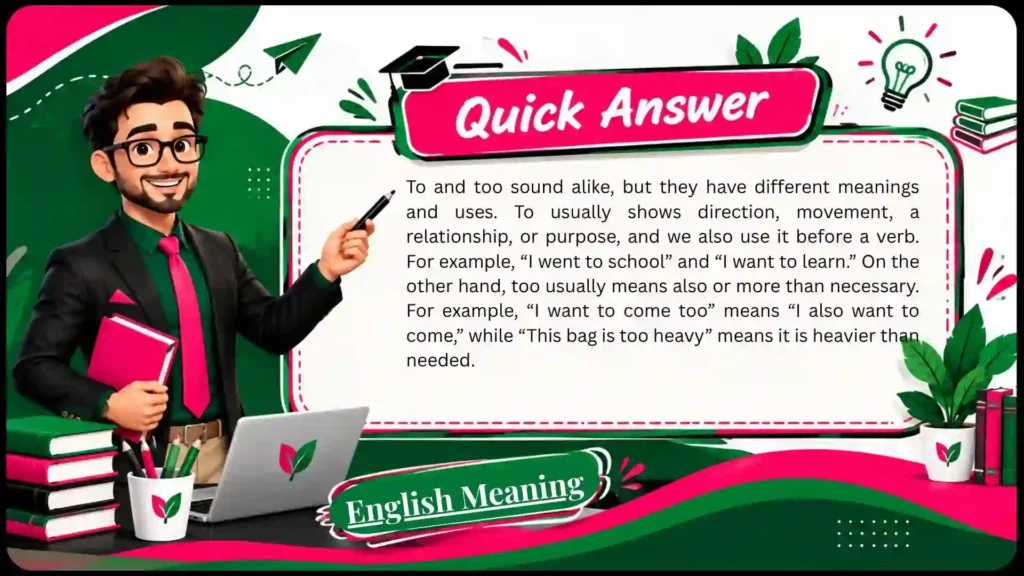
To and too sound alike, but they have different meanings and uses. To usually shows direction, movement, a relationship, or purpose, and we also use it before a verb. For example, “I went to school” and “I want to learn.” On the other hand, too usually means also or more than necessary. For example, “I want to come too” means “I also want to come,” while “This bag is too heavy” means it is heavier than needed.
The easiest way to remember the difference between to and too is to focus on meaning. If you talk about going, doing, or connecting something, you probably need to. If you mean also or excessively, choose too. There is also two, which sounds the same but means the number 2. 🔑
TL;DR: To vs Too vs Two
Here is the quickest way to understand to, too, and two:
| Word | Main Meaning | Example |
| 🔵 To | Direction, purpose, or before a verb | I want to study. |
| 🟢 Too | Also or more than needed | I want to study too. |
| 🟡 Two | The number 2 | I have two books. |
Remember this simple rule: To = action or direction, Too = extra or also, and Two = number 2. These words are homophones, which means they sound alike but have different meanings and spellings. Learning this small difference can help you avoid many common English grammar and spelling mistakes. ✨
You Might Also Like That: What is a Preposition
What Does “To” Mean?
The word to has several common uses in English. It often works as a preposition when it shows direction, movement, destination, or a connection between people or things. For example, “She walked to school” shows movement toward a place. Similarly, “Give the book to Ali” shows who receives something. These uses make to one of the most common words in English.
We also use to before the base form of a verb. This use creates an infinitive, such as “to eat,” “to sleep,” “to learn,” or “to work.” For example, “I want to learn English.” Here, to does not mean direction. Instead, it connects with the verb learn. Understanding these two main uses makes to much easier to recognize. 📘
How to Use “To” Correctly
Use to when you describe movement toward a person, place, or thing. You can also use it when you show a destination, purpose, or action. For example, “We went to the market,” “Send this to your friend,” and “I went there to study.” You should also use to before many base verbs, as in “I need to sleep” or “They plan to travel.”
Common expressions also help you recognize to quickly. These include want to, need to, have to, going to, try to, plan to, and used to. For example, “I want to improve my writing.” Remember that too cannot replace to in these expressions. ❌ “I want too learn” is incorrect; ✅ “I want to learn” is correct. 📝
What Does “Too” Mean?
The word too commonly has two main meanings. First, it can mean also or as well. For example, “I like coffee too” means “I also like coffee.” This use often appears at the end of a sentence. You may hear it often in everyday conversations, texting, and casual writing. “Me too” is another simple example.
The second meaning of too shows something that goes beyond a suitable or wanted level. In this use, too can mean excessively or “more than necessary.” For example, “The soup is too hot” means the soup has more heat than you want. Similarly, “This box is too heavy” means its weight creates a problem. 🔥
How to Use “Too” Correctly
Use too when you mean also or as well. For example, “She wants to come too” means she also wants to come. Use too when something has more of a quality than is suitable, such as “The shirt is too expensive” or “The water is too cold.” Context tells you which meaning too has.
A useful test can make this easier. When too means “also,” try replacing it with also. “I want to go too” becomes “I also want to go.” When too shows excess, you can often connect it with the idea of more than needed. This simple check can help you choose too correctly. ✅
You Might Also Like That: What Does SMH Mean in Text
To vs Too: What Is the Difference?
The main difference between to and too comes down to meaning and grammatical use. To commonly shows direction, connection, purpose, or comes before a verb. Too means also or more than necessary. Although both words sound the same, they perform different jobs in a sentence.
Compare these examples: “I want to go” and “I want to go too.” In the first sentence, to comes before the verb go. In the second sentence, too means also. Another example is “I went to the store” versus “The store is too crowded.” Looking at the meaning helps you select the correct word. 🎯
How to Quickly Choose Between “To” and “Too”
You can use a simple decision rule whenever you are unsure about to or too. First, ask what the word means in the sentence. If it shows direction, movement, purpose, or comes before a verb, choose to. If it means also, choose too. If it means something is more than necessary, choose too.
- ➡️ Direction or destination → TO
- ✍️ Before a verb → TO
- ➕ Means “also” → TOO
- ⚠️ Means “more than needed” → TOO
- 🔢 Means the number 2 → TWO
This quick method can help you make the right choice without memorizing complicated grammar rules.
Why Do “To” and “Too” Sound the Same?
To and too are homophones. Homophones are words that have the same or very similar pronunciation but different meanings and spellings. This explains why people often confuse them when writing. Hearing the word alone may not tell you which spelling you need. You must understand the sentence and its meaning.
The same problem occurs with two. The words to, too, and two sound alike in standard English, but they have completely different meanings. To relates to direction or verbs, too means also or excessive, and two represents the number 2. 🗣️ Checking the meaning before writing can prevent these common spelling mistakes.
To vs Too vs Two
The difference between to, too, and two becomes simple when you give each word a clear job. To can show direction or come before a verb. Too can mean also or more than necessary. Two simply refers to the number 2. These words share pronunciation, but their spelling and meaning separate them.
| Word | Use | Example |
| 🔵 To | Direction/action | We went to work. |
| 🟢 Too | Also/excess | She came too. |
| 🟡 Two | Number | I bought two pens. |
When you understand the meaning, the spelling becomes much easier to remember. ⭐
You Might Also Like That: Effect vs Affect
Common Mistakes With To and Too
Many to vs too mistakes happen because both words sound identical. Writers may type “to much” instead of “too much” or “I want too go” instead of “I want to go.” The easiest fix involves checking what role the word plays. Before a verb, you will often need to. When the word means “also” or shows excess, you usually need too.
| ❌ Incorrect | ✅ Correct | Why? |
| to much | too much | Shows excess |
| to late | too late | Shows excess |
| to bad | too bad | Shows excess |
| too go | to go | Comes before a verb |
| used too | used to | Fixed expression |
| come to | come too | Means also |
These small corrections can make your everyday writing much clearer. ✍️
Common Phrases That Use “To” or “Too”
Learning common phrases gives you a practical way to recognize the correct spelling. Expressions such as want to, need to, have to, going to, try to, and plan to normally use to because the word connects with an action or verb. For example, “I need to leave” and “They plan to travel.”
Other common phrases use too because they express addition or excess. Examples include too much, too many, too late, too early, too fast, too expensive, me too, and you too. For example, “This costs too much” shows excess, while “I like it too” means “I also like it.” 🔑
Can “Too” Mean “Also”?
Yes. Too can mean also or as well, and this is one of its most common uses. For example, “I want to visit Pakistan too” means “I also want to visit Pakistan.” You can often replace too with also and keep the main meaning of the sentence.
In everyday English, people often place too at the end of a sentence when it means “also.” Examples include “I like this song too,” “She wants to join too,” and “Me too!” This makes too very common in conversations, messages, and social media. Remember: if you can naturally use also, too may be the correct choice. 💬
Can You Use a Comma Before “Too”?
You may see a comma before too, especially when too means also at the end of a sentence. For example, “I want to come, too.” However, you will also see “I want to come too” without a comma. In many everyday sentences, both styles appear in English writing.
The choice can depend on style, emphasis, and sentence structure. For simple writing, you do not need to worry too much about the comma. Focus first on choosing the correct word. The important point is that too still means “also” in both examples. 📌
You Might Also Like That: Effect vs Affect
Easy Memory Trick for To, Too, and Two
A simple memory trick can help you remember these three confusing words. Think of to as the word connected with action or direction: “I want to learn” or “I went to school.” For too, remember the extra O as something extra. “Too much” means more than needed, while “me too” means an additional person agrees.
For two, think about the number 2. 🔢 So remember this quick formula: TO = action/direction, TOO = extra/also, and TWO = number 2. Once you connect each spelling with its meaning, you will find these words much easier to use correctly.
To vs Too Practice Quiz
Now test your understanding. Choose to, too, or two for each sentence:
- I want ___ learn English.
- She wants ___ come with us.
- I have ___ brothers.
- This bag is ___ heavy.
- Can you give this ___ Ali?
- I would like some ___.
- We need ___ leave early.
- I want ___ join the class.
Answers: 1. to | 2. to | 3. two | 4. too | 5. to | 6. too | 7. to | 8. to
The key is to check the meaning, not just the sound. If you practice this difference regularly, choosing the correct word will become much more natural. 🧠
Frequently Asked Questions About To vs Too
What is the difference between to and too?
To usually shows direction, purpose, or comes before a verb. Too means also or more than necessary.
Is it “too much” or “to much”?
The correct phrase is too much when you mean more than necessary. For example, “There is too much sugar.”
Is it “too late” or “to late”?
The correct phrase is too late. Here, too means something has gone beyond the suitable time.
Is it “used to” or “used too”?
The correct phrase is used to. For example, “I am used to waking up early.”
What is the difference between to, too, and two?
To shows direction or comes before a verb, too means also or excessive, and two means the number 2.
Quick Reference: To vs Too vs Two
Use this cheat sheet whenever you feel unsure:
| 🔤 Word | 💡 Remember It As | ✍️ Example |
| TO | Action, direction, purpose | I want to read. |
| TOO | Also or extra | I want to read too. |
| TWO | Number 2 | I have two books. |
The best way to avoid mistakes is to focus on meaning instead of sound. If the sentence talks about movement, direction, purpose, or an action after the word, choose to. If it means also or more than necessary, choose too. If you are counting, choose two. ⭐
Final Thought
Understanding to vs too does not require complicated grammar rules. You only need to remember what each word does. To commonly connects with direction, purpose, or an action. Too means also or more than necessary. Two represents the number 2. Once you learn these basic differences, you can avoid many common English mistakes.
The easiest final reminder is: TO = action or direction ➡️, TOO = extra or also ➕, and TWO = number 2 🔢. Keep these three meanings in mind, practice them in real sentences, and choosing the correct spelling will become much easier and more natural.