
Have you ever wondered whether to write practise or practice? These two spellings often confuse students, English learners, and writers because they have the same meaning but follow different spelling rules. The correct choice depends on whether you use British English or American English. In British English, practice is a noun, while practise is a verb. However, American English uses practice for both nouns and verbs. Understanding this simple rule can help you avoid spelling mistakes and improve your writing. In this guide, you’ll learn the difference between practise vs practice, with clear examples and useful tips.
Quick Answer: Practise vs Practice
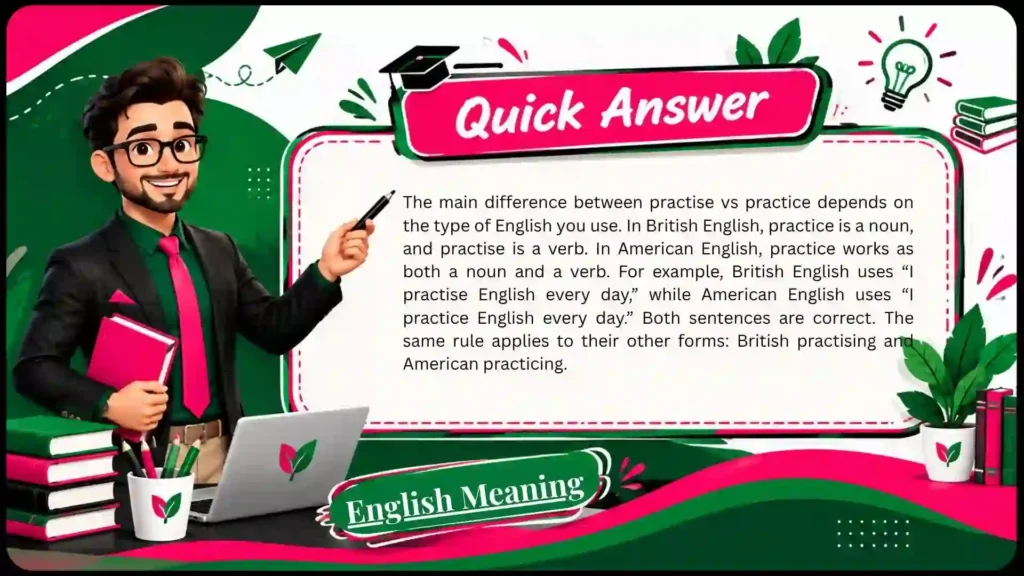
The main difference between practise vs practice depends on the type of English you use. In British English, practice is a noun, and practise is a verb. In American English, practice works as both a noun and a verb.
For example, British English uses “I practise English every day,” while American English uses “I practice English every day.” Both sentences are correct. The same rule applies to their other forms: British practising and American practicing.
TL;DR: Practise vs Practice
- 🇬🇧 British English: Use practice as a noun and practise as a verb.
- 🇺🇸 American English: Use practice for both the noun and the verb.
- Practising: The British English spelling of the -ing form.
- Practicing: The American English spelling of the -ing form.
- Practised: The usual British English past-tense form.
- Practiced: The American English past-tense form.
Remember to use the spelling style that matches your audience and keep it consistent throughout your writing.
You Might Also Like That: Simple Present Tense
What Is the Difference Between Practice and Practise?
The main difference between practice and practise is their grammatical use in British English. Practice is a noun, which names an activity, while practise is a verb, which describes doing something repeatedly to improve a skill. In American English, however, practice is used for both purposes.
For example, “Daily practice helps me improve” uses practice as a noun. On the other hand, “I practise English daily” uses practise as a verb in British English. American writers would use practice in both sentences. The meaning stays the same, even though the spelling changes.
Practice vs Practise in British and American English
British and American English follow different spelling rules for this word. Knowing which version you are writing in will help you choose the correct spelling. Neither spelling is wrong when used according to the appropriate English variety.
| Word form | British English | American English |
| Noun | Practice | Practice |
| Verb | Practise | Practice |
| Third-person singular | Practises | Practices |
| -ing form | Practising | Practicing |
| Past tense | Practised | Practiced |
For example, a British student might write, “She practises spelling every evening.” An American student would write, “She practices spelling every evening.” Both sentences are correct in their respective spelling systems.
Practice as a Noun vs Practise as a Verb
Understanding the difference between a noun and a verb makes this spelling rule much easier. A noun names a person, place, thing, or activity. A verb describes an action or state. In British English, practice is the noun, while practise is the verb. American English uses practice for both.
Practice as a Noun
Use practice when talking about an activity, training session, or experience gained by repeating something.
Examples:
- Regular practice helps you become a better writer.
- Our football practice starts at 4 p.m.
- She needs more practice before the exam.
Practise as a Verb
In British English, use practise when describing the action of repeating something to improve a skill. American English uses practice in the same situations.
Examples:
- I practise English every morning.
- He practises the piano after school.
- They practise their presentation before the meeting.
Practising or Practicing: Which Spelling Is Correct?
Both practising and practicing are correct spellings. The difference depends on whether you use British or American English. British English uses practising, while American English uses practicing. Both forms describe the action of practising or practicing something at that moment.
Examples:
- British English: “I am practising for my driving test.”
- American English: “I am practicing for my driving test.”
- British English: “She is practising the piano.”
- American English: “She is practicing the piano.”
The meaning does not change. Choose the spelling that matches your intended audience, and use it consistently throughout your article, schoolwork, or other writing.
Practise vs Practice: Which One Should You Use?
The correct spelling depends on two things: the type of English you use and how the word functions in your sentence. If you are writing in British English, use practice for a noun and practise for a verb. If you are writing in American English, use practice for both.
For example, “I need more practice” is correct in both varieties because practice is a noun. However, the verb differs: British English uses “I practise every day,” while American English uses “I practice every day.”
Use this quick guide:
- Writing for a British audience? Use practise as a verb.
- Writing for an American audience? Use practice as a verb.
- Talking about an activity or training session? Use the noun practice in both varieties.
Practice vs Practise Example Sentences
Examples make it easier to understand when to use each spelling. The following sentences show how British and American English express the same ideas with different verb spellings.
| British English | American English |
| I practise English every day. | I practice English every day. |
| She practises the piano. | She practices the piano. |
| We are practising for the match. | We are practicing for the match. |
| He practised his speech yesterday. | He practiced his speech yesterday. |
Notice that the spelling of the noun practice stays the same in both varieties. Only the verb forms change. These examples can help you recognize the correct spelling when writing about school, sports, music, or everyday activities.
Practiced vs Practised: What About the Past Tense?
The same spelling rule applies to the past tense of the verb. Practised is the usual British English spelling, while practiced is the American English spelling. Both describe an action that happened in the past.
Examples:
- British English: “I practised my speech yesterday.”
- American English: “I practiced my speech yesterday.”
- British English: “She practised the piano last night.”
- American English: “She practiced the piano last night.”
Remember that practice remains the noun in both varieties. For example, “The team had football practice yesterday” is correct in both British and American English.
Common Mistakes to Avoid
Writers sometimes mix British and American spelling because the words look and sound similar. However, following a few simple rules can help you avoid common mistakes.
- ❌ Using practise as a noun in standard British English.
- ❌ Using practise instead of practice when following standard American spelling.
- ❌ Mixing practising and practicing in the same article without a clear reason.
- ❌ Assuming that one spelling is always correct everywhere.
Instead, identify your audience first. Use British spelling for British English content and American spelling for American English content. Consistency is the key to clear and professional writing.
How to Remember Practice vs Practise
A simple memory trick can help you remember the difference between practice vs practise. In British English, the noun ends in c, while the verb ends in s. Think of practice as the activity and practise as doing that activity.
For American English, the rule is even simpler: use practice for both the noun and the verb.
Remember these examples:
- Noun: “I need more practice.”
- British verb: “I practise every day.”
- American verb: “I practice every day.”
This small trick can help you choose the correct spelling whenever you write.
FAQs About Practise vs Practice
1. Is practice always spelled with a c?
Yes, when used as a noun, practice is spelled with a c in both British and American English. However, British English uses practise with an s when it is a verb.
2. Is practising British or American English?
Practising is the standard British English spelling. American English uses practicing. Both forms have the same meaning.
3. Is practicing ever correct in British English?
In standard British English, practising is the usual verb form. Practicing is the standard American spelling. Follow the spelling guide required by your school, employer, or publication.
4. Is practise correct in American English?
In standard American English, practice is used as both a noun and a verb. Therefore, practise is not the usual American spelling.
5. What is the difference between practice and practise?
In British English, practice is a noun, and practise is a verb. In American English, practice is used for both.
6. Is it practiced or practised?
Both spellings are correct. Practised is the usual British English form, while practiced is the standard American English form.
Final Thoughts
Understanding practise vs practice is easy once you know the difference between British and American English. British English uses practice as a noun and practise as a verb, while American English uses practice for both. The same distinction applies to practising and practicing, as well as practised and practiced.
When writing, choose the spelling that suits your audience and keep it consistent. With this simple rule and the examples in this guide, you can use these words correctly in schoolwork, articles, emails, and everyday writing.