
There, their, and they’re often confuse English learners and writers because they sound alike but have different meanings and uses. If you have ever wondered about the difference between there vs their vs they’re, you are not alone. These three words are homophones, but each one plays a different role in a sentence. There usually points to a place or shows that something exists, their shows possession, and they’re is the short form of “they are.”
Learning when to use there, their, and they’re can make your writing clearer and help you avoid common grammar mistakes. In this guide, you’ll learn the meaning, usage, differences, and examples of each word. You’ll also find simple rules, easy memory tricks, and practical examples that show how to tell the difference between there, their, and they’re in everyday writing.
Quick Answer: There vs Their vs They’re
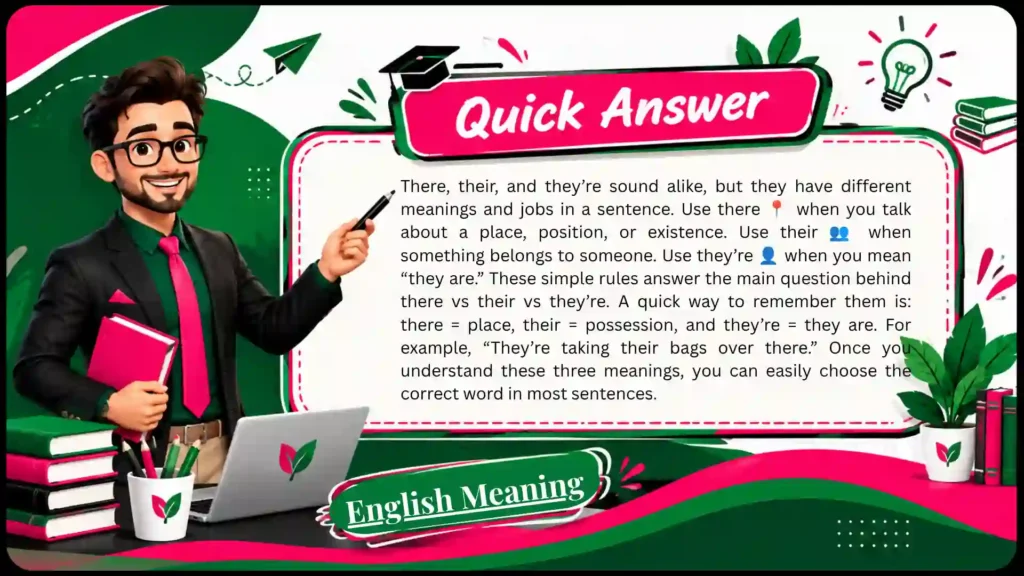
There, their, and they’re sound alike, but they have different meanings and jobs in a sentence. Use there 📍 when you talk about a place, position, or existence. Use their 👥 when something belongs to someone. Use they’re 👤 when you mean “they are.” These simple rules answer the main question behind there vs their vs they’re.
A quick way to remember them is: there = place, their = possession, and they’re = they are. For example, “They’re taking their bags over there.” Once you understand these three meanings, you can easily choose the correct word in most sentences.
TL;DR: There, Their, and They’re
- 📍 There = a place, position, or existence
- 👥 Their = something that belongs to them
- 👤 They’re = short for “they are”
- 🔤 All three words sound alike but have different meanings.
- ✅ Replace they’re with they are to check if it works.
- 🧠 Connect there with here to remember that both can describe a place.
- ✍️ Use their when you can ask, “Does this belong to them?”
- ⭐ Always check the meaning of the sentence, not just how the word sounds.
You Might Also Like That: What Does TLDR Mean
What Is the Difference Between There, Their, and They’re?
The main difference between there, their, and they’re comes from their meaning and grammatical function. There can point to a location or introduce something that exists. Their shows possession or association, while they’re works as a contraction of they are. These words are often called homophones because they sound alike even though their spelling and meaning differ.
Writers often confuse these words because pronunciation does not help much. Instead, look at the sentence around the word. Ask whether you mean a place 📍, ownership 👥, or “they are” 👤. This simple check can help you avoid many common grammar mistakes.
What Does “There” Mean?
There usually refers to a place or position. For example, in “Your shoes are over there,” the word points to a location. However, there can also introduce the existence of something, as in “There is a problem.” This makes there more than just a word for a physical place.
You can often connect there with here to remember its use. Both words can describe location. You can also see there in common structures such as there is and there are. Understanding these uses will help you choose there correctly when writing or speaking.
How to Use “There” in a Sentence
Use there when you point to a place 📍, position, or something that exists. For example, “The keys are over there” shows location, while “There is a new store nearby” shows existence. You can also use it with plural nouns: “There are three books on the desk.” A useful tip is to check whether the sentence talks about where something is or whether something exists. If it does, there may be the correct choice. Do not use their simply because the two words sound the same.
What Does “Their” Mean?
Their shows possession or association. It tells readers that something belongs to, relates to, or connects with someone. For example, “The students finished their homework” means the homework belongs to the students. This makes their a common possessive determiner in English.
You can usually place their before a noun, such as their house, their car, or their ideas. Modern English also uses their with singular they, especially when the person’s gender remains unknown or when the person uses they/them pronouns. This makes their useful in both everyday and formal writing.
How to Use “Their” in a Sentence
Use their when something belongs to or relates to them 👥. For example, “They forgot their keys” shows that the keys belong to them. You can also write, “The company changed their policy” when referring to the company in a suitable context. A simple question can help: “Does this thing belong to them?” If the answer is yes, their may be correct. Remember that their normally comes before a noun, such as their book, their teacher, or their home.
What Does “They’re” Mean?
They’re is a contraction of “they are.” The apostrophe replaces letters from the two original words. For example, “They’re happy” means “They are happy.” You can use they’re when the full phrase they are fits naturally into the sentence.
Because they’re sounds exactly like there and their, writers often choose the wrong form. The easiest solution involves checking the full sentence. Do not focus only on pronunciation. Instead, try replacing they’re with they are. If the sentence still makes sense, you have probably chosen the correct word.
The “They Are” Test for “They’re”
The “they are” test provides one of the easiest ways to identify they’re. Simply replace they’re with they are. For example, “They’re coming later” becomes “They are coming later,” and the sentence still works. That means they’re is correct. You can use the same test with questions such as “I think they’re ready” → “I think they are ready.” If the expanded version sounds correct, use they’re. If it does not, check whether there or their fits the meaning.
There vs Their vs They’re Comparison Table
| Word | Meaning | Grammar | Easy Test | Example |
| There 📍 | Place, position, or existence | Adverb/pronoun | Think about a place | Put the bag over there |
| Their 👥 | Possession or association | Possessive determiner | Ask if it belongs to them | Their house is large |
| They’re 👤 | They are | Contraction | Replace with “they are” | They’re ready |
This table gives you a quick way to compare the three words. When you see there, think about location or existence. When you see their, think about ownership or association. When you see they’re, expand it to they are. These simple tests cover most everyday uses and make the difference between there, their, and they’re easier to remember.
There vs Their
The difference between there and their becomes clear when you focus on meaning. There 📍 normally refers to a place, position, or existence, while their 👥 shows that something belongs to or relates to people. Compare “The books are over there” with “The students brought their books.” The first sentence talks about a location, while the second shows possession.
A common mistake happens when writers choose their simply because it sounds like there. Always check the meaning first. If the word answers a location idea such as “where?”, choose there. If it answers “whose?”, choose their.
Their vs They’re
The difference between their and they’re depends on possession and meaning. Their 👥 shows that something belongs to or relates to them, while they’re 👤 means they are. For example, “Their dog is friendly” shows possession. In “They’re walking the dog,” the word means “they are.”
Try two quick questions when you feel unsure. First, does the sentence show ownership or association? If yes, choose their. Second, can you replace the word with they are? If yes, choose they’re. This simple comparison can prevent many common writing errors.
There vs They’re
The difference between there and they’re becomes easier when you check whether the sentence describes a place or means they are. For example, “The children are over there” points to a location. However, “They’re waiting outside” means “They are waiting outside.” The two words sound alike, but their functions differ.
When you see there, look for an idea about location or existence. When you see they’re, try the they are test. For example, “They’re ready” becomes “They are ready,” so the contraction works. This quick check helps you choose correctly.
How to Know Which One to Use
You can choose between there, their, and they’re by asking three simple questions:
- 📍 Is it about a place or existence? → Use there.
- 👥 Does something belong to them? → Use their.
- 👤 Can you replace it with “they are”? → Use they’re.
For example, “They’re putting their bags over there.” Here, they’re means “they are,” their shows possession, and there identifies a place. These quick tests work well in school assignments, emails, social media posts, and everyday writing.
Common Mistakes With There, Their, and They’re
Writers often make there their they’re mistakes because the three words sound alike. The most common errors involve using a possessive word for a location or using a contraction before a noun. For example:
- ❌ Their going home. → ✅ They’re going home.
- ❌ Put it over their. → ✅ Put it over there.
- ❌ They’re house is new. → ✅ Their house is new.
Remember that all three words are correctly spelled. The problem usually involves choosing the wrong word for the meaning, not spelling the word incorrectly. Always check the sentence before choosing.
Easy Tricks to Remember There, Their, and They’re
Simple memory tricks can make these commonly confused words easier to remember. For there 📍, think about here because both words can describe a place. For their 👥, think about belonging to them. For they’re 👤, remember that the apostrophe joins the words they and are.
You do not need to memorize a complicated grammar rule. Just connect each spelling with one clear idea: there = place, their = possession, and they’re = they are. When you practice these three connections, you will recognize the correct form more quickly.
Remember “There” With “Here”
A useful trick for remembering there is to connect it with here. Both words can describe location 📍. For example, “Your phone is here” and “Your phone is there” both tell us where the phone is. If you are talking about a place or position, there may be the right choice. This trick can help separate there from their, which shows possession. When you see there, ask yourself, “Am I talking about where something is?” If the answer is yes, there usually fits.
Remember “Their” as Possession
To remember their, connect it with possession 👥. When something belongs to or relates to people, use their. For example, “They brought their lunch” tells us that the lunch belongs to them. You can ask the question “Whose?” If the answer is “theirs” or “belonging to them,” their may be the correct form. This trick also helps you avoid confusing their with there. Think of their whenever the sentence focuses on ownership, relationships, or something associated with a person or group.
Remember “They’re” as “They Are”
The easiest way to remember they’re is to connect it directly with “they are.” The apostrophe shows that the word combines the two words. For example, “They’re happy” means “They are happy.” Whenever you feel unsure, expand they’re back into they are. If the sentence still makes sense, you have found the correct form. This method works in many situations and gives you a reliable way to check your writing without memorizing a long grammar rule.
There, Their, and They’re in Real-Life Sentences
You can find there, their, and they’re in everyday conversations, schoolwork, emails, and online messages. For example, “They’re meeting their friends over there.” In this sentence, they’re means “they are,” their shows a relationship, and there points to a place. Seeing the three forms together can make their differences easier to understand.
Try noticing these words when you read messages or articles. Ask what each word means in its sentence. This small habit can improve your grammar naturally because you learn from real examples instead of memorizing rules alone.
There, Their, or They’re? Practice Quiz
Choose there, their, or they’re to complete each sentence:
- ___ going to the park later.
- The children left ___ shoes outside.
- Put the boxes over ___.
- ___ is a new restaurant nearby.
- I think ___ ready to leave.
- The students finished ___ project.
- Your keys are right over ___.
- ___ planning a trip next month.
Answers:
- They’re
- their
- there
- There
- they’re
- their
- there
- They’re
The best way to improve is to explain why each answer works. Use the they are test for they’re, the possession test for their, and the place/existence test for there.
Quick Tips to Avoid These Grammar Mistakes
You can avoid most there their they’re mistakes by slowing down for a few seconds before you choose a word. Do not rely only on how the word sounds because all three forms sound alike.
- 📍 Use there for a place or existence.
- 👥 Use their for possession or association.
- 👤 Use they’re for they are.
- 🔎 Check the meaning of the whole sentence.
- ✍️ Replace they’re with they are when unsure.
- ❓ Ask “Whose?” when checking their.
- 📍 Ask “Where?” when checking there.
These simple habits can make your writing much more accurate.
Frequently Asked Questions
What is the difference between there, their, and they’re?
There refers to a place, position, or existence. Their shows possession or association, while they’re means they are. For example, “They’re carrying their bags over there.” Each word has a different job even though all three sound alike. If you remember there = place, their = possession, and they’re = they are, you can solve most common usage questions quickly.
Is “they’re” the same as “they are”?
Yes. They’re is the contraction of they are. The apostrophe replaces letters from the original phrase. For example, “They’re happy” means “They are happy.” You can usually check they’re by replacing it with they are. If the sentence still makes sense, the contraction works. This test provides a simple way to avoid confusing they’re with there or their.
How do I know when to use “their”?
Use their when you show possession or association. For example, “The students brought their books” means the books belong to the students. You can ask “Whose?” to check the word. If the answer means “belonging to them,” use their. Remember that their commonly appears before a noun, such as their car, their home, or their ideas.
Can “there” mean more than a place?
Yes. There can identify a location, but it can also introduce the existence of something. For example, “The bag is over there” uses there for a place. In “There is a problem,” it introduces something that exists. You will often see this second use in phrases such as there is and there are. So, there does not always point to a physical location.
Can “their” refer to one person?
Yes. English can use their with singular they. For example, “Someone left their phone on the table.” Here, their refers to one person whose identity or gender the sentence does not specify. This use appears frequently in modern English. The important point remains the same: their shows possession or association. It can refer to one person or multiple people depending on the context.
What is an easy way to remember there, their, and they’re?
Use three simple connections: there 📍 = place, their 👥 = possession, and they’re 👤 = they are. You can also remember there through here, since both relate to location. For they’re, use the “they are” test. For their, ask “Does it belong to them?” These quick checks make the three words easier to use correctly.
Which is correct: “there” or “their”?
Both there and their are correct words, but they work in different situations. Use there for a place, position, or existence, such as “The store is over there.” Use their for possession, such as “That is their store.” The correct choice depends on what you want the sentence to mean. Always check the context rather than choosing based on pronunciation.
Final Thoughts
Understanding there vs their vs they’re does not require a difficult grammar lesson. You only need to remember three useful ideas: there 📍 refers to a place or existence, their 👥 shows possession or association, and they’re 👤 means they are. These rules work across everyday conversations, school assignments, professional writing, and online communication.
When you are unsure, stop and use the three quick tests. Ask whether you mean a place, whether something belongs to them, or whether “they are” fits the sentence. With regular practice, you can use there, their, and they’re naturally and avoid these common English grammar mistakes.