
Lose vs loose is a common English grammar mix-up because these words look and sound similar, but they have different meanings and uses. Lose usually works as a verb and can mean to misplace something, fail to win, or no longer have something. Loose, on the other hand, usually works as an adjective and describes something that is not tight, fixed, or secure. Knowing this basic difference can help you choose the correct word in everyday writing and conversation.
The confusion does not stop with lose and loose. Many people also wonder whether loosing or losing is correct, or whether they should write lose or loose in a particular sentence. In this guide, you will learn the difference between lose and loose, their meanings, pronunciation, common uses, and simple examples. You will also learn how to avoid common spelling mistakes and remember when to use each word.
Lose vs Loose: Quick Answer
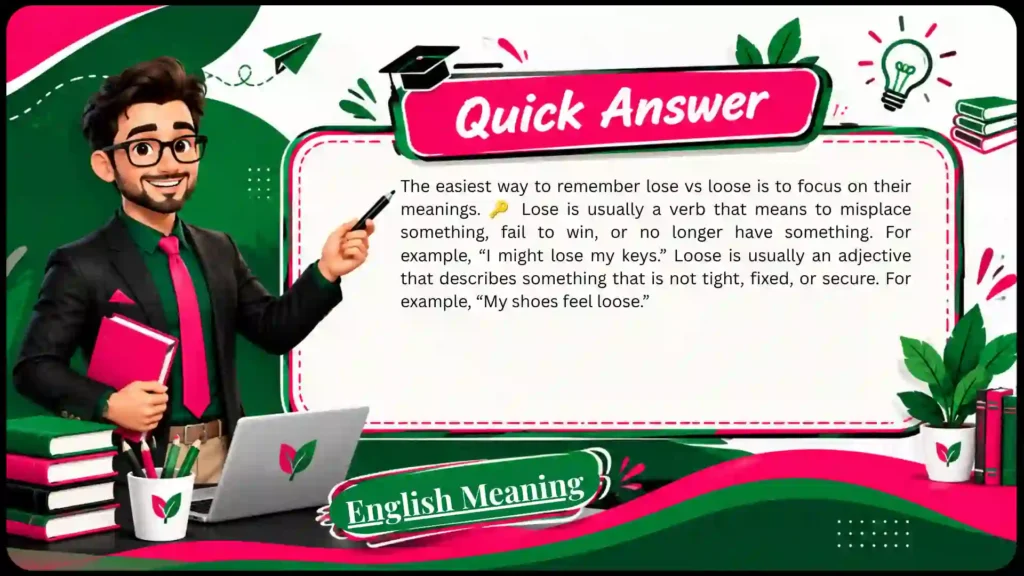
The easiest way to remember lose vs loose is to focus on their meanings. 🔑 Lose is usually a verb that means to misplace something, fail to win, or no longer have something. For example, “I might lose my keys.” Loose is usually an adjective that describes something that is not tight, fixed, or secure. For example, “My shoes feel loose.”
Here is the quick difference:
| Word | Main Use | Example |
| Lose | Verb | Don’t lose your phone. |
| Loose | Adjective | My shirt is loose. |
| Losing | Form of lose | She is losing weight. |
| Loosing | Form of loose | He was loosing the arrow. |
TL;DR
- 🔵 Lose usually works as a verb.
- 🟢 Loose usually works as an adjective.
- ✏️ Losing is the -ing form of lose.
- ✏️ Loosing is the -ing form of loose when loose acts as a verb.
- ⚖️ Use lose weight, not “loose weight.”
- 👕 Use loose clothing when something does not fit tightly.
- 🔊 Lose ends with a /z/ sound, while loose ends with an /s/ sound.
- 🧠 Think of loose as having extra room, while lose means something is gone or missing.
You Might Also Like That: Low Key Meaning
What Is the Difference Between Lose and Loose?
The main difference between lose and loose comes from their meanings and grammatical roles. Lose normally describes an action. You can lose your keys, lose a game, lose money, or lose interest in something. Loose normally describes a condition. Something can be loose when it does not fit tightly or does not stay firmly attached.
You should not use these words interchangeably. For example, “I don’t want to lose my phone” means you do not want your phone to become missing. However, “My phone case is loose” means the case does not fit tightly. Understanding this basic difference makes lose or loose much easier to choose.
What Does Lose Mean?
Lose is mainly a verb. It can describe several situations, including misplacing something, failing to win, or no longer having something. You might lose your keys, lose a game, lose money, or lose your way. The word can also describe losing something less physical, such as time, hope, focus, or interest.
Examples make the meaning easier to understand:
- “I don’t want to lose my wallet.”
- “Our team could lose the match.”
- “She does not want to lose hope.”
- “He may lose interest in the project.”
These examples show why lose meaning depends on the context.
What Does Loose Mean?
Loose usually works as an adjective. It describes something that is not tight, firmly attached, or securely held. For example, you can have loose clothing, a loose screw, or a loose connection. The word can also describe something free from control or restraint.
Consider these examples:
- “This shirt is too loose.”
- “The dog is running loose.”
- “One of the buttons is loose.”
- “The rules are fairly loose.”
Unlike lose, which normally describes an action, loose usually describes a condition. This distinction helps you understand when to use loose instead of lose.
Lose vs Loose Pronunciation
🔊 Pronunciation can also help you tell lose and loose apart. Although the words look very similar, they end with different sounds. Lose has a /z/ sound at the end, while loose has an /s/ sound.
A simple way to remember the sounds is through rhyming words:
| Word | Pronunciation | Rhymes With |
| Lose | /luːz/ | choose, shoes |
| Loose | /luːs/ | goose, moose |
The spelling still matters more when you write. If you are unsure, first think about the meaning and grammatical role, then check which word fits the sentence.
Lose or Loose: Which Word Should You Use?
When you wonder whether to use lose or loose, look at what you want the sentence to mean. If you describe an action such as misplacing something or failing to win, choose lose. If you describe something that is not tight or secure, choose loose.
Try these examples:
- Don’t lose your keys. 🔑
- My shoes are loose. 👟
- We might lose the game. 🏆
- This screw is loose.
- She could lose her phone.
- His shirt looks loose.
A quick meaning check usually gives you the correct answer.
Losing or Loosing: What’s the Difference?
Losing and loosing come from different words. Losing is the -ing form of lose, so you use it when someone is misplacing something, failing to win, or no longer having something. For example, “She is losing weight” and “They are losing the game.”
Loosing is the -ing form of loose when loose works as a verb meaning to release or set something free. This form is much less common in everyday English. For example, “The archer was loosing an arrow.” So, loosing or losing depends on the meaning, but losing appears far more often.
Is It Lose Weight or Loose Weight?
The correct phrase is lose weight. ⚖️ You use lose because the phrase describes an action: a person wants to reduce the amount of weight they have. Loose weight is not the standard expression in this context.
Compare these examples:
- ✅ “She wants to lose weight.”
- ❌ “She wants to loose weight.”
- ✅ “He bought a loose shirt.”
- ❌ “He bought a lose shirt.”
The difference becomes clear when you focus on meaning. Lose describes the action of no longer having something, while loose describes something that is not tight. This makes lose weight or loose weight a useful example of the main rule.
Common Lose and Loose Mistakes
People often make spelling mistakes because lose and loose look almost identical. The best way to avoid them is to check the meaning before choosing the word.
| ❌ Incorrect | ✅ Correct |
| loose weight | lose weight |
| loose the game | lose the game |
| lose clothing | loose clothing |
| loosing weight | losing weight |
| loose my phone | lose my phone |
Remember that lose normally describes an action, while loose usually describes a condition. Once you understand this difference, many common mistakes become easier to spot.
Lose, Loose, Losing, and Loosing Compared
These four words look closely related, but they do not have the same role or meaning. The following table gives you a quick comparison:
| Word | Main Role | Meaning | Example |
| Lose | Verb | Misplace, no longer have, or fail to win | Don’t lose your keys. |
| Loose | Adjective | Not tight or secure | My shoes are loose. |
| Losing | Verb form | Present participle of lose | He is losing the game. |
| Loosing | Verb form | Present participle of loose | The archer was loosing arrows. |
The key point is simple: lose → losing, while loose → loosing. In everyday English, you will encounter losing much more often than loosing.
Related Words: Loser, Looser, Lost, and Loss
Learning related words can make the lose vs loose difference even easier. Loser refers to someone or something that loses, while looser means something is more loose. For example, “The team was the loser” and “This shirt is looser than the other one.”
Other related forms include:
- Lost → past tense of lose
- Loss → a noun related to lose
- Loosen → to make something less tight
- Loosely → in a loose or relaxed way
- Loosest → the superlative form of loose
These forms belong to different word families, so checking the base word can help you avoid mistakes.
How to Remember the Difference Between Lose and Loose
🧠 A simple memory trick can help you remember the difference. Think of the extra “o” in loose as representing extra room. Something loose has extra space and does not fit tightly.
For example:
Loose clothes have extra room, but you can lose your clothes if you cannot find them.
Another useful trick is to connect lose with something that disappears or gets away. Connect loose with something that is not tight or secure. With regular practice, these simple associations can make the correct spelling feel natural.
Lose vs Loose in Everyday English
You can find lose and loose in many everyday conversations, messages, and written sentences. Lose often appears when people talk about possessions, games, feelings, time, or opportunities. Loose commonly describes clothing, objects, rules, or things that are not secure.
Common examples include:
- 📱 lose your phone
- 🗺️ lose your way
- 😤 lose your temper
- 🎯 lose focus
- 👕 loose clothing
- 💰 loose change
- 🔧 loose connection
- 🐕 on the loose
- 🕊️ let loose
Seeing these words in real situations helps you understand their meaning instead of memorizing isolated definitions.
FAQs About Lose vs Loose
What is the difference between lose and loose?
Lose is usually a verb, while loose is usually an adjective. You can lose something or fail to win, while something can be loose when it is not tight or secure.
Is it losing or loosing?
Losing is normally correct when you mean the -ing form of lose. Loosing can also be a real word when loose acts as a verb meaning to release something, but this use is uncommon.
Is it lose weight or loose weight?
The correct expression is lose weight. The verb lose describes the action of no longer having something, while loose describes something that is not tight.
Is loose ever a verb?
Yes. Loose can work as a verb meaning to release or set something free. However, people use this form much less often than the adjective loose.
What is the difference between loser and looser?
A loser is someone or something that loses. A looser is something that is more loose than another thing.
How do you pronounce lose and loose?
Lose ends with a /z/ sound, while loose ends with an /s/ sound. Lose rhymes with “choose,” while loose rhymes with “goose.”
How can I remember the difference?
Think of the extra o in loose as extra room. Loose clothing has extra room, while lose usually refers to something that you no longer have or fail to win.
Final Thought
The difference between lose and loose becomes simple once you focus on meaning. 🔵 Lose usually describes an action, such as misplacing something, failing to win, or no longer having something. 🟢 Loose usually describes something that is not tight, fixed, or secure. The same rule helps you understand losing, loosing, loser, looser, lost, and loss.
When you are unsure, stop and ask yourself what the sentence means. Are you talking about something that is gone or no longer yours? Choose lose. Are you describing something that is not tight or secure? Choose loose. This simple check can help you use both words correctly.