

If you are unsure whether to write learned or learnt, you are not alone. Both forms are correct, but English speakers use them differently depending on the variety of English they follow. Learned appears more often in American English, while learnt remains especially common in British English. Both words can serve as the past tense of learn and the past participle of learn, so neither form is simply “wrong.”
Understanding the difference can help you choose the right form for your audience and keep your writing consistent. In this guide, we will explain the learn past tense, compare learned vs. learnt, show clear examples, and cover their use in American and British English. We will also look at learned as an adjective, pronunciation, verb forms, and common phrases such as lesson learned and lesson learnt.
Quick Answer
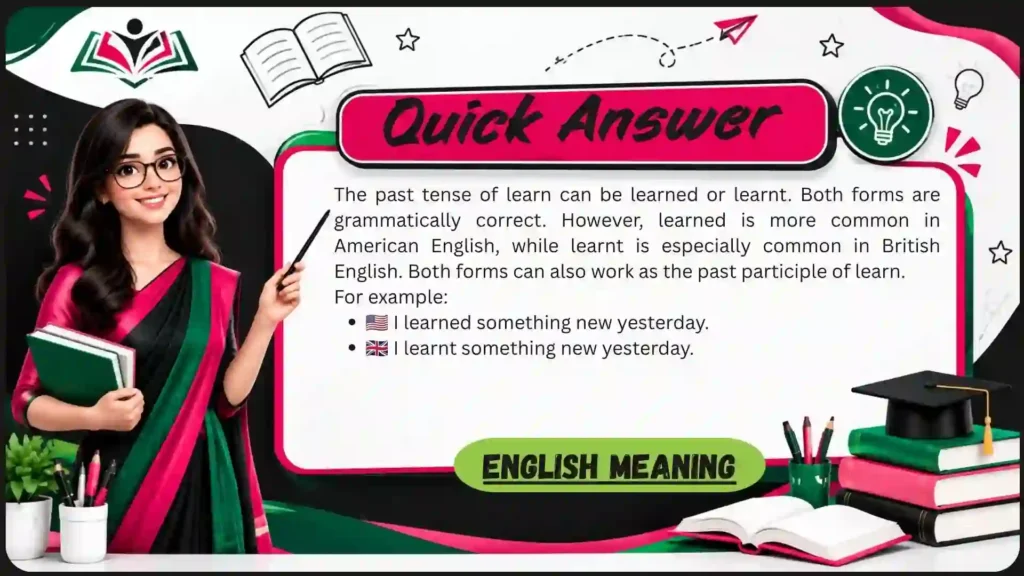
The past tense of learn can be learned or learnt. Both forms are grammatically correct. However, learned is more common in American English, while learnt is especially common in British English. Both forms can also work as the past participle of learn.
For example:
- 🇺🇸 I learned something new yesterday.
- 🇬🇧 I learnt something new yesterday.
The choice usually depends on the variety of English you use. If you write for an American audience, learned is usually the safer choice. If you follow British English, learnt is a natural choice.
TL;DR: Learned vs. Learnt
- ✅ Learned and learnt are both correct forms of learn.
- 🇺🇸 Learned is more common in American English.
- 🇬🇧 Learnt is especially common in British English.
- 📚 Both forms can work as the past tense and past participle.
- ✍️ Choose the form that matches your preferred variety of English.
- 💡 Learned can also work as an adjective meaning knowledgeable or well-educated.
You Might Also Like That: BTW Meaning
What Is the Past Tense of Learn?
The past tense of learn is learned or learnt. You can use either form when you talk about something that happened in the past. The main difference comes from regional preference rather than meaning. American English generally favors learned, while British English often uses learnt.
For example, you can say, “I learned a new skill last year” or “I learnt a new skill last year.” Both sentences have the same basic meaning. This makes learned or learnt a common grammar question for students and English learners.
Past Tense Examples
Here are some simple examples:
- 📖 She learned Spanish at school.
- 🎓 He learnt an important lesson.
- 💻 We learned how to use the software.
- 🧠 They learnt a lot from the experience.
Learned or Learnt: What’s the Difference?
The main difference between learned and learnt involves English variety. Learned is the more common form in American English, while learnt is especially common in British English. Both forms describe the same past action, so you normally do not change the meaning when you switch between them.
For example, “She learned the rules” and “She learnt the rules” both mean that she gained knowledge of the rules in the past. You should focus more on consistency than on finding one universally correct form. Your audience and the English style you follow can guide your choice.
Learned vs. Learnt in American and British English
Regional English explains why you may see both forms in books, websites, schools, and everyday conversations. American English usually prefers learned, while British English commonly accepts and uses learnt. British writers can also use learned, so the distinction does not create a strict rule.
| English Variety | Common Form |
| 🇺🇸 American English | learned |
| 🇬🇧 British English | learnt |
| 🇦🇺 Other English varieties | learned or learnt |
If you are writing for a specific audience, follow its usual English style. This approach keeps your writing natural and consistent.
Forms of the Verb “Learn”
Understanding the different learn verb forms makes the grammar easier to remember. The base form is learn, while learns works with third-person singular subjects. The present participle is learning, and the past forms are learned and learnt.
| Verb Form | Word | Example |
| Base form | learn | I learn quickly. |
| Third-person singular | learns | She learns quickly. |
| Present participle | learning | He is learning English. |
| Past tense | learned / learnt | We learned a lesson. |
| Past participle | learned / learnt | I have learned a lot. |
This table gives you a quick view of the basic learn conjugation.
Learned or Learnt: Which One Should You Use?
You can use learned or learnt depending on the English variety you follow. If your writing follows American English, learned will usually sound more natural. If you follow British English, learnt often fits better.
The most important rule is to stay consistent. For example, if you use American English throughout an article, choose learned instead of switching between learned and learnt without a reason. Your school, workplace, publisher, or style guide may also tell you which form to use.
A Simple Rule to Remember
👉 American English → learned
👉 British English → learnt
Both remain correct, so you do not need to worry that one form is grammatically wrong.
Examples of Learned and Learnt in Sentences
Examples can make the difference between learned and learnt much easier to understand. Both forms can appear in several verb structures, including the simple past, present perfect, and past perfect. The choice between them usually depends on regional English rather than grammar.
Simple past:
- 📚 I learned French last year.
- 📚 I learnt French last year.
Present perfect:
- 🧠 She has learned an important lesson.
- 🧠 She has learnt an important lesson.
Past perfect:
- ✏️ They had learned the rules before the test.
- ✏️ They had learnt the rules before the test.
All of these sentences are grammatically acceptable.
When “Learned” Is an Adjective
The word learned can also work as an adjective. In this use, it describes someone who has a lot of knowledge, especially in a subject or academic field. This meaning differs from the simple past form of the verb learn.
For example:
- 🎓 She is a learned professor.
- 📚 He is a learned scholar.
- 🧠 The book contains ideas from several learned writers.
The adjective learned can also have a different pronunciation from the past-tense verb. This small difference can confuse English learners, so it helps to recognize the word’s role in a sentence.
How Do You Pronounce “Learned” and “Learnt”?
When learned works as the past tense or past participle of learn, speakers usually pronounce it with one syllable, similar to “learnd.” Learnt also has one syllable. The adjective learned, however, normally has two syllables when it means knowledgeable or scholarly.
For example:
- 🔤 learned as a verb → one syllable
- 🔤 learnt → one syllable
- 🎓 learned as an adjective → two syllables
Knowing this difference can help you understand spoken English and avoid confusion when you hear the word in different contexts.
“Lesson Learned” or “Lesson Learnt”?
Both lesson learned and lesson learnt are correct expressions. The choice again depends mainly on regional English. American writers generally use lesson learned, while British writers may use lesson learnt.
The phrase often describes something valuable that someone discovered through experience. For example, “That mistake taught me a lesson learned the hard way” is common in American English. A British writer may naturally choose lesson learnt instead. If you are writing for a specific audience, use the version that matches its English style.
Why Does English Have Both “Learned” and “Learnt”?
English sometimes allows more than one past-tense form for the same verb. Learned follows the common -ed pattern, while learnt follows an older -t pattern found in some English verbs. Over time, different English-speaking regions developed different preferences.
You can see similar choices with words such as:
- 🔥 burned / burnt
- 💭 dreamed / dreamt
- ✍️ spelled / spelt
- 👃 smelled / smelt
These pairs show that English can accept different forms without changing the basic meaning. The same idea explains learned and learnt.
Common Mistakes With Learned and Learnt
English learners often make a few simple mistakes when choosing between these forms. The biggest mistake is assuming that learnt is wrong or that learned is the only correct form. Both can work as the past tense and past participle of learn.
Avoid these common errors:
- ❌ Saying learnt is always incorrect.
- ❌ Saying learned is only used in America.
- ❌ Treating the two forms as having different basic meanings.
- ❌ Mixing English varieties without a clear reason.
- ❌ Confusing the verb learned with the adjective learned.
Choose the form that fits your English variety and keep your writing consistent.
Learned vs. Learnt Quick Reference
If you need a fast answer, this table covers the main points:
| Question | Answer |
| ❓ What is the past tense of learn? | Learned / learnt |
| ❓ What is the past participle? | Learned / learnt |
| 🇺🇸 Which is common in American English? | Learned |
| 🇬🇧 Which is common in British English? | Learnt |
| ✅ Is learnt correct? | Yes |
| ✅ Is learned correct? | Yes |
| 🎓 Can learned be an adjective? | Yes |
The easiest rule is to remember the regional preference while understanding that both forms are grammatically valid.
Frequently Asked Questions
Is “learned” or “learnt” correct?
Both learned and learnt are correct. Learned is more common in American English, while learnt is especially common in British English. Both can serve as the past tense and past participle of learn.
Is “learnt” grammatically correct?
Yes. Learnt is a correct English form. British English commonly uses it, although British writers also use learned.
Is “learned” American or British English?
Learned is especially common in American English, but British English also uses it. Therefore, it is not accurate to call learned exclusively American.
What is the past participle of “learn”?
The past participle can be learned or learnt. For example, you can say, “I have learned a lot” or “I have learnt a lot.”
Can I use “learnt” in American English?
You can, and readers will understand it. However, learned is generally the more natural choice for standard American English writing.
Which is correct: “lesson learned” or “lesson learnt”?
Both are correct. Lesson learned is more common in American English, while lesson learnt is common in British English.
Why does “learned” sometimes sound different?
Learned has two common pronunciations because it can work as either a verb or an adjective. The verb form usually has one syllable, while the adjective meaning knowledgeable usually has two.
Are “learned” and “learnt” interchangeable?
They are generally interchangeable when learned and learnt function as the past tense or past participle of learn. Your choice should mainly follow the English variety and style you use.
Final Thought
The answer to “learned or learnt” is simple: both are correct. The past tense and past participle of learn can appear as learned or learnt. American English generally prefers learned, while British English often uses learnt.
When choosing between them, think about your audience and keep your writing consistent. If you follow American English, learned is usually the best choice. If you follow British English, learnt works naturally. Once you understand this small regional difference, choosing the correct learn past tense becomes much easier.