
If you have ever seen an -ing word and wondered whether it is a verb or a noun, you are not alone. Words like reading, swimming, cooking, and writing can work in different ways depending on the sentence. A gerund is an -ing form of a verb that works as a noun. Understanding this simple rule can make English grammar much easier.
In this guide, you will learn the gerund meaning, how to identify gerunds, where they appear in sentences, and how they differ from present participles and infinitives. You will also see simple examples and common mistakes.
Quick Answer: What Is a Gerund?
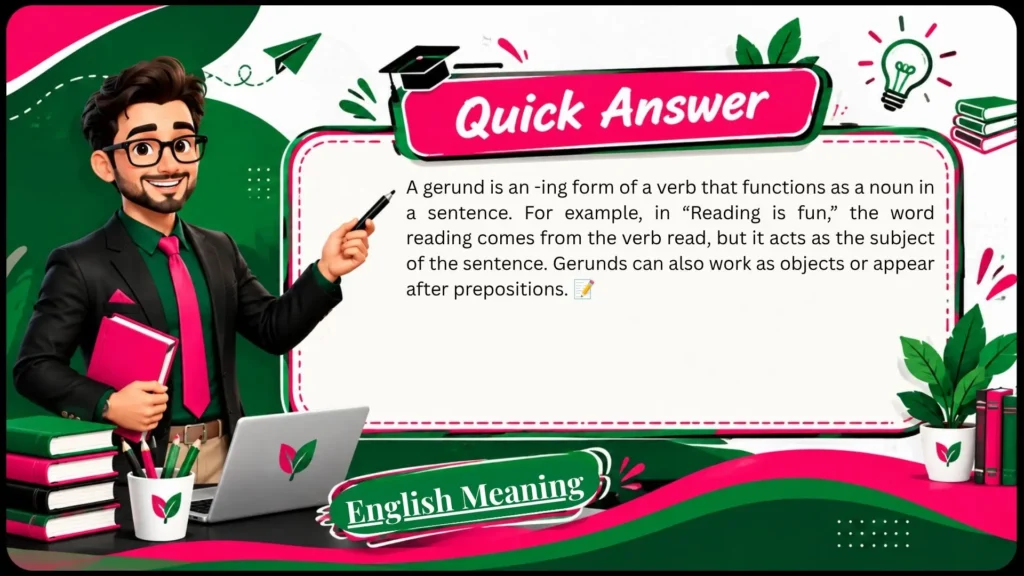
A gerund is an -ing form of a verb that functions as a noun in a sentence. For example, in “Reading is fun,” the word reading comes from the verb read, but it acts as the subject of the sentence. Gerunds can also work as objects or appear after prepositions. 📝
The easiest rule to remember is: a gerund looks like a verb but works like a noun. For example, “I enjoy cooking” uses cooking as the object of the verb enjoy. This simple idea helps you understand most basic gerund examples.
TL;DR: Gerund Meaning at a Glance
Key Points to Remember
- 🔹 A gerund comes from a verb.
- 🔹 It usually ends in -ing.
- 🔹 It functions as a noun.
- 🔹 It can be a subject or object.
- 🔹 It can follow a preposition.
- 🔹 A group of words containing a gerund can form a gerund phrase.
- 🔹 Not every -ing word is a gerund.
- 🔹 Its job in the sentence helps you identify it.
You Might Also Like That: ISTG Meaning in Text
What Does Gerund Mean in English Grammar?
In simple words, a gerund changes an action into something you can talk about as a thing or activity. For example, “Swimming is healthy” talks about swimming as an activity. The word swimming comes from the verb swim, but it works as the subject of the sentence. 🏊
You can find gerunds in everyday English. Consider “Learning English takes time” or “I enjoy walking.” In both examples, learning and walking name activities. This is why gerunds are often described as verbs that act like nouns.
How Do You Identify a Gerund?
To identify a gerund, first look for an -ing word. Then ask what job it performs in the sentence. If the word acts like a noun, it is a gerund. For example, “Dancing makes me happy” uses dancing as the subject, so it is a gerund. 💡
Remember that not every -ing word is a gerund. In “She is dancing,” dancing is part of the verb phrase, so it is a present participle. Always look at the word’s function, not only its ending.
Gerund Examples in Sentences
Easy Examples to Understand
Here are some simple gerund examples:
| Sentence | Gerund | Function |
| Reading is relaxing. | Reading | Subject |
| I enjoy cooking. | Cooking | Object |
| She is good at drawing. | Drawing | Object of a preposition |
| Walking keeps me active. | Walking | Subject |
| He loves playing football. | Playing | Object |
These examples show how the same type of -ing form can perform different jobs. Once you notice what the word does in the sentence, identifying a gerund becomes much easier. 📚
You Might Also Like That: Discreet vs Discrete
How Are Gerunds Used in a Sentence?
Main Functions of Gerunds
A gerund can perform several noun functions. It can be the subject of a sentence, such as “Reading improves vocabulary.” It can also be a direct object, as in “I enjoy reading.” After a preposition, you can say, “She is interested in learning.” ✨
Gerunds can also work as subject complements and, in some sentence structures, object complements. You do not need to memorize every grammar term at once. The main idea is simple: the gerund takes the place of a noun while keeping its connection to a verb.
What Is a Gerund Phrase?
Gerund vs. Gerund Phrase
A gerund phrase contains a gerund along with words that complete or describe it. For example, in “Reading books before bed helps me relax,” the whole phrase is a gerund phrase, while reading is the gerund. 📖
Gerund phrases can contain objects, modifiers, and other words. In the example above, books is connected to the gerund reading, while before bed gives extra information. The whole phrase works as the subject of the sentence.
Gerund vs. Present Participle: What Is the Difference?
Same Form, Different Job
A gerund and a present participle can look exactly the same because both often end in -ing. The difference is their function. A gerund works as a noun, while a present participle can form part of a verb or describe a noun.
Compare these sentences:
- Swimming is good exercise. → Gerund 🏊
- She is swimming. → Present participle
In the first sentence, swimming is the subject. In the second, it helps form the verb phrase is swimming.
Gerund vs. Infinitive: When Should You Use Each?
A gerund uses the -ing form, while an infinitive usually uses to + base verb. For example, “I enjoy reading” uses a gerund, while “I want to read” uses an infinitive. 📌
You Might Also Like That: EYP Meaning in Text
Some verbs normally take gerunds, while others take infinitives. Some can take both. For example, we commonly say “She finished working” and “She decided to work.” Learning common verb patterns will help you choose the correct form naturally.
Which Verbs Are Commonly Followed by Gerunds?
Some common verbs are usually followed by a gerund. These include enjoy, avoid, finish, consider, suggest, keep, practice, admit, and recommend. For example, you can say, “I enjoy reading,” “She avoided answering,” and “They finished cleaning.” ✅
Learning these common patterns can make your English sound more natural. Instead of memorizing hundreds of rules, start with a small group of common verbs and learn them through examples. This is especially useful for English learners.
Gerunds After Prepositions
A gerund commonly comes after a preposition. For example, we say “She is interested in learning English,” “He left without saying goodbye,” and “They talked about moving abroad.” The word after the preposition works as a gerund. 🎯
This rule can help you avoid a common mistake. Do not normally use a to-infinitive directly after a preposition. For example, “interested in learning” is correct, while “interested in to learn” is incorrect. Watch the preposition before choosing the verb form.
How Is a Gerund Formed?
A gerund is generally formed by adding -ing to a verb. For example, read becomes reading, play becomes playing, and work becomes working. However, some verbs need spelling changes when you add -ing. ✍️
For example:
| Verb | Gerund |
| run | running |
| sit | sitting |
| make | making |
| write | writing |
| lie | lying |
The basic idea is easy, but spelling rules can change depending on the final letters of the verb.
Common Gerund Mistakes
One common mistake is thinking every -ing word is a gerund. That is not true. You also need to watch gerund and infinitive patterns, especially after certain verbs. Another common problem is using an infinitive after a preposition instead of a gerund. ⚠️
For example, say “She is good at drawing,” not “She is good at to draw.” Also remember the difference between “Swimming is fun” and “She is swimming.” The first uses a gerund, while the second uses a present participle.
Gerund vs. Verbal Noun
A gerund and a verbal noun can look similar because both may come from verbs and end in -ing. However, they do not always behave in exactly the same way. A gerund keeps some verb-like qualities, such as taking an object, while a verbal noun behaves more like an ordinary noun.
For beginners, the most useful point is not to worry too much about this difference. First understand the main rule: a gerund comes from a verb but functions as a noun. This will cover most everyday grammar situations.
You Might Also Like That: Elicit vs Illicit
Do Gerunds Always End in -ing?
Understanding the -ing Form
In modern English, gerunds normally use the -ing form of a verb. However, seeing an -ing ending does not automatically mean you have found a gerund. The word may be a present participle or part of another structure. 🔍
Compare:
- Reading helps me learn. → Gerund
- She is reading now. → Present participle
- The reading student looked tired. → Descriptive use
The best way to identify the form is to look at its role in the sentence.
Gerund Subject-Verb Agreement
How Gerunds Affect the Verb
When a gerund or gerund phrase acts as a single subject, it usually takes a singular verb. For example, “Reading is useful” is correct. Here, reading represents one activity, so we use is. 📚
When two separate gerunds are joined with and, a plural verb is normally used. For example, “Reading and writing are important skills.” Understanding this simple rule can help you avoid subject-verb agreement mistakes when using gerunds.
Should You Use a Possessive Before a Gerund?
In formal English, a possessive noun or pronoun can come before a gerund. For example, “I appreciate your helping me.” Here, your describes the person connected to the action. This structure is common in careful or formal writing. ✨
In everyday English, people also commonly say, “I appreciate you helping me.” Both forms can appear in real communication, but the possessive form is often preferred in more formal grammar. Choose the style that fits your audience and context.
Can Gerunds Make Writing Better?
Using Gerunds for Better Sentences
Gerunds can make writing more clear and flexible because they let you talk about activities as nouns. For example, instead of repeating longer structures, you can say “Learning a new language takes practice.” This makes the sentence direct and easy to understand. ✨
You can also use gerund phrases to vary sentence structure. For example, “Practicing English every day can improve your confidence.” However, do not use gerunds just to make sentences sound complicated. Always choose the form that makes your meaning clear.
Gerund Practice: Can You Identify Them?
Try to identify the gerunds in these sentences:
- Swimming is my favorite activity.
- She is swimming in the pool.
- I enjoy reading books.
- He is interested in learning English.
- They decided to travel next month.
The answers are: Swimming in sentence 1, reading in sentence 3, and learning in sentence 4. Sentence 2 uses a present participle, while to travel in sentence 5 is an infinitive. 🧠
You Might Also Like That: EYP Meaning in Text
Frequently Asked Questions About Gerunds
What is a gerund in simple words?
A gerund is an -ing form of a verb that works as a noun.
What are some examples of gerunds?
Examples include reading, swimming, cooking, writing, and dancing when they function as nouns.
Is every -ing word a gerund?
No. An -ing word can also be a present participle or have another grammatical role.
What is a gerund phrase?
A gerund phrase contains a gerund plus related words, such as “reading books before bed.”
What is the difference between a gerund and an infinitive?
A gerund uses the -ing form, while an infinitive commonly uses to + base verb.
Final Thoughts
The easiest way to remember gerund meaning is this: a gerund comes from a verb but works as a noun. Words such as reading, swimming, and cooking can be gerunds when they perform a noun-like job in a sentence. 📌
Most importantly, do not judge an -ing word only by its form. Look at what it does in the sentence. Once you understand this function, you can easily tell the difference between a gerund, a present participle, and other -ing forms.