
Have you ever noticed how often you use words like I, you, he, she, it, we, and they? These small words make everyday English easier because they help us avoid repeating the same names and nouns again and again. A pronoun is an important part of English grammar that can take the place of a noun or noun phrase. For example, instead of saying, “Sarah likes Sarah’s new phone,” we can say, “Sarah likes her new phone.” Here, her works as a pronoun.
Understanding the pronoun definition can make English grammar much easier. In this guide, you will learn what a pronoun is, why we use pronouns, the main types of pronouns, and how to use them in sentences. You will also see simple examples, common mistakes, and easy ways to identify pronouns. ✨
Quick Answer: What Is a Pronoun?
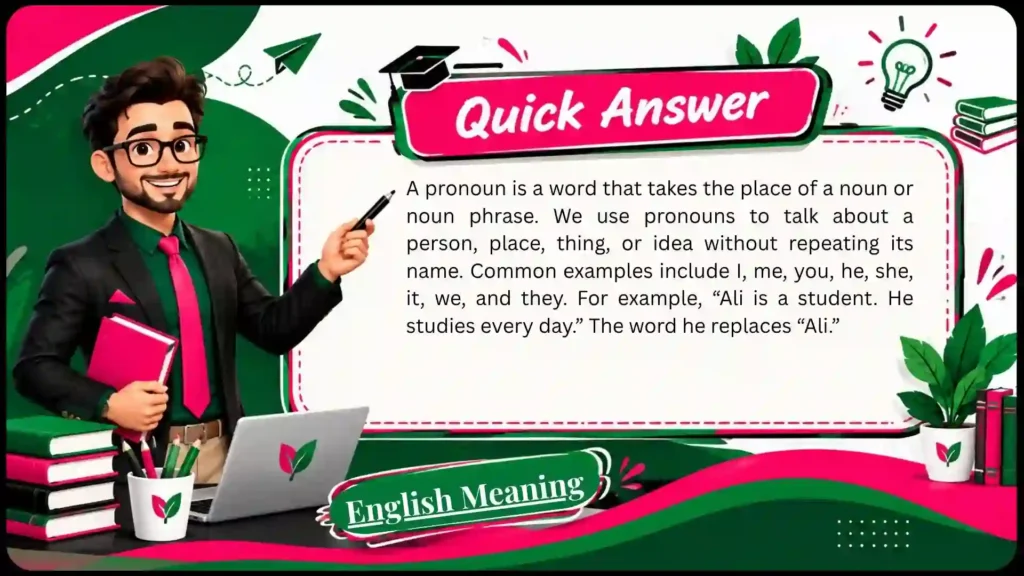
A pronoun is a word that takes the place of a noun or noun phrase. We use pronouns to talk about a person, place, thing, or idea without repeating its name. Common examples include I, me, you, he, she, it, we, and they. For example, “Ali is a student. He studies every day.” The word he replaces “Ali.”
Pronouns can perform different jobs in a sentence. They can act as subjects, objects, possessive words, or words that point to something. This simple pronoun definition helps explain why pronouns appear so often in spoken and written English. 📌
TL;DR: Pronoun Definition in Simple Words
- 📌 A pronoun replaces a noun or noun phrase.
- ✨ Pronouns help prevent unnecessary repetition.
- 👤 Common examples include I, you, he, she, it, we, and they.
- 📝 Pronouns can work as subjects or objects.
- 🔑 English has several types of pronouns.
- 💬 We use pronouns in everyday speaking and writing.
- 🎯 A pronoun usually connects to a noun or idea called an antecedent.
In simple words, a pronoun makes a sentence shorter, smoother, and easier to understand.
You Might Also Like That: Conjunction Definition
What Does Pronoun Mean?
The word pronoun means a word used instead of a noun. In English grammar, pronouns help us refer to people, things, places, or ideas without saying the same noun repeatedly. For example, “Emma bought a book. She read it at home.” Here, she refers to Emma, while it refers to the book.
The pronoun meaning becomes easier when you look at real sentences. Instead of repeating “Emma” and “the book,” we use pronouns to keep the sentence natural. This is why pronouns in English play such an important role in clear communication. 💡
Why Do We Use Pronouns?
We use pronouns mainly to avoid repetition and make sentences sound natural. Imagine saying, “John went to John’s room because John wanted John’s book.” The sentence sounds awkward. We can improve it by saying, “John went to his room because he wanted his book.” The pronouns make the message much smoother.
Pronouns also help us connect ideas. They let readers and listeners understand who or what we already mentioned. Good pronoun usage can make writing clearer, shorter, and more natural. That makes pronouns useful in conversations, schoolwork, professional writing, and everyday communication. ✨
How Are Pronouns Used in a Sentence?
A pronoun can perform different grammatical jobs. It can act as the subject of a sentence, such as “She runs every morning.” It can also act as a direct object, as in “Tom called me.” A pronoun can even work as an indirect object, such as “Sara gave him a gift.”
Pronouns can also appear after prepositions. For example, “The teacher spoke to them.” Learning these basic pronoun functions helps you understand how pronouns work instead of simply memorizing a pronoun list. 📝
Types of Pronouns in English
English contains several types of pronouns, and each type performs a different job. Learning these categories makes it easier to understand pronoun grammar and recognize pronouns in sentences. The most common groups include personal, possessive, demonstrative, interrogative, relative, reflexive, indefinite, reciprocal, intensive, and dummy pronouns.
You Might Also Like That: What Does WYF Mean
You do not need to memorize every category at once. Start with common personal pronouns, then learn the other groups through simple examples. This approach makes the different types of pronouns easier to remember and use correctly.
Personal Pronouns
Personal pronouns refer to specific people or things. Examples include I, me, you, he, him, she, her, it, we, us, they, and them. They can show first person, second person, or third person and can be singular or plural. For example, “She likes music,” and “They play football.” Subject pronouns perform the action, while object pronouns receive the action. Personal pronouns form one of the most important parts of English grammar. 👤
Possessive Pronouns
Possessive pronouns show ownership or possession. Common examples include mine, yours, his, hers, ours, and theirs. For example, “This book is mine,” or “That car is theirs.” These words can stand alone rather than appearing directly before a noun. Do not confuse them with possessive determiners such as my, your, her, and our. Understanding this difference can prevent common grammar mistakes. 🔑
Demonstrative Pronouns
Demonstrative pronouns point to particular people or things. The main examples are this, that, these, and those. Use this and these for things that feel near, and that and those for things that feel farther away. For example, “This is my bag,” and “Those are your shoes.” The same words can also act as determiners when they come directly before a noun.
Interrogative Pronouns
Interrogative pronouns help us ask questions. The main examples include who, whom, whose, which, and what. For example, “Who called you?” and “Which do you prefer?” These pronouns help us ask about people, ownership, choices, or things. Who commonly works as a subject, while whom usually works as an object in formal English. Knowing these words makes question formation much easier. ❓
You Might Also Like That: OMP Meaning
Relative Pronouns
Relative pronouns connect information about a noun to another part of a sentence. Common examples include who, whom, whose, which, and that. For example, “The woman who lives next door is a doctor.” The word who connects the noun “woman” with additional information. Relative pronouns often introduce relative clauses, which help writers combine related ideas without creating several short sentences.
Reflexive Pronouns
Reflexive pronouns refer back to the subject of a sentence. Common forms include myself, yourself, himself, herself, itself, ourselves, yourselves, and themselves. For example, “I taught myself English,” and “They prepared themselves for the test.” These pronouns often show that the person who performs an action also receives the action. 🔄
Indefinite Pronouns
Indefinite pronouns refer to people or things without naming a specific one. Examples include someone, anyone, everyone, nobody, something, nothing, each, either, neither, many, few, and none. For example, “Someone left a message,” or “Everyone enjoyed the event.” These pronouns are useful when the exact person or thing remains unknown or does not matter.
Reciprocal Pronouns
Reciprocal pronouns describe actions or feelings shared between people. English mainly uses each other and one another. For example, “The two friends helped each other,” and “The team members supported one another.” These expressions show a mutual relationship or action. They often appear when two or more people perform the same action toward one another. 🤝
Intensive Pronouns
Intensive pronouns add emphasis to a noun or pronoun. They use the same forms as reflexive pronouns, such as myself, himself, herself, and themselves. For example, “I myself completed the project.” If you remove “myself,” the sentence still makes sense: “I completed the project.” That difference helps you identify an intensive pronoun.
Dummy or Expletive Pronouns
Dummy pronouns, also called expletive pronouns, do not refer to a specific person or thing. English often uses it or there in these structures. For example, “It is raining,” and “There is a problem.” Here, the words help form a grammatically complete sentence without replacing a specific noun. 💡
You Might Also Like That: Elicit vs Illicit
Pronoun Examples in Sentences
Seeing pronoun examples makes the concept much easier to understand. Consider these sentences:
- 👤 She works at a bank. — Personal pronoun
- 🔑 The blue bag is mine. — Possessive pronoun
- 👉 This is my phone. — Demonstrative pronoun
- ❓ Who called you? — Interrogative pronoun
- 🔗 The man who called is my uncle. — Relative pronoun
- 🌐 Someone left a message. — Indefinite pronoun
- 🔄 He hurt himself. — Reflexive pronoun
- 🤝 They helped each other. — Reciprocal pronoun
These pronouns in sentences show how each type performs a different job.
Pronouns vs. Nouns: What’s the Difference?
A noun names a person, place, thing, or idea, while a pronoun usually takes the place of that noun. For example, “Maria loves music” uses Maria as a noun. We can then say, “She loves music,” where she replaces Maria. This explains the basic difference between a noun and a pronoun.
Nouns can give specific names, while pronouns help us avoid repeating those names. Both can perform similar grammatical roles, but they work differently. Understanding pronouns vs. nouns is one of the easiest ways to understand pronoun grammar. 📚
Pronouns vs. Determiners
Pronouns and determiners can sometimes look similar, but they perform different jobs. A pronoun can stand alone, while a determiner usually appears before a noun. Compare: “This is expensive” and “This phone is expensive.” In the first sentence, this acts as a pronoun. In the second, it works as a determiner.
The same idea appears with possessive forms. “This book is mine” uses a possessive pronoun, while “This is my book” uses a possessive determiner. 🔍
What Is a Pronoun Antecedent?
A pronoun antecedent is the noun or noun phrase that a pronoun refers to. For example, “David lost his keys.” Here, David is the antecedent of his. The connection helps readers understand who owns the keys.
A clear antecedent makes writing easier to follow. If readers cannot tell what a pronoun refers to, the sentence can become confusing. For this reason, writers should make sure every important pronoun has a clear reference. 🎯
Pronoun-Antecedent Agreement
Pronoun-antecedent agreement means that a pronoun should match its antecedent in important grammatical features, especially number. For example, “The students finished their work” uses the plural pronoun their because “students” is plural. A singular noun normally needs a suitable singular reference.
Clear agreement helps readers understand your meaning quickly. Writers should also watch for unclear references, especially in long sentences. Good pronoun agreement keeps English writing accurate, natural, and easy to follow.
You Might Also Like That: What Does WYF Mean
Common Pronoun Mistakes to Avoid
Pronoun mistakes often happen when writers choose the wrong form or create an unclear reference. Watch for these common problems:
- ❌ Unclear pronoun antecedents
- ❌ Incorrect subject and object forms
- ❌ Wrong pronoun agreement
- ❌ Using myself when another form is needed
- ❌ Confusing possessive pronouns and determiners
- ❌ Confusing who and whom
- ❌ Repeating nouns when a pronoun would sound more natural
Always check what your pronoun refers to and whether it fits the sentence. ✅
How to Identify a Pronoun in a Sentence
You can identify a pronoun by following a few simple steps. First, look for a word that refers to a person, place, thing, or idea. Next, ask whether the word replaces or represents a noun. Then, check whether it connects to an antecedent. For example, in “Lisa said she was tired,” she refers to Lisa.
Practice makes identification easier. Look at short sentences and underline words such as he, them, this, someone, or which. Then decide what each word refers to and what job it performs.
Why Are Pronouns Important in English?
Pronouns make English clearer, shorter, and more natural. Without them, we would repeat names and nouns too often. Imagine saying, “Ahmed went to Ahmed’s office because Ahmed forgot Ahmed’s laptop.” Replacing repeated words with he and his makes the sentence much easier to read.
Pronouns also help conversations flow naturally. We use them constantly when talking with friends, writing emails, studying, and telling stories. Once you understand what a pronoun is, you can recognize these useful words almost everywhere. 🌟
Frequently Asked Questions
What is a pronoun?
A pronoun is a word that replaces a noun or noun phrase. Examples include I, you, he, she, it, we, and they.
What is the simple definition of a pronoun?
A simple pronoun definition is: a word used instead of a noun.
What are 10 examples of pronouns?
Ten common examples are I, me, you, he, she, it, we, they, them, and who.
What are the main types of pronouns?
Major types include personal, possessive, demonstrative, interrogative, relative, indefinite, reflexive, reciprocal, intensive, and dummy pronouns.
What does a pronoun replace?
A pronoun can replace a noun or noun phrase and refer to a person, thing, place, or idea.
How do you identify a pronoun?
Look for a word that represents or refers to a noun without naming it directly. Then check its role and reference in the sentence.
What is a pronoun antecedent?
An antecedent is the noun or noun phrase that a pronoun refers to, such as “Sarah” before she.
Final Thoughts
Understanding the pronoun definition does not have to feel difficult. A pronoun is simply a word that helps us refer to a noun without repeating it again and again. Words such as he, she, it, they, this, someone, and which can perform different pronoun roles depending on the sentence.
Once you learn the main types of pronouns, their sentence functions, and their relationship with antecedents, English grammar becomes much easier. Keep practicing with real examples, and you will quickly learn how to identify and use pronouns correctly. ✨