
If you are unsure about okay vs. OK, you are not choosing between a correct spelling and a misspelling. Both are established English forms, and major dictionaries recognize them. The real question is usually one of style, context, and tone.
In American English, you can write Are you OK? or Are you okay? without changing the basic meaning. However, a workplace style guide, publication, or academic context may favor one form. In very formal writing, replacing either form with a more precise word such as acceptable, approved, or satisfactory may be better. The choice also changes slightly when OK/okay acts as a noun or verb.
Quick Answer
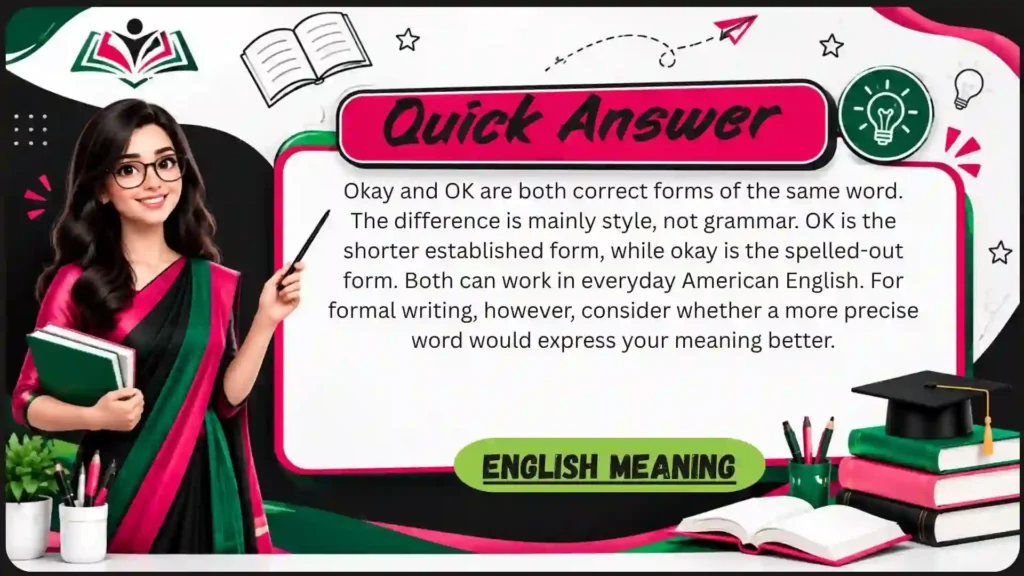
Okay and OK are both correct forms of the same word. The difference is mainly style, not grammar. OK is the shorter established form, while okay is the spelled-out form. Both can work in everyday American English. For formal writing, however, consider whether a more precise word would express your meaning better.
TL;DR
- OK and okay are both correct.
- They usually have the same meaning and pronunciation.
- OK is common in edited and informal writing.
- Okay is also standard and often looks more like an ordinary word.
- Lowercase ok is more casual.
- In formal writing, acceptable or approved may be more precise.
You Might Also Like That: IYKYK Meaning
| Context | Good Choice | Why |
| Everyday writing | OK / okay | Both are established forms |
| Professional style guide | Follow the guide | Styles can differ |
| Text message | OK / okay / ok | Casual communication allows more flexibility |
| Academic prose | okay or a precise alternative | Avoid conversational wording when precision matters |
| Formal approval | approved / authorization | More exact than OK |
| Older or historical text | O.K. may appear | Dotted forms have historical use |
Are OK and okay both correct?
Yes. OK and okay are both correct English forms. Merriam-Webster lists OK as an adjective or adverb and gives okay as a variant. It also lists noun and verb uses.
For example, all of these sentences are acceptable:
- Are you OK?
- Are you okay?
- OK, I understand.
- Okay, I understand.
- Is it OK if I leave early?
- Is it okay if I leave early?
The important point is that this is not a right-versus-wrong spelling problem. Both forms belong to standard English.
The choice can still affect the appearance or tone of your writing. That is a style decision, not a basic grammar rule. The Chicago Manual of Style, for example, treats OK and okay as acceptable variants rather than declaring one universally correct.
What do OK and okay mean?
OK and okay can express several related ideas. They can mean all right, acceptable, satisfactory, agreed, or in a safe or satisfactory condition. Dictionaries also recognize additional grammatical uses.
You Might Also Like That: Elicit vs Illicit
As an adjective
They can describe a person, situation, or thing.
I’m OK now.
I’m okay now.
The movie was OK, but I expected more.
The movie was okay, but I expected more.
Here, both forms can mean that something is satisfactory or that someone is fine.
As an adverb
They can describe how an action happens.
She did OK on the exam.
She did okay on the exam.
The meaning is roughly “well enough” or “acceptably.”
As an interjection or discourse marker
They can show agreement or introduce what comes next.
OK, let’s start.
Okay, let’s start.
Cambridge describes okay/OK as a discourse marker as well as an adjective and adverb. Oxford also records uses for agreement, introducing a comment, and checking understanding.
As a noun
OK or okay can mean approval or permission.
We need the manager’s OK first.
We need the manager’s okay first.
As a verb
The word can also mean approve or authorize.
The manager OK’d the request.
The manager okayed the request.
Merriam-Webster and Oxford both recognize the verb use and its inflected forms.
When should you use OK or okay?
For ordinary American English, you can generally choose either form. The better choice depends on the surrounding writing.
You Might Also Like That: OMP Meaning
Use OK when your publication or organization prefers the shorter form:
The supervisor said the revised plan was OK.
Use okay when you prefer the fully spelled-out form:
The supervisor said the revised plan was okay.
If you are not following a specific style guide, consistency is a sensible rule. Switching randomly between OK and okay does not normally create a grammar error, but a consistent house style can make edited writing look cleaner.
A useful decision rule is:
1. Does your style guide specify one form? Follow it.
2. If not, is the writing ordinary or conversational? Either OK or okay works.
3. Is the writing highly formal? Consider a more precise word instead.
For example:
The proposal is okay.
can become:
The proposal is acceptable.
The second sentence gives the reader a more specific description.
You Might Also Like That: IFG Meaning
Is OK more formal than okay?
Not universally. There is no reliable rule that says OK is formal and okay is informal, or vice versa.
Different style authorities make different choices. Microsoft’s Style Guide recommends OK rather than okay or all right.
The Language Portal of Canada takes a different approach. It describes OK, O.K., and okay as informal and recommends more precise alternatives for formal writing. For everyday writing, it recommends okay.
Chicago likewise does not make one form universally mandatory. Its guidance recognizes both OK and okay.
So the safest lesson is:
Formality depends more on context and style than on the spelling alone.
If a formal report says:
The results were okay.
the issue may not be the spelling. The problem may be that okay is too vague.
A stronger version could be:
The results were satisfactory.
That sentence tells the reader more.
What about ok, Ok, and O.K.?
These forms need more careful treatment.
OK
OK is an established modern form and is widely used in edited English. Merriam-Webster gives it as the main dictionary form and lists okay as a variant.
You Might Also Like That: Delulu Meaning
okay
Okay is also fully established. It is not merely a casual attempt to spell the abbreviation.
Okay, I’ll send it today.
The final version is okay.
ok
Lowercase ok is common in informal digital communication:
ok, see you later
However, it is more casual than the conventional edited forms. If you are writing an essay, report, application, or polished article, OK or okay is usually the safer choice.
This distinction is about writing conventions and register. It does not mean readers cannot understand lowercase ok.
O.K.
O.K. is an older dotted form. It has historical legitimacy, but modern general writing commonly uses OK or okay instead. Merriam-Webster’s current entry uses OK as its main form.
So, for modern general writing, a practical order is:
OK / okay → preferred modern choices
ok → casual digital choice
O.K. → older or house-style form
OK and okay as nouns and verbs
The spelling choice becomes especially interesting when the word changes grammatical function.
As a noun, both forms can refer to approval:
We need the director’s OK.
We need the director’s okay.
As a verb, the forms develop different-looking endings:
The director OK’d the proposal.
The director okayed the proposal.
Merriam-Webster lists OK’d and okayed as past-tense forms, while Oxford also records OK’d as a past form of the verb.
This is one reason okay can sometimes feel easier in continuous prose. Its related forms look like ordinary English words:
- okay
- okayed
- okaying
You Might Also Like That: Weather Report Meaning
Meanwhile, the capitalized form keeps the visual character of OK:
- OK
- OK’d
- OK’ing
Neither pattern changes the basic meaning.
OK vs. okay in common writing situations
In a text message
Either form can work:
OK, see you at six.
Okay, see you at six.
Lowercase ok is also common:
ok, see you at six
The last version is strongly casual. That can be exactly right in a text.
In an email
Both OK and okay can work:
Okay, I’ll review the file this afternoon.
OK, I’ll review the file this afternoon.
However, you may not need either word:
I’ll review the file this afternoon.
That version is more direct.
In an academic essay
OK and okay are not automatically grammatical mistakes. However, academic writing often benefits from precision.
Instead of:
The results were okay.
you might write:
The results were satisfactory.
Instead of:
The method is OK for this study.
you might write:
The method is acceptable for this study.
The goal is not to ban OK or okay. The goal is to choose the word that communicates the intended level of precision.
In dialogue
Either form can sound natural:
“Okay, I’ll come with you.”
“OK, I’ll come with you.”
Dialogue can reflect a character’s preferred style, so consistency with the surrounding voice matters more than forcing one spelling.
In technical or workplace documentation
Follow the organization’s style guide when one exists. For example, Microsoft specifically prefers OK in its style guidance.
You Might Also Like That: Discreet vs Discrete
What are good synonyms for OK and okay?
The best synonym depends on what OK/okay means in the sentence.
| Meaning of OK/okay | Possible alternative | Example |
| Fine or well | fine | I’m fine now. |
| Acceptable | acceptable | The proposal is acceptable. |
| Satisfactory | satisfactory | The result was satisfactory. |
| Agreement | yes | “Can you come?” “Yes.” |
| Approval | approval | We need her approval. |
| Permission | permission | We need their permission. |
| Approve | approve | The manager must approve it. |
These are not perfect synonyms in every sentence.
For example:
OK, let’s begin.
cannot always become:
Acceptable, let’s begin.
The first OK functions as a discourse marker. The second word does not perform the same job.
Likewise:
I need your OK.
can naturally become:
I need your approval.
But fine would not express the same noun meaning.
You Might Also Like That: What is a Nouns
So choose a synonym based on the grammatical function and intended meaning, not simply because a thesaurus lists the words together. Merriam-Webster lists related alternatives such as fine, good, approval, accept, and approve for different uses.
Common mistakes to avoid
Mistake 1: Saying “okay” is wrong
Wrong idea: OK is correct, but okay is a misspelling.
Correction: Both are established forms.
Mistake 2: Saying “OK” is always more formal
Different style guides make different recommendations. Context matters more than a universal formal/informal label.
Mistake 3: Treating lowercase ok like OK
Lowercase ok is common in casual digital writing. In polished edited prose, OK or okay is generally a better choice.
Mistake 4: Thinking British English requires okay
British English also uses OK. Oxford and Cambridge both document the forms.
Mistake 5: Replacing every OK with okay
That is unnecessary. If your style guide uses OK, changing every instance to okay does not make the writing grammatically better.
Mistake 6: Using either form when a precise word would be stronger
The application was okay.
may be vague.
If you mean that the application met the requirements, write:
The application was acceptable.
Precision is often more valuable than choosing between two equivalent spellings.
You Might Also Like That: Effect vs Affect
An easy rule to remember
Use this three-step rule:
Choose the style. Check the context. Prefer precision when needed.
- Style: If your organization has a style guide, follow it.
- Context: For ordinary writing, OK and okay are both acceptable.
- Precision: In formal writing, use acceptable, satisfactory, approved, approval, or another exact word when that is what you mean.
The shortest memory aid is:
OK = correct. Okay = correct.
The difference is usually style, not correctness.
FAQs
Is “okay” a correct spelling?
Yes. Okay is a standard English form and is listed as a variant of OK in major dictionaries. You can use okay in ordinary American English without treating it as a misspelling.
Is “OK” a word or an abbreviation?
Today, OK functions as a word with several grammatical roles, including adjective, adverb, noun, verb, and interjection. Its historical origin is associated with a 19th-century abbreviation, but modern speakers use OK as an established lexical item.
Which is better for formal writing, OK or okay?
Neither is automatically the formal choice. Style guides differ. In highly formal writing, a precise term such as acceptable, satisfactory, or approval may communicate the intended meaning better.
You Might Also Like That: FOMO Meaning
Is “ok” acceptable in an email?
It can be acceptable in a casual email, especially between people who regularly communicate informally. For polished professional writing, however, OK or okay is generally a better convention.
Should I write “O.K.” with periods?
You may encounter O.K. in older texts or particular styles, but OK and okay are the more useful modern forms for general writing. Merriam-Webster currently uses OK as its main form.
Are OK and okay pronounced differently?
No. In ordinary English, they have the same pronunciation, commonly represented in American English as approximately /oʊˈkeɪ/. The difference is primarily written form, not pronunciation.
Can OK be used as a verb?
Yes. OK can mean “approve” or “authorize.” For example, The manager OK’d the request is a standard use documented by major dictionaries. Okayed is also an established past-tense form.
Test Your Understanding
1. Which sentence uses an accepted modern form?
A. Are you Ok?
B. Are you okay?
C. Are you O.Kay?
D. Are you Okkay?
2. Which statement about OK and okay is correct?
A. Only okay is grammatically correct.
B. Only OK is grammatically correct.
C. Both are established English forms.
D. OK is only used as an abbreviation for Oklahoma.
3. Which word is the most precise replacement for the noun in this sentence?
“We need the manager’s OK before proceeding.”
A. approval
B. fine
C. well
D. satisfactory
4. Which sentence uses OK as a verb?
A. I’m OK now.
B. The movie was OK.
C. OK, let’s begin.
D. The manager OK’d the request.
You Might Also Like That: What Does WYF Mean
5. Which choice is usually best for highly formal writing when you mean “acceptable”?
A. ok
B. okay
C. O.K.
D. acceptable
Answer Key
- B — Okay is an established modern spelling.
- C — Both OK and okay are recognized forms.
- A — Approval expresses the noun meaning of permission or authorization.
- D — OK’d is the past-tense verb meaning “approved” or “authorized.”
- D — Acceptable is more precise when that specific meaning is intended.
Conclusion
Okay vs. OK is mainly a question of spelling preference and writing style, not basic grammatical correctness. Both forms are established in English and can perform several grammatical functions. Use the form your style guide requires, or choose either one consistently in ordinary writing. In formal contexts, however, consider whether a precise word such as acceptable, satisfactory, or approval communicates your meaning more clearly.