
Have you ever wanted something because another person had it? Maybe a friend got a new phone, a classmate achieved a great result, or someone at work received a promotion. That feeling may be envy. The simple envy meaning is the feeling of wanting something that another person has, such as a possession, quality, skill, or success. If you want to know what does envy mean, it describes a common human feeling that can appear when we compare ourselves with others.
In this guide, we will explain the envy definition in simple English and show you what envy means through clear examples. You will also learn how to use envy as a noun and verb, understand the meaning of envious, explore common synonyms and phrases, and see the difference between envy and jealousy. By the end, you will have a clear understanding of this useful English word.
Quick Answer
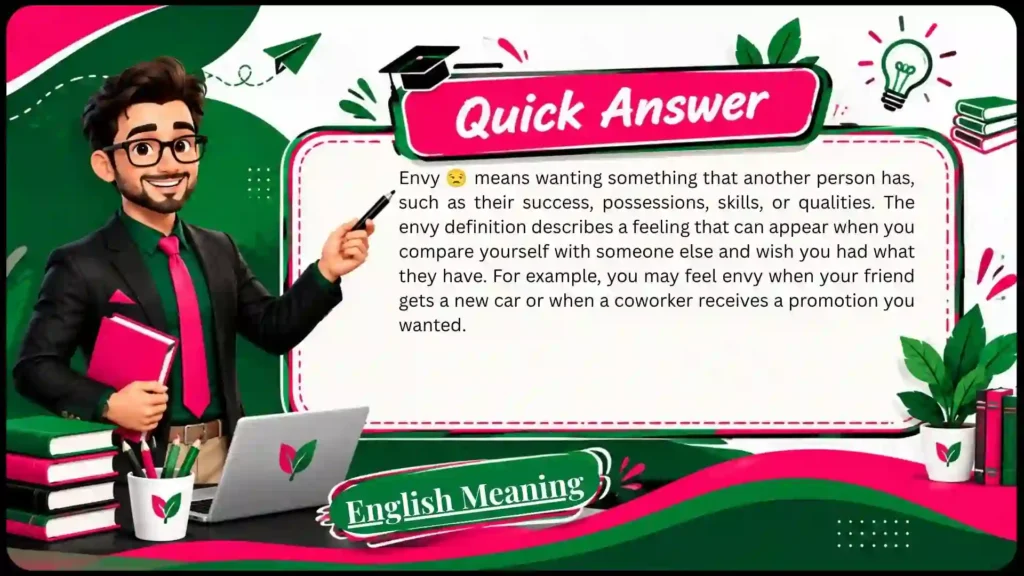
Envy 😒 means wanting something that another person has, such as their success, possessions, skills, or qualities. The envy definition describes a feeling that can appear when you compare yourself with someone else and wish you had what they have. For example, you may feel envy when your friend gets a new car or when a coworker receives a promotion you wanted.
In simple words, what does envy mean? It means feeling unhappy or dissatisfied because someone else has something you would like to have. Envy can work as both a noun and a verb, while envious describes someone who feels envy.
TL;DR
- Envy 😒 means wanting something that someone else has.
- Envy can describe a feeling, desire, or reaction to another person’s success.
- You can use envy as both a noun and a verb.
- Envious describes someone who feels envy.
- Envy and jealousy are related, but they do not always mean the same thing.
- Green with envy 💚 is a common English idiom.
- Contentment and gratitude can express ideas opposite to envy.
You Might Also Like That: To vs Too
What Does Envy Mean?
The simple envy meaning is a feeling you get when you want something another person has. That thing could be their money, talent, appearance, success, relationship, or possession. For example, if your friend buys a car you have always wanted, you might feel envy. You may admire the car while also wishing it belonged to you.
So, what does envy mean in simple words? It means wanting what someone else has. The word can describe a passing feeling or a stronger sense of dissatisfaction. The exact meaning depends on the situation and how the speaker uses it.
Envy Definition
The envy definition focuses on a feeling of wanting another person’s advantage, possession, quality, or achievement. When you experience envy, you may compare your situation with another person’s situation and wish you had something similar. For example, someone might envy a friend’s confidence, a coworker’s success, or a neighbor’s beautiful home.
In English, envy can also work as an action. When you say, “I envy her confidence,” you mean that you wish you had the same confidence. This makes envy useful as both a noun and a verb in everyday English.
Examples of Envy in Everyday Life
Envy 😒 can appear in many normal situations. It does not always involve expensive things. People can feel envy toward another person’s skills, achievements, lifestyle, or personal qualities.
- A student feels envy when a classmate gets the highest grade.
- A worker envies a coworker’s promotion.
- Someone feels envy when a friend buys their dream phone.
- A person may envy someone’s natural talent for music.
- Someone may feel envy when another person receives praise.
These examples of envy show that the feeling often begins with comparison. The person sees something desirable in someone else and wishes they had it too.
Envy in a Sentence
You can use envy in a sentence as either a noun or a verb. As a noun, it describes the feeling itself. For example, “She felt envy when her friend won the award.” As a verb, it describes the act of wishing you had something another person has: “I envy his confidence.”
You can also use envious as an adjective: “He was envious of his brother’s success.” These examples show how the words work naturally in everyday English. Using different forms can help you sound clearer when talking or writing about envy.
Is Envy a Noun or a Verb?
Envy can be both a noun and a verb. Its meaning stays closely related, but its grammar changes depending on how you use it.
| Word | Part of Speech | Meaning | Example |
| Envy | Noun | A feeling of wanting what someone has | She felt envy. |
| Envy | Verb | To want something another person has | I envy her confidence. |
| Envious | Adjective | Feeling or showing envy | He is envious of her success. |
| Envied | Verb | Past form of envy | They envied his talent. |
| Envying | Verb | -ing form | She was envying his freedom. |
Knowing these forms makes it easier to use envy correctly in sentences.
Envy vs. Jealousy: What Is the Difference?
Envy 😒 and jealousy 😟 often overlap, but they usually describe different situations. Envy usually involves wanting something another person has. For example, you might envy your friend’s new car. Jealousy often involves concern about losing something you already have, especially a relationship, position, or advantage.
| Envy | Jealousy |
| You want what someone else has | You fear losing what you have |
| Often involves comparison | Often involves rivalry or a possible threat |
| “I envy her success” | “He felt jealous when his friend became close to someone else” |
In everyday conversation, people sometimes use these words interchangeably, so context matters.
Synonyms for Envy
Several words connect closely with envy, but they do not always work as exact replacements. Enviousness describes the feeling of being envious, while resentment describes anger or bitterness toward a situation or person. Covet means to strongly desire something, especially something another person has. Begrudge can describe feeling unhappy about someone having or enjoying something.
Other related words include covetousness, resent, and jealousy. When choosing a synonym for envy, always check the sentence and meaning. A word that looks similar may carry a slightly different idea.
Envious Meaning
Envious 😒 is the adjective form of envy. It describes someone who feels or shows envy toward another person. If you say, “Maria is envious of her friend’s success,” you mean Maria wishes she had similar success. The common pattern is envious of + person or thing.
For example, you can say, “He is envious of his brother’s talent.” You can also say, “She felt envious when she saw her friend’s new house.” In simple English, envious meaning is feeling unhappy because someone else has something you want.
Common Phrases and Idioms With Envy
English uses envy in several common phrases. These expressions can help you understand how native speakers use the word beyond a basic definition.
Green With Envy
Green with envy 💚 means feeling very envious of another person. For example, “He was green with envy when he saw his friend’s new sports car.” The phrase does not mean that the person’s skin actually turns green.
Be the Envy of Someone
Be the envy of someone means that other people strongly admire or want something that a person has. For example, “Her beautiful garden was the envy of the neighborhood.”
These phrases add useful everyday meaning to the word envy.
Envy vs. Coveting vs. Resentment
Envy, coveting, and resentment are related, but they focus on different ideas. Envy means wanting something another person has. Coveting means strongly desiring something, often something that belongs to someone else. Resentment focuses more on feeling upset, bitter, or unhappy about another person’s situation or treatment.
For example, you may envy your friend’s success, covet their expensive car, or feel resentment because you believe they received an unfair advantage. Understanding these differences helps English learners choose the right word instead of treating every related term as an exact synonym.
What Is the Opposite of Envy?
There is no single perfect opposite of envy in every situation. However, contentment 😊, gratitude 🙏, and appreciation are useful ideas that contrast with envy. Contentment means feeling satisfied with what you have. Gratitude means being thankful for the good things in your life.
For example, instead of feeling envy because your friend bought a new phone, you might feel happy for them while appreciating your own phone. Admiration can also differ from envy. You can admire someone’s talent without wishing that you had their talent or that they lost it.
How to Use Envy Correctly in English
You can use envy naturally in several common patterns. As a verb, say “I envy her” or “I envy his success.” As a noun, say “She felt envy toward her successful coworker.” When you use the adjective, the common pattern is “envious of.” For example, “He is envious of his friend’s skills.”
A common learner mistake is saying “envious to someone.” The natural structure is “envious of someone.” Learning these simple patterns will help you use envy more naturally in both speaking and writing.
Envy Pronunciation and Word Origin
Envy 🔤 is pronounced EN-vee and has two syllables. The first syllable sounds like “en,” while the second sounds like “vee.” The pronunciation stays simple in both everyday speech and formal English.
The word has a long history in English and comes through earlier French from a Latin root connected with looking at something with ill feeling or dissatisfaction. You do not need to remember its full history to use the word correctly. For most English learners, understanding the meaning, pronunciation, grammar, and examples is more useful.
Frequently Asked Questions About Envy
What does envy mean in simple words?
Envy means wanting something another person has. You may envy someone’s success, money, talent, appearance, possessions, or other qualities.
What is an example of envy?
If your friend gets a new car and you wish you had the same car, you may feel envy. The feeling can happen with success, skills, possessions, or other advantages.
Is envy the same as jealousy?
No. Envy usually involves wanting something another person has, while jealousy often involves fear of losing something you already have. However, people sometimes use the words interchangeably.
Is envy a noun or a verb?
Envy can be both a noun and a verb. “She felt envy” uses it as a noun, while “I envy her” uses it as a verb.
What does “green with envy” mean?
Green with envy 💚 is an idiom that means feeling very envious of someone else.
What is the opposite of envy?
Useful contrasting ideas include contentment, gratitude, and appreciation. The best word depends on the context.
Final Thoughts
The simple envy meaning is the feeling of wanting something another person has. That something could be a possession, skill, quality, achievement, or advantage. You can use envy as both a noun and a verb, while envious works as an adjective. Understanding these forms makes everyday English easier to use.
It is also helpful to remember the difference between envy and jealousy. Envy usually focuses on wanting what someone else has, while jealousy often relates to protecting something you already have. With these meanings, examples, phrases, and grammar patterns, you can understand and use envy with confidence.