
If you have ever wondered whether “canceling or cancelling” is the correct spelling, you are not alone. Both forms describe the same action, but English uses them differently by region. Canceling is more common in American English 🇺🇸, while cancelling is more common in British English 🇬🇧. Neither spelling is simply wrong. The difference mainly comes from regional spelling conventions ✍️.
In this guide, you’ll learn the difference between canceling vs. cancelling, when to use each spelling, and why one version has one L while the other has two Ls. You’ll also see clear examples, related forms such as canceled and cancelled, and the correct spelling of cancellation. By the end, you’ll know which form fits your audience and how to use it consistently.
Quick Answer: Canceling or Cancelling?
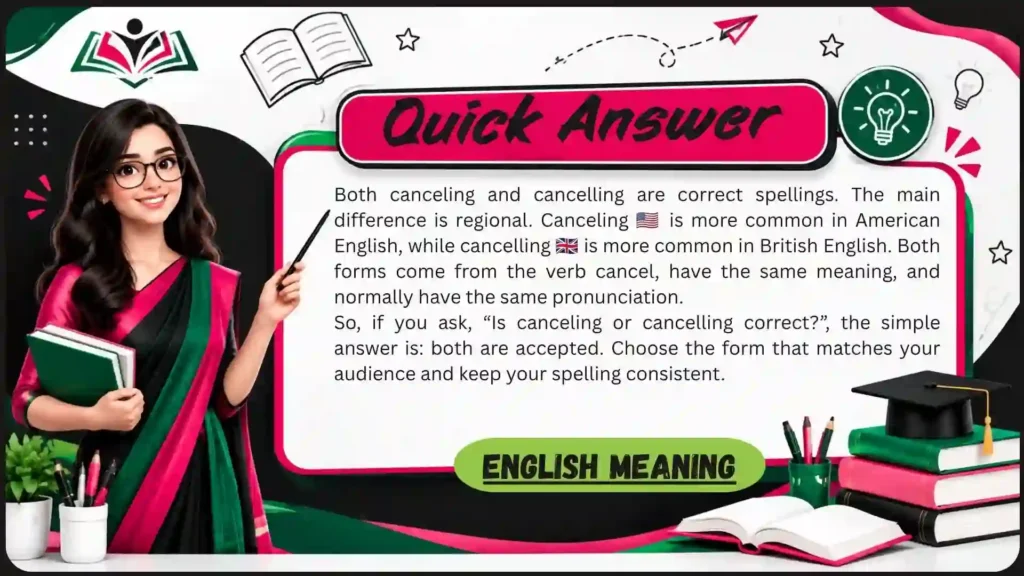
Both canceling and cancelling are correct spellings. The main difference is regional. Canceling 🇺🇸 is more common in American English, while cancelling 🇬🇧 is more common in British English. Both forms come from the verb cancel, have the same meaning, and normally have the same pronunciation.
| Spelling | Common usage | Example |
| Canceling 🇺🇸 | American English | I am canceling the meeting. |
| Cancelling 🇬🇧 | British English | I am cancelling the meeting. |
So, if you ask, “Is canceling or cancelling correct?”, the simple answer is: both are accepted. Choose the form that matches your audience and keep your spelling consistent.
TL;DR: Canceling vs Cancelling
- ✅ Both “canceling” and “cancelling” are correct spellings.
- 🇺🇸 Canceling is more common in American English.
- 🇬🇧 Cancelling is more common in British English.
- 📝 Both words have the same meaning and pronunciation.
- 🔤 The main difference is one L vs. two Ls.
- 📚 American English also commonly uses canceled, while British English uses cancelled.
- 📌 Cancellation is the usual spelling in both varieties.
- 🎯 For formal writing, choose the spelling that matches your audience and style guide.
- ⭐ The most important rule is to keep your spelling consistent throughout your writing.
You Might Also Like That: Canceled or Cancelled
Canceling vs. Cancelling: What’s the Difference?
The difference between canceling and cancelling 🔤 is mainly a spelling difference, not a difference in meaning. Both words are forms of the verb cancel, and both describe stopping something that was planned, booked, or arranged. You can use either word when talking about canceling a meeting, cancelling an appointment, or ending a planned event.
The key difference appears in American and British English 🌎. American English generally uses canceling with one l, while British English generally uses cancelling with two l’s. This same regional pattern also appears in the past tense: canceled in American English and cancelled in British English.
When Should You Use “Canceling”? 🇺🇸
Use canceling ✍️ when you follow the usual spelling conventions of American English. This form appears often in US writing, including everyday messages, business communication, websites, and other forms of professional writing. For example, an American writer might say, “We are canceling the event because of the weather.”
You may also see canceling when someone talks about a canceled flight, canceled order, or canceled appointment. If your main readers are in the United States, this spelling will usually feel more natural to them. The important point is to use the same English variety throughout your writing instead of switching between regional spellings.
When Should You Use “Cancelling”? 🇬🇧
Use cancelling ✍️ when you follow the usual spelling conventions of British English. British writers commonly use the double l in words such as cancelling and cancelled. For example, a British English sentence might say, “We are cancelling the meeting tomorrow.”
You can use this spelling in everyday, academic, business, and professional writing aimed at a British audience. The same form may also appear in other varieties of English that follow similar spelling patterns. If your publication or organization follows British English, cancelling is the natural choice.
Why Does “Canceling” Have One L but “Cancelling” Has Two?
The difference comes from regional spelling rules 🧠 and the history of English spelling. American English often uses canceling and canceled, while British English generally keeps the double l in cancelling and cancelled. The difference does not come from a change in meaning or pronunciation.
English contains many spelling differences between American and British varieties. Words such as traveling/travelling and modeling/modelling show similar patterns. Merriam-Webster also discusses the historical influence of Noah Webster 📚 on American spelling and explains why some American forms differ from British ones.
Why Does the Extra L Matter?
The extra L matters for spelling style rather than meaning. In canceling, the word contains one l before -ing. In cancelling, it contains two. You should not treat the extra letter as a grammatical difference. Instead, think of it as a regional spelling choice. If you write mainly for US readers, choose canceling; if you write mainly for UK readers, choose cancelling. Most importantly, avoid switching between the two forms without a reason.
Canceling and Cancelling in Sentences
Seeing both forms in real sentences makes the difference easier to understand. The following examples show that canceling and cancelling work in exactly the same way. Only the spelling changes.
- 🇺🇸 We are canceling the meeting.
- 🇬🇧 We are cancelling the meeting.
- 🇺🇸 She is canceling her appointment.
- 🇬🇧 She is cancelling her appointment.
- 🇺🇸 They are canceling the flight.
- 🇬🇧 They are cancelling the flight.
- 🇺🇸 I am canceling my subscription.
- 🇬🇧 I am cancelling my subscription.
These examples show why canceling vs. cancelling does not create a meaning difference. The choice simply follows the spelling convention you use.
Canceling, Cancelling, Canceled, and Cancelled
The same regional difference appears in other forms of the word cancel 🔤. American English generally prefers canceling and canceled, while British English generally prefers cancelling and cancelled. Understanding this word family can help you avoid mixing spelling styles.
| Word form | American English 🇺🇸 | British English 🇬🇧 |
| Base verb | cancel | cancel |
| -ing form | canceling | cancelling |
| Past tense | canceled | cancelled |
| Noun | cancellation | cancellation |
So, if you use canceling, you will usually also see canceled in the same American English style.
What About “Cancellation” vs. “Cancelation”?
The noun cancellation 📌 can create another spelling question. Unlike canceling/cancelling and canceled/cancelled, the usual spelling cancellation keeps two l’s in both American and British English. You may occasionally encounter cancelation, but it is much less common.
This means you should not assume that every word related to cancel follows exactly the same spelling pattern. If you are writing a normal article, email, report, or professional document, cancellation is the safest and most familiar form. ProWritingAid also highlights this word because readers often expect it to follow the same pattern as canceling and canceled.
Are “Canceling” and “Cancelling” Pronounced the Same?
Yes. Canceling and cancelling 🔊 normally have the same pronunciation and the same meaning. The extra l in the British spelling does not create a different spoken word. This makes the difference especially easy to notice in writing but difficult to hear in conversation. If someone says either form aloud, you usually cannot tell which spelling they would use on the page. Therefore, focus on your written English variety ✍️ rather than pronunciation when choosing between the two spellings.
Which Spelling Should You Use in Formal Writing?
The best spelling depends on your audience 🎯 and the English variety your writing follows. If you write for readers in the United States, canceling is generally the better choice. If you write for a British audience, cancelling is generally more suitable.
For academic, business, or professional writing, check your organization’s style guide 📘 if one exists. Most importantly, stay consistent. Avoid using canceling in one paragraph and cancelling in another unless you have a specific reason. Consistent spelling makes your writing look more polished and professional.
Can You Use “Cancelling” in American English?
Yes, you may encounter cancelling in American English, although canceling is the more common American form. The same idea works in reverse: canceled and canceling can appear outside the United States even though British English generally favors the double-L forms.
For this reason, it is better to describe the difference as a regional preference 🌎 rather than an absolute rule. If you write specifically for a US audience, choose canceling to match common American usage. However, seeing cancelling in American writing does not automatically make the sentence grammatically wrong.
How to Remember Canceling vs. Cancelling
A simple memory trick 🧠 can make the spelling easier:
🇺🇸 US → canceling → one L
🇬🇧 UK → cancelling → two Ls
You can connect this pattern with other spelling differences, such as traveling/travelling and modeling/modelling. However, do not treat this as a rule for every English word. English spelling has many exceptions and historical patterns. Use the memory trick as a quick reminder for canceling or cancelling, then choose the spelling that matches your target variety of English. ProWritingAid also uses similar examples to help readers remember the difference.
Canceling vs. Cancelling: Common Mistakes to Avoid
A few simple mistakes can make this spelling question more confusing than it needs to be:
- ❌ Saying cancelling is always wrong in American English.
- ❌ Saying canceling is always wrong in British English.
- ❌ Mixing US and UK spellings throughout one article.
- ❌ Assuming cancellation must follow the same pattern.
- ❌ Treating the two spellings as different words.
- ❌ Changing spelling simply because a reader uses another English variety.
Instead, choose a clear English style 🌎, follow your audience or style guide, and use it consistently. Remember that regional spelling differences are normal parts of English rather than signs that one writer automatically made a grammar mistake.
Frequently Asked Questions
Is canceling or cancelling correct?
Both canceling and cancelling are correct. Canceling is more common in American English, while cancelling is more common in British English. They have the same meaning and pronunciation.
Is canceling American or British English?
Canceling 🇺🇸 is more common in American English. British English generally uses cancelling 🇬🇧.
Is cancelling British English?
Yes. Cancelling is the standard and more common spelling in British English. It uses two l’s before the -ing ending.
Do canceling and cancelling mean the same thing?
Yes. Both words mean the same thing. The difference comes from regional spelling conventions, not meaning.
Which spelling is more common?
Usage depends on the region. Canceling is more common in American English, while cancelling is more common in British English.
Can I use cancelling in American English?
Yes. Cancelling can appear in American English, although canceling is generally more common in US usage.
Can I use canceling in British English?
You may encounter canceling in British-related contexts, but cancelling is the more common British spelling. Follow the style expected by your audience or publication.
Are canceling and cancelling pronounced the same?
Yes. The spelling differs, but the words normally have the same pronunciation.
Is it canceled or cancelled?
Both are accepted regional spellings. Canceled 🇺🇸 is more common in American English, while cancelled 🇬🇧 is more common in British English.
Is it cancellation or cancelation?
Cancellation is the usual and more widely used spelling. Cancelation exists as a variant but is much less common.
Final Answer: Canceling or Cancelling?
So, canceling or cancelling? The answer is simple: both are correct ✅. Use canceling when following common American English 🇺🇸 spelling and cancelling when following common British English 🇬🇧 spelling. Neither form changes the meaning of the word.
If you are writing for a specific audience, follow its usual spelling convention or your organization’s style guide 📘. Above all, keep your spelling consistent. Once you remember the one-L American / two-L British pattern, choosing between canceling and cancelling becomes much easier.