
Have you ever received a text that says “IMO, this is the best choice” and wondered what it means? 🤔 IMO is a common texting abbreviation that stands for “In My Opinion.” People use it in texts, chats, comments, and social media when they want to share a personal view.
In this guide, you’ll learn the IMO meaning in text, how to use it correctly, whether it sounds rude or polite, and when it works best. You’ll also see simple examples and learn the difference between IMO, IMHO, and IME.
Quick Answer: What Does IMO Mean?
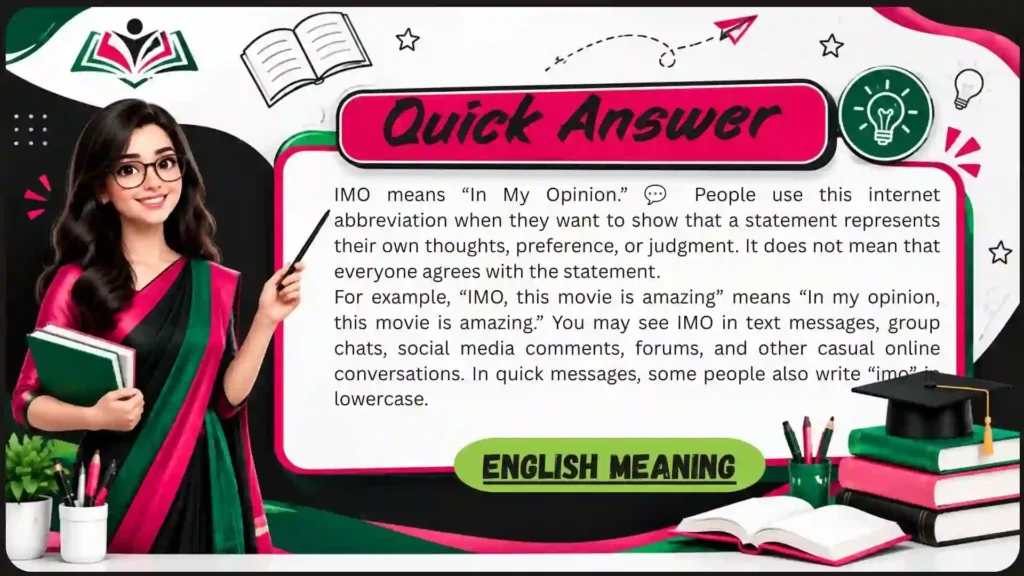
IMO means “In My Opinion.” 💬 People use this internet abbreviation when they want to show that a statement represents their own thoughts, preference, or judgment. It does not mean that everyone agrees with the statement.
For example, “IMO, this movie is amazing” means “In my opinion, this movie is amazing.” You may see IMO in text messages, group chats, social media comments, forums, and other casual online conversations. In quick messages, some people also write “imo” in lowercase.
TL;DR: What Does IMO Mean? 📌
- 💬 IMO means “In My Opinion.”
- 📱 It is commonly used in texts, chats, and social media.
- 🗣️ People use IMO to introduce a personal opinion or viewpoint.
- ✍️ You can write IMO at the beginning or end of a sentence.
- 🙂 IMO is generally neutral, but the surrounding words affect the tone.
- 💼 IMO is mostly informal, so use more formal alternatives in professional or academic writing.
- 🔤 IMO and imo usually have the same meaning.
- 🔄 IMHO means “In My Humble Opinion,” while IME means “In My Experience.”
- ⚓ In another context, IMO can mean the International Maritime Organization.
You Might Also Like That: Nouns vs Pronouns
What Does IMO Stand For?
IMO stands for “In My Opinion.” The letters come from the first letters of the three words: I for “in,” M for “my,” and O for “opinion.” People use this short form because it makes casual online communication quicker and easier.
The IMO abbreviation is common when someone wants to introduce a personal viewpoint. For example, “IMO, you should choose the cheaper option” tells the reader that the suggestion comes from the writer’s own judgment. It does not present the suggestion as a proven fact.
What Does IMO Mean in Texting?
The IMO meaning in texting is “In My Opinion.” People use it when they want to share their thoughts about something such as a movie, product, restaurant, game, or personal decision. It helps the reader understand that the message reflects the sender’s personal view.
For example, someone might text, “IMO, you should wait before buying that phone.” Here, IMO shows that the sender is giving personal advice. You can also place it at the end: “That phone is too expensive, IMO.” Both forms have the same basic meaning.
What Does IMO Mean in Chat and Online Conversations?
In online chats, IMO introduces a personal opinion. People often use it during discussions where different people may have different views. It can make a statement feel more personal because the speaker clearly presents it as their own perspective.
For example:
Alex: “Which phone should I buy?”
Sam: “IMO, the cheaper one is better.”
Here, Sam is not saying that the cheaper phone is objectively better. Sam is simply sharing a personal opinion. This makes IMO in chat useful for friendly discussions, group messages, and casual online conversations.
You Might Also Like That: Okay vs OK
How Is IMO Used on Social Media?
The IMO meaning on social media remains “In My Opinion.” 📱 People use it in comments, replies, posts, and direct messages when they want to share a personal thought. The abbreviation works especially well when a post invites people to discuss or compare different opinions.
For example, someone might comment, “IMO, the original movie was much better.” Another person could write, “IMO, this is the best feature in the new update.” Whether you see IMO on Instagram, TikTok, Reddit, Facebook, or another platform, its basic meaning usually stays the same.
IMO Examples in Real Conversations
Simple examples can make the IMO meaning much easier to understand. Here are some natural examples:
- 🎬 “IMO, the first movie was better.”
- 🍕 “IMO, pizza is better than burgers.”
- 📱 “IMO, this phone is worth the price.”
- 🎓 “IMO, you should take the easier class.”
- 🛍️ “That shirt looks better, IMO.”
Each example uses IMO to show a personal opinion. You can use it when giving advice, sharing a preference, reviewing something, or joining a discussion.
Where Does IMO Go in a Sentence?
You can place IMO at the beginning or end of a sentence. Both positions are correct in casual digital communication. When you put it at the beginning, it clearly introduces the opinion.
Beginning: “IMO, this is the better choice.”
You can also put it at the end:
End: “This is the better choice, IMO.”
The meaning does not change. When IMO starts a sentence, a comma usually follows it. When it appears at the end, a comma often comes before it. This simple pattern makes how to use IMO in a sentence easy to remember.
Is IMO Rude or Polite?
IMO is generally neutral. 🙂 The abbreviation itself does not sound rude or polite. The words around it usually determine the overall tone. Using IMO can sometimes make an opinion feel less forceful because the writer presents it as a personal view.
Compare these examples:
Polite: “IMO, you could try a different approach.”
Blunt: “IMO, that idea makes no sense.”
Both sentences use IMO correctly, but the second one may sound harsh. So, if you ask “Is IMO rude?”, the answer depends on the complete message. Use respectful words when you want your opinion to sound friendly.
You Might Also Like That: Weather Report Meaning
Is IMO Formal or Informal?
IMO is mainly informal. 💬 It works naturally in text messages, social media, chats, forums, and conversations with friends. It may not fit well in academic papers, formal reports, or highly professional writing.
For formal situations, you can use “in my opinion,” “in my view,” or “from my perspective.” For example, instead of writing “IMO, this method works best,” you can write “In my view, this method works best.” You can still use IMO in some casual work chats or friendly emails, but always consider your audience and the purpose of your message.
Should You Write IMO or imo?
You may see both IMO and imo online. The uppercase version is clearer and looks more polished because it shows that the term is an initialism. Lowercase imo is common in quick, casual texting where people often skip capitalization.
For example:
- “IMO, this is the best choice.”
- “imo this is the best choice.”
Both usually mean “In My Opinion.” If you want your writing to look neat and professional, use IMO. In very casual messages, imo is also easy to understand. The important thing is to use the form that matches your writing style and audience.
Is IMO Necessary When Giving an Opinion?
You do not always need IMO when expressing an opinion. Readers can often understand that a statement is personal without seeing the abbreviation. For example, “This movie is excellent” already sounds like a personal judgment.
However, adding IMO can make your meaning clearer:
“IMO, this movie is excellent.”
Here, IMO directly tells the reader that the statement represents your view. It can also help during disagreements because you are presenting your thought rather than saying that everyone must agree. Still, avoid using IMO in every sentence because too much repetition can make your writing sound unnatural.
IMO vs. IMHO: What’s the Difference?
IMO means “In My Opinion,” while IMHO usually means “In My Humble Opinion.” Both abbreviations introduce a personal viewpoint, so they often appear in similar conversations.
For example:
“IMO, this is the best option.”
“IMHO, this is the best option.”
The main difference is the word “humble.” IMHO can give the opinion a more modest tone, although people do not always use it seriously. If someone asks about IMO vs. IMHO, remember this simple rule: IMO states an opinion, while IMHO adds a humble or modest tone.
IMO vs. IME, TBH, and AFAIK
Several internet abbreviations can look similar to IMO, but they have different meanings. Knowing the difference helps you choose the right term in a conversation.
You Might Also Like That: Delulu Meaning
| Abbreviation | Full Form | Main Meaning |
| IMO 💬 | In My Opinion | Shares an opinion |
| IMHO 🙂 | In My Humble Opinion | Shares an opinion modestly |
| IME 🗣️ | In My Experience | Shares personal experience |
| TBH 💭 | To Be Honest | Shows frankness |
| AFAIK ℹ️ | As Far As I Know | Shows limited knowledge |
The most useful difference to remember is IMO vs. IME. IMO talks about your opinion, while IME talks about something you have personally experienced.
Does IMO Have Any Other Meaning?
In texting and social media, IMO usually means “In My Opinion.” However, the abbreviation can have another meaning in a different context. IMO can also refer to the International Maritime Organization, a specialized United Nations agency connected with shipping and maritime matters.
Context tells you which meaning someone intends. For example, “IMO, that restaurant is great” clearly uses the texting meaning. A discussion about international shipping may use IMO for the organization. Therefore, when someone searches “what does IMO mean in text?”, the expected meaning is almost always “In My Opinion.”
Common Mistakes When Using IMO
One common mistake is using IMO before a proven fact. IMO works best when you share a personal opinion, preference, judgment, or suggestion. Another mistake is confusing IMO with IME, which refers to personal experience.
Some people also use IMO too often. Adding it to every sentence can make your writing feel repetitive. Another mistake involves assuming that IMO automatically makes a message polite. The surrounding words still control the tone. Finally, avoid using the abbreviation without considering your audience. Correct IMO usage depends on both the meaning and the situation.
When Should You Avoid Using IMO?
You should avoid or limit IMO when you need a formal or professional tone. Academic essays, official reports, formal documents, and important business communication usually work better with complete phrases.
For example, instead of writing:
“IMO, this strategy is more effective.”
you can write:
“In my view, this strategy is more effective.”
Casual work chats may allow IMO, depending on the workplace. The best choice depends on your audience, purpose, and relationship with the reader. When you are unsure, writing “in my opinion” instead of IMO gives your message a safer and more professional tone.
How to Replace IMO in Formal Writing
When you need a more formal alternative to IMO, choose a phrase that matches your meaning. You can use “in my opinion” for a direct and neutral statement. “In my view” sounds concise and professional, while “from my perspective” emphasizes your personal viewpoint.
You can also use “I believe” when you want to clearly state your position. For analytical writing, “I would argue that” can work well when you are presenting a reasoned position. These alternatives keep the main idea but remove the casual feel of an internet abbreviation.
Frequently Asked Questions About IMO
What does IMO mean?
IMO means “In My Opinion.” People use it to introduce a personal viewpoint in texts, chats, and online conversations.
What does IMO stand for?
IMO stands for “In My Opinion.”
What does IMO mean in text?
In a text message, IMO means “In My Opinion” and shows that the sender is sharing a personal view.
Is IMO slang?
People often call IMO internet slang, but it is more accurately described as an internet abbreviation or initialism.
Is IMO rude?
No. IMO is generally neutral, but the surrounding words can make a message sound friendly, blunt, or rude.
Is IMO formal or informal?
IMO is mainly informal and works best in casual digital communication.
What is the difference between IMO and IMHO?
IMO means “In My Opinion,” while IMHO means “In My Humble Opinion.”
What is the difference between IMO and IME?
IMO expresses an opinion, while IME expresses something based on personal experience.
Conclusion
IMO means “In My Opinion” in most texts, chats, and social media conversations. 💬 People use this common internet abbreviation to introduce a personal viewpoint, preference, recommendation, or judgment. You can place IMO at the beginning or end of a sentence, and casual users may write it as IMO or imo.
The key thing to remember is that IMO expresses an opinion, not an unquestionable fact. Use it naturally in casual communication, and choose alternatives such as “in my view” or “from my perspective” when you need a more formal tone. This simple approach will help you understand and use IMO correctly.