
Transitive vs intransitive verbs can seem confusing at first, but the basic difference is simple. A transitive verb takes a direct object, while an intransitive verb does not. The key is to look at how the verb works in a complete sentence. Once you understand the role of the object, you can identify both types much more easily.
In this guide, you’ll learn what transitive and intransitive verbs mean, how to identify them, and how they differ. You’ll also see clear examples, common mistakes, passive voice rules, verbs that can be both, phrasal verbs, and a short practice section. ✨
Quick Answer: Transitive vs Intransitive Verbs
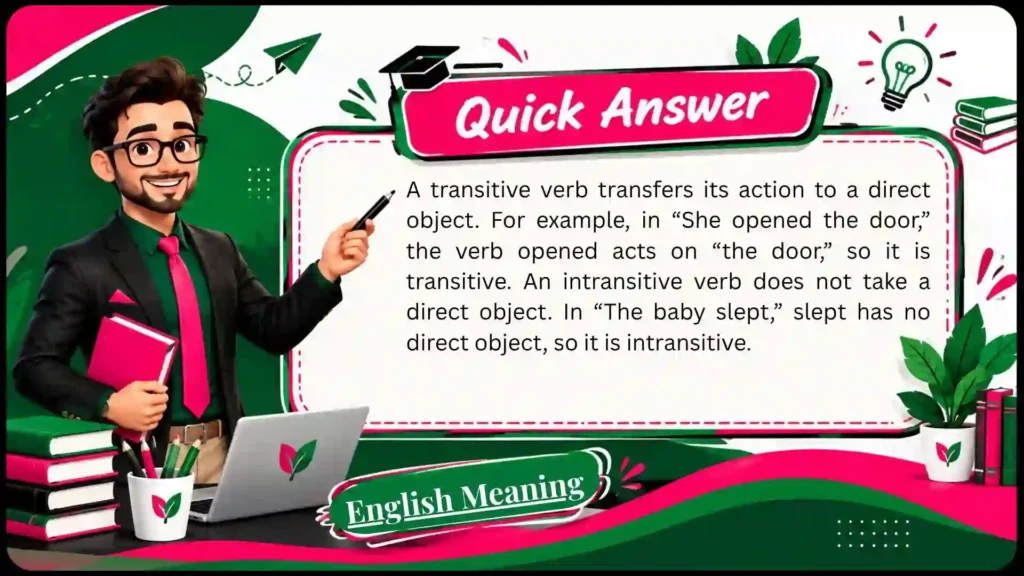
A transitive verb transfers its action to a direct object. For example, in “She opened the door,” the verb opened acts on “the door,” so it is transitive. An intransitive verb does not take a direct object. In “The baby slept,” slept has no direct object, so it is intransitive.
| Type | Main Rule | Example |
| Transitive 🔄 | Takes a direct object | She opened the door. |
| Intransitive 🚫 | Has no direct object | The baby slept. |
Remember: transitive = object, while intransitive = no direct object.
TL;DR
- 🔄 Transitive verb: Takes a direct object — She opened the door.
- 🚫 Intransitive verb: Does not take a direct object — The door opened.
- 🎯 Ask “what?” or “whom?” after the verb to help identify a direct object.
- ⚠️ Not every word after a verb is an object; prepositional phrases can follow intransitive verbs.
- 🔀 Some verbs can be both transitive and intransitive, depending on the sentence.
- 📝 Transitive verbs can usually form the passive voice; ordinary intransitive verbs generally cannot.
- 💡 Easy rule: Transitive = verb + object | Intransitive = verb without a direct object.
You Might Also Like That: Simple Present Tense
What Is a Transitive Verb?
A transitive verb is a verb that needs or takes a direct object to receive its action. The basic sentence pattern often looks like subject + verb + object. For example, “Tom kicked the ball.” Here, kicked is the verb, and “the ball” is the direct object. The action moves from Tom to the ball.
You can often identify a transitive verb by asking “what?” or “whom?” after the verb. In “She read the book,” ask, “She read what?” The answer is “the book,” so read works as a transitive verb. ✅
Transitive Verb Examples
Here are some simple transitive verb examples:
- She opened the window. 🪟
- He bought a laptop. 💻
- They watched the movie. 🎬
- We finished the project. 📋
- Sarah wrote a letter. ✉️
Each sentence contains a direct object. “Window,” “laptop,” “movie,” “project,” and “letter” receive the action. These examples show how transitive verbs with direct objects create clear sentence structures.
What Is an Intransitive Verb?
An intransitive verb does not take a direct object. The sentence can still express a complete idea without one. For example, “The baby slept.” The verb slept does not transfer an action to an object, so it works as an intransitive verb.
An intransitive verb can still have other words after it. For example, “She laughed loudly” contains the adverb loudly. Similarly, “They arrived at noon” contains a time expression. These words add information, but they do not become direct objects. No direct object means the verb is intransitive. 🚫
Intransitive Verb Examples
Common intransitive verb examples include:
- The baby slept. 😴
- She laughed loudly. 😂
- They arrived early. ⏰
- He ran quickly. 🏃
- The leaves fell. 🍂
Notice that none of these verbs has a direct object. You can add an adverb, time phrase, or prepositional phrase, but that does not automatically change the verb into a transitive verb. This distinction helps you understand verbs without direct objects more accurately.
Transitive vs Intransitive Verbs: Key Differences
The main difference between transitive and intransitive verbs comes down to the direct object. A transitive verb takes one, while an intransitive verb does not. Their common sentence patterns also differ.
| Feature | Transitive Verb | Intransitive Verb |
| Direct object 🎯 | Yes | No |
| Common pattern | Subject + Verb + Object | Subject + Verb |
| Example | She read a book. | She laughed. |
| Passive voice | Usually possible | Usually not possible |
The most important rule is simple: check the verb’s function in the sentence, rather than memorizing a fixed list of verbs.
You Might Also Like That: What Does SMH Mean in Text
How to Identify a Transitive or Intransitive Verb
You can use a simple process to identify transitive and intransitive verbs. First, find the main verb. Next, ask “what?” or “whom?” after it. If you can identify a direct object that receives the action, the verb is transitive. If you cannot, it is usually intransitive.
For example, “David cleaned the room.” Cleaned what? The room. Therefore, cleaned is transitive. In “David laughed loudly,” laughed what? There is no direct object, so laughed is intransitive. 🔎 Always consider the complete sentence because some verbs can work both ways.
The “What or Whom?” Test
The what or whom test provides a quick way to identify many transitive verbs. Consider “Maria carried the bag.” Ask, “Maria carried what?” The answer is “the bag,” which acts as the direct object.
Now consider “Maria walked slowly.” Ask, “Maria walked what?” The sentence gives no direct object, so walked is intransitive here. ⚡ However, don’t treat this test as a perfect formula. Always check whether the answer truly functions as an object and whether the verb’s meaning changes with context.
Not Everything After a Verb Is a Direct Object
Beginners often think that any word appearing after a verb must be an object. That isn’t true. A prepositional phrase or adverbial phrase can follow an intransitive verb without creating a direct object.
Compare these sentences:
- She read the book. → “the book” is a direct object.
- She read in the library. → “in the library” is a prepositional phrase.
- He slept on the sofa. → “on the sofa” gives location.
This difference is important when you learn how to identify a direct object. 📚
Can a Verb Be Both Transitive and Intransitive?
Yes! Some verbs can work as both transitive and intransitive verbs, depending on how you use them. This means you should not assume that a verb always belongs to only one category. Context determines the verb’s function.
For example, “She opened the window” uses opened transitively because “the window” receives the action. But “The window opened” uses opened intransitively because there is no direct object. Other common examples include run, eat, sing, play, read, write, change, and stop. 🔄
Common Verbs That Can Be Both
| Verb | Transitive Use | Intransitive Use |
| open | She opened the door. | The door opened. |
| run | He runs a business. | He runs daily. |
| eat | We ate dinner. | We ate early. |
| sing | She sang a song. | She sang beautifully. |
| play | They played football. | The children played. |
These examples show why transitive and intransitive verbs depending on context deserve special attention. Grammar depends on how the verb functions in the sentence, not simply on the word itself.
Transitive Verbs and Passive Voice
Transitive verbs and passive voice have a close connection because a transitive verb has a direct object that can usually become the subject of a passive sentence. For example, “The chef cooked the meal” contains the direct object “the meal.”
You Might Also Like That: What Does WYF Mean
In a passive voice, we can say, “The meal was cooked by the chef.” 🍽️ The object from the active sentence becomes the subject of the passive sentence. Ordinary intransitive verbs cannot normally form passive sentences because they do not have a direct object to move into the subject position.
Ditransitive Verbs: When a Verb Takes Two Objects
Some verbs can take two objects. We call these ditransitive verbs. They commonly take an indirect object and a direct object. For example, “She gave me a book.” Here, “me” is the indirect object, while “a book” is the direct object.
Other examples include “He sent his mother a letter” and “They told us the story.” ✉️ Understanding direct and indirect objects helps you see how these sentences work. Ditransitive verbs add useful depth to your knowledge of transitive verbs without changing the basic rule about direct objects.
Transitive and Intransitive Phrasal Verbs
Phrasal verbs can also work as transitive or intransitive verbs. A transitive phrasal verb takes an object, while an intransitive phrasal verb does not. For example, “Please turn off the light” uses turn off transitively because “the light” receives the action.
Compare it with “The plane took off.” ✈️ Here, took off has no direct object, so it works intransitively. Learning transitive phrasal verbs and intransitive phrasal verbs can help you understand everyday English more naturally.
Common Mistakes to Avoid
Several common mistakes can make transitive vs intransitive verbs confusing. First, don’t assume that every word after a verb is a direct object. Second, don’t assume that a verb always has the same classification. Some verbs work both ways.
Also, don’t confuse an indirect object with a direct object. Finally, remember that a prepositional phrase does not automatically make a verb transitive. 📝 Always look at the sentence as a whole and ask whether the verb acts directly on a specific object.
Transitive vs Intransitive Verbs Practice
Test yourself with these examples. Identify each verb as transitive or intransitive:
- Sarah opened the door. → Transitive ✅
- The baby cried loudly. → Intransitive ✅
- Mark bought a phone. → Transitive ✅
- The children laughed. → Intransitive ✅
- They played football. → Transitive ✅
- The children played outside. → Intransitive ✅
Look for the direct object before choosing your answer. This simple exercise can improve your ability to recognize different verb types in real sentences.
You Might Also Like That: IYKYK Meaning
Easy Trick to Remember the Difference
Use this simple memory trick: Transitive verbs transfer action to an object. 🔄 Intransitive verbs do not transfer their action to a direct object. When you see a verb, find the verb first and then ask “what?” or “whom?”
If the sentence contains a genuine direct object, the verb is transitive. If it doesn’t, the verb is intransitive. Just remember that some verbs can work both ways. This quick rule makes English verb usage much easier to understand.
FAQs
What is the difference between transitive and intransitive verbs?
A transitive verb takes a direct object, while an intransitive verb does not.
How do you identify a transitive verb?
Find the verb and ask “what?” or “whom?” If the answer gives you a direct object, the verb is transitive.
How do you identify an intransitive verb?
Check whether the verb has a direct object. If it does not, the verb is usually intransitive.
Can a verb be both transitive and intransitive?
Yes. Some verbs can function as both, depending on how you use them in a sentence.
Do transitive verbs always need an object?
Transitive verbs take direct objects when they function transitively. Some verbs can also have an intransitive use.
Do intransitive verbs have direct objects?
No. An intransitive verb does not take a direct object, although other words can follow it.
Can intransitive verbs be used in passive voice?
Ordinary intransitive verbs generally cannot form passive constructions because they have no direct object.
What are examples of transitive verbs?
Open, buy, read, write, watch, carry, build, teach, and kick can work as transitive verbs when they take direct objects.
What are examples of intransitive verbs?
Sleep, laugh, arrive, fall, swim, sneeze, happen, and disappear can work without direct objects.
Final Thoughts
Understanding transitive vs intransitive verbs becomes much easier when you focus on the direct object instead of trying to memorize long verb lists. A transitive verb takes an object, while an intransitive verb does not. The what or whom test can help you identify many transitive verbs quickly.
Most importantly, remember that some verbs can work in both ways. 🔑 Always examine the complete sentence and consider the verb’s context. Once you practice spotting direct objects, prepositional phrases, and different sentence patterns, you can identify transitive and intransitive verbs with much more confidence.