
Have you ever opened a long message, article, or online post and wished someone would give you the short version? That is where TLDR comes in. The TLDR meaning is “too long; didn’t read.” People commonly use this internet abbreviation to point readers to a short summary or the main point of longer content. You may also see it written as TL;DR, tldr, or tl;dr. If you are wondering what does TLDR mean, the simple answer is that it helps people quickly understand important information without reading every detail.
Today, people use TLDR in texting, chat, social media, emails, online posts, and workplace messages. Someone may write “TLDR:” before a quick summary, while another person may use TLDR to ask for a shorter explanation. In this guide, we will explain the TLDR definition, full form, meaning, examples, common uses, and difference between TLDR and TL;DR so you can understand and use this popular abbreviation correctly.
Quick Answer
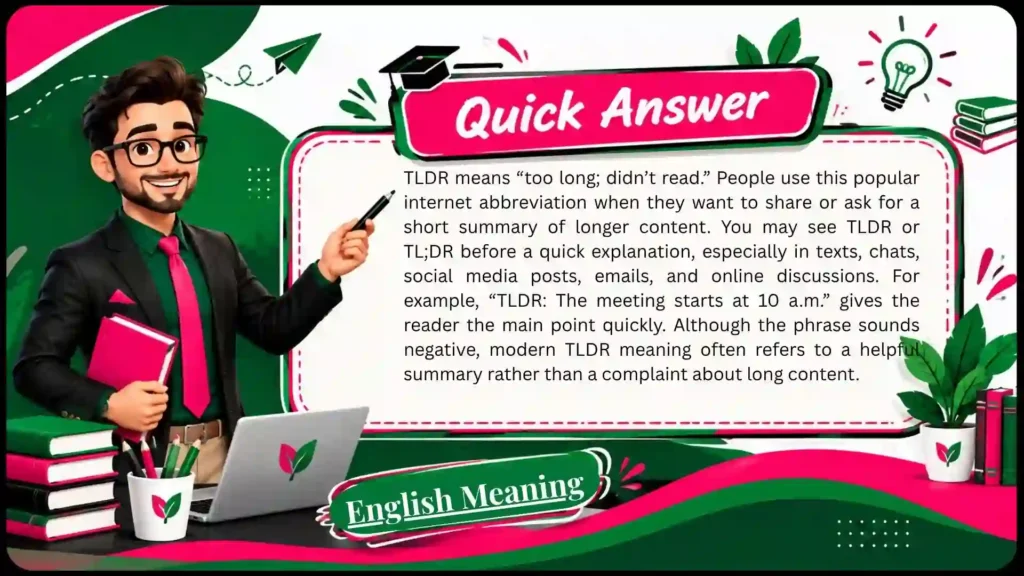
TLDR means “too long; didn’t read.” People use this popular internet abbreviation when they want to share or ask for a short summary of longer content. You may see TLDR or TL;DR before a quick explanation, especially in texts, chats, social media posts, emails, and online discussions. For example, “TLDR: The meeting starts at 10 a.m.” gives the reader the main point quickly. Although the phrase sounds negative, modern TLDR meaning often refers to a helpful summary rather than a complaint about long content.
TLDR
- 📌 TLDR means “too long; didn’t read.”
- 📝 It can introduce a short summary of longer content.
- 💬 People commonly use TLDR in texting and chat.
- 📱 You can see TLDR on social media and online posts.
- 📧 It can provide the main point of a long email.
- 💼 TLDR can work in informal workplace communication.
- 🔤 TLDR and TL;DR generally have the same meaning.
- ⚠️ Saying only “TLDR” can sometimes sound rude or dismissive.
- 🔊 People usually pronounce it T-L-D-R.
- 🌐 The abbreviation became popular through internet communication.
You Might Also Like That: FYI Meaning
TLDR Meaning
The basic TLDR definition is “too long; didn’t read.” However, people now use TLDR in another common way: to introduce a brief summary of a longer message, article, or discussion. This second meaning helps readers find the key information quickly. You can write it as TLDR, TL;DR, tldr, or tl;dr. These forms generally have the same meaning. The abbreviation appears often in online communication because people want to save time while still understanding the main idea. 📌
In simple words, TLDR tells a reader, “Here is the short version.” Someone can also use it to ask another person for a summary. For example, a friend might say, “Can you give me a TLDR?” This means they want the main points without reading the full explanation. Merriam-Webster also recognizes the term as an abbreviation and noun, showing how its use has grown beyond its original phrase. 🔎
What Does TLDR Stand For?
TLDR stands for “too long; didn’t read.” Each part represents a word from the original phrase: T means “too,” L means “long,” D means “didn’t,” and R means “read.” You may also see the traditional form TL;DR, which places a semicolon between “TL” and “DR.” Both forms communicate the same basic idea. 📖
Today, however, TLDR does not always mean that someone refused to read something because it was too long. People often use it as a label for a quick summary. That is why you may see “TLDR:” followed by one or two sentences explaining the most important information from a longer piece of content.
What Does TLDR Mean in Texting and Chat?
In texting and chat, TLDR usually means that someone wants or provides a short version of a longer message. If a friend sends you a long explanation and you reply, “TLDR?” you are asking for the main point. If you write “TLDR: I passed the exam,” you give the other person the important information without making them read the full story. 💬
People also use TLDR in messages when they want to make communication faster. You may find it in group chats, private messages, team conversations, and online discussions. The meaning stays simple: give me the short version or here is the short version. Context tells you which meaning the writer intends.
How Is TLDR Used Online?
People use TLDR online in many places, including social media, forums, comments, blogs, articles, and discussion threads. A writer may spend several paragraphs explaining an idea and then add “TLDR:” followed by the main takeaway. This helps readers who want the important information without reading every detail. 🌐
You may also see TLDR in social media posts or comments when someone wants to summarize a long argument or explanation. On an online post, it can appear at the beginning or end of the content. In both cases, the goal remains the same: make the main information easy to find and understand.
How to Use TLDR Correctly
Using TLDR Before a Summary
You can place TLDR before a short summary to help readers find the main point quickly. A colon often follows the abbreviation, as in “TLDR: The event was canceled because of bad weather.” This format works well for long posts, emails, articles, and online discussions. Keep the summary short and include only the most important information. ✍️
Using TLDR as a Request
You can also use TLDR as a request for a shorter explanation. For example, “TLDR?” asks someone to explain the main point without unnecessary details. However, remember that the tone can sound blunt in some situations. With friends, it may feel casual and normal. In professional communication, a phrase such as “Could you give me a quick summary?” may sound more polite.
TLDR Examples
Here are some simple TLDR examples that show how people use the abbreviation in everyday communication:
- 💬 Text: “TLDR: I’m running late, so start without me.”
- 📱 Social media: “TLDR: The company changed its return policy.”
- 📧 Email: “TLDR: The deadline has moved to Friday.”
- 💼 Work chat: “TLDR: We approved the new project plan.”
- 📝 Article: “TLDR: The study found that regular practice improved results.”
- 💻 Online discussion: “TLDR: Both options have benefits, but the second costs less.”
These examples show that TLDR can introduce a quick summary in many different situations.
TLDR vs TL;DR — What’s the Difference?
TLDR and TL;DR generally mean the same thing. The main difference comes from punctuation and style. TL;DR uses a semicolon, while TLDR removes it. You may also see lowercase forms such as tldr and tl;dr, especially in casual online communication. 🔤
The traditional form is TL;DR, but TLDR has become common across texts, social media, and other online platforms. You do not need to treat them as different abbreviations. In most everyday situations, readers understand both forms as “too long; didn’t read” or as a label introducing a short summary.
Is TLDR the Same as a Summary?
TLDR can act as a summary, but it usually points to a very short version of longer content. A normal summary may explain several important ideas, while a TLDR often focuses only on the main point or key takeaway. 📌 This makes it useful when readers need information quickly.
A TLDR can also differ from an abstract. An abstract usually gives a structured overview of a paper or formal document. TLDR tends to sound more casual and conversational. In simple terms, a TLDR gives readers the information they need most, while a full summary or abstract may provide more detail and context.
Is TLDR Rude?
TLDR is not automatically rude, but its tone depends on how someone uses it. When you write “TLDR:” before your own summary, it usually sounds helpful. When someone replies only “TLDR” to another person’s long message, it can sound dismissive or impatient. 😐
Context matters too. Friends may use TLDR casually without intending offense, while the same reply in a serious conversation may feel disrespectful. If you want to ask for a summary politely, try “Could you give me the short version?” or “Can you summarize the main points?” These alternatives make your request clearer and friendlier.
Can You Use TLDR at Work?
You can use TLDR at work, especially in informal channels such as Slack, team chats, or internal messages. For example, “TLDR: The client approved the new design” can help coworkers understand the key update quickly. 💼
However, workplace style varies. In a formal report, client email, official document, or professional presentation, “Summary,” “Key Takeaway,” or “Overview” may sound more suitable. Before using TLDR in professional communication, consider your audience and workplace culture. When your readers already use internet abbreviations, TLDR may feel natural and easy to understand.
How Do You Pronounce TLDR?
Most people pronounce TLDR by saying the individual letters: “T-L-D-R.” It works as an initialism, rather than as one ordinary spoken word. The same applies to TL;DR, which people generally read letter by letter. 🔊
You may see different written forms, but the pronunciation usually stays the same. If you are writing for an audience that may not know the abbreviation, it helps to write “too long; didn’t read” the first time and then use TLDR later. This approach keeps your writing clear and easy to follow.
Where Did TLDR Come From?
TLDR developed from internet communication, where people often wanted quick ways to describe long posts or discussions. The phrase “too long; didn’t read” became associated with online conversations and later developed another common use: introducing a short summary. 🌐
Merriam-Webster records 2002 as the first known use of TL;DR. Over time, people began using the abbreviation in blogs, forums, social media, emails, chats, and other forms of digital communication. Today, the summary use is especially common. A reader may see “TLDR:” and immediately know that the following text contains the main information.
TLDR Meaning in Different Contexts
| Context 📍 | Common TLDR Meaning |
| Texting 💬 | A short version of a message |
| Social media 📱 | A quick summary of a long post |
| Comments 💭 | A summary or request for one |
| Email 📧 | The main takeaway |
| Work chat 💼 | A brief project or task update |
| Articles 📝 | A quick overview of the content |
| Online forums 🌐 | The key points of a discussion |
The meaning remains closely connected across these contexts. The main difference comes from how the person uses TLDR. It can introduce a summary or ask someone to provide one.
TLDR Synonyms and Alternatives
If your audience may not understand TLDR, you can use simple alternatives such as “in short,” “in brief,” “quick summary,” “key takeaway,” “main point,” or “bottom line.” These phrases communicate a similar idea without using internet slang. ✨
For example, instead of writing “TLDR: The plan changed,” you could write “In short: The plan changed.” In formal writing, “Summary” or “Key Takeaway” may work better. The best choice depends on your audience, platform, and tone. TLDR works well for casual digital communication, while traditional alternatives often fit formal content.
Frequently Asked Questions About TLDR
What does TLDR mean?
TLDR means “too long; didn’t read.” People also use it to introduce a short summary of longer content. You can find it in texts, chats, social media posts, emails, articles, and online discussions.
What does TLDR stand for?
TLDR stands for “too long; didn’t read.” The abbreviation uses the first letters of each word in the phrase.
What does TLDR mean in texting?
In texting, TLDR usually introduces a quick summary or asks someone to provide one. Its exact meaning depends on the conversation.
Is TLDR rude?
TLDR is not always rude. It can sound helpful when you use it to introduce your own summary. However, replying only “TLDR” to someone’s long message can sometimes sound dismissive.
Is TLDR the same as TL;DR?
Yes. TLDR and TL;DR generally have the same meaning. The main difference is that TL;DR includes a semicolon.
How do you use TLDR in a sentence?
You can write “TLDR:” before a short summary. For example: “TLDR: The meeting starts at 9 a.m.”
Can I use TLDR in a professional email?
You can use it in an informal workplace email, but “Summary” or “Key Takeaway” may work better for formal business communication.
What does TLDR mean on social media?
On social media, TLDR usually introduces a short version of a longer post, discussion, or explanation.
How do you pronounce TLDR?
Most people pronounce TLDR by saying each letter: “T-L-D-R.”
What is the difference between TLDR and a summary?
A TLDR usually gives a very short version or key takeaway, while a regular summary may provide more detail about the main ideas.
Final Thought
TLDR has a simple meaning, but people use it in several ways online. It can mean “too long; didn’t read” and can also introduce a short summary of a longer message, article, or discussion. 💡 You may see TLDR or TL;DR in texting, social media, emails, work chats, and online posts. When you understand the context, the meaning becomes easy to recognize. If you use TLDR yourself, keep the summary clear and useful, and choose a more formal phrase when your audience or situation requires it.