
Do you ever wonder whether to use compliment or complement in a sentence? These two words sound exactly alike, but they have different meanings. A compliment expresses praise or admiration, while a complement completes or improves something. For example, you might compliment someone’s outfit, but their shoes may complement their dress. Knowing the difference helps you avoid common spelling mistakes and write with confidence.
The confusion doesn’t stop there! Many people also mix up complimentary vs complementary. One can describe something free or express praise, while the other describes things that work well together. In this guide, you’ll learn the difference between compliment and complement, explore everyday examples, discover easy memory tricks, and practice choosing the correct word.
🎯 Quick Answer: Compliment vs Complement
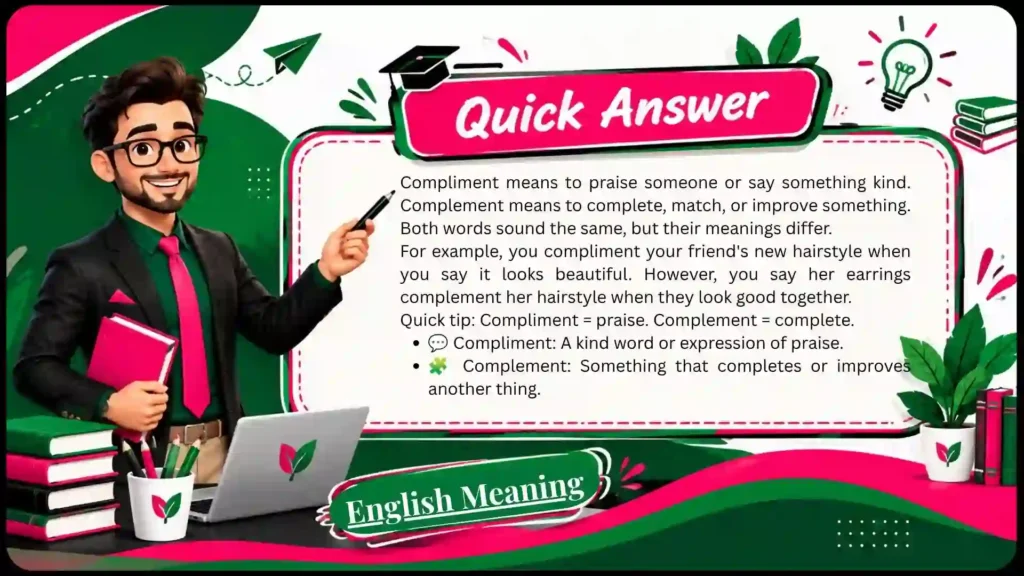
Compliment means to praise someone or say something kind. Complement means to complete, match, or improve something. Both words sound the same, but their meanings differ.
For example, you compliment your friend’s new hairstyle when you say it looks beautiful. However, you say her earrings complement her hairstyle when they look good together.
| Word | Meaning | Example |
| Compliment 💬 | Praise or admiration | She gave me a compliment. |
| Complement 🧩 | Complete or enhance | The scarf complements her coat. |
Quick tip: Compliment = praise. Complement = complete.
📌 TL;DR: Compliment vs Complement
The easiest way to understand compliment vs complement is to focus on what each word does. One expresses praise, while the other describes how things work well together.
Here are the main differences to remember:
- 💬 Compliment: A kind word or expression of praise.
- 🧩 Complement: Something that completes or improves another thing.
- 🎁 Complimentary: Free or expressing praise.
- 🎨 Complementary: Matching, completing, or working well together.
- 🔤 Pronunciation: Both words sound the same.
- 🧠 Memory trick: Compliment connects with praise; complement connects with complete.
Use the sentence’s meaning to choose the correct spelling.
You Might Also Like That: Spelled or Spelt
💬 What Does Compliment Mean?
A compliment is a kind statement that shows praise, admiration, or respect. You can compliment someone’s appearance, skills, work, or personality. People often give compliments to encourage others or recognize their efforts.
The word works as both a noun and a verb. For example, “Your presentation was excellent” is a compliment. When you say those words to someone, you compliment them.
Compliment as a Noun
A noun names a person, place, thing, or idea. Here, compliment means a statement of praise.
- 😊 She gave me a lovely compliment.
- 🌟 His teacher appreciated the compliment.
Compliment as a Verb
As a verb, compliment describes the action of praising someone.
- 💖 I always compliment her creativity.
- 👏 The manager complimented his team on their hard work.
🧩 What Does Complement Mean?
Complement means something that completes, matches, or improves another thing. People commonly use this word when discussing clothes, colors, food, teamwork, and design.
For example, a bright scarf can complement a dark jacket. The scarf adds something that makes the outfit look better. Similarly, two people with different strengths may complement each other when they work together.
Complement as a Noun
As a noun, complement refers to something that completes or enhances another thing.
- 🍽️ Rice makes a great complement to spicy curry.
- 🏡 The rug is a perfect complement to the room.
Complement as a Verb
As a verb, complement means to complete or improve something.
- 🎨 Blue curtains complement the white walls.
- 🤝 Their different skills complement each other.
⚖️ Compliment vs Complement: Key Differences
The main difference between compliment and complement involves praise and completion. You use compliment when you express admiration. You use complement when something improves or completes another thing.
Both words can function as nouns and verbs, so grammar alone cannot always help you choose. Instead, check the meaning of your sentence.
| Feature | Compliment 💬 | Complement 🧩 |
| Meaning | Praise | Complete or enhance |
| Purpose | Express admiration | Improve or match |
| Noun example | A kind compliment | A perfect complement |
| Verb example | Compliment a friend | Complement an outfit |
| Related adjective | Complimentary | Complementary |
Remember: Praise someone with a compliment; improve something with a complement.
❓ Complement or Compliment: Which Is Correct?
When choosing complement or compliment, think about what you want to express. Are you praising someone, or are you describing how something matches or improves another thing?
Both spellings are correct English words. However, you must choose the one that fits your sentence.
| Sentence | Correct word |
| I want to ___ your cooking. | Compliment |
| These shoes ___ your outfit. | Complement |
| She gave him a kind ___. | Compliment |
| This sauce is a perfect ___ to fish. | Complement |
💡 Helpful rule: If you can replace the word with praise, choose compliment. If complete or enhance fits better, choose complement.
🎁 Complimentary vs Complementary: What’s the Difference?
Complimentary vs complementary follows a similar rule. Complimentary means free or expressing praise. Complementary describes things that complete each other or work well together.
For example, a hotel may offer a complimentary breakfast, while two colors may create a complementary color scheme. Both adjectives sound alike, but they describe different ideas.
🎁 Complimentary Breakfast, Tickets, and Services
Businesses use complimentary to describe something they provide without an extra charge.
- 🏨 The hotel offers complimentary breakfast.
- 🎟️ Guests received complimentary tickets.
- ☕ The café provided complimentary coffee.
The word can also mean praising, as in complimentary remarks.
🎨 Complementary Colors, Skills, and Products
Complementary describes things that complete or enhance each other.
- 🎨 Blue and orange are complementary colors.
- 🤝 Their complementary skills make a strong team.
- 🛍️ Printers and ink cartridges are examples of complementary products.
✍️ Compliment vs Complement in Everyday Sentences
You can understand compliment vs complement examples more easily when you connect them with daily life. People use these words in conversations about clothing, food, relationships, and work.
Notice how compliment focuses on praise, while complement focuses on matching or improving something.
| Situation | Example |
| 👗 Fashion | Her shoes complement her dress. |
| 💬 Praise | I complimented her beautiful dress. |
| 🍲 Food | Fresh herbs complement the soup. |
| 👏 Work | The boss complimented my report. |
| 🤝 Teamwork | Their skills complement each other. |
| 🎨 Design | The colors complement the furniture. |
Tip: Ask whether the sentence describes kind words or things working well together.
⏳ Complimented vs Complemented: Past-Tense Usage
Complimented and complemented are the past-tense forms of compliment and complement. Both describe actions that happened earlier, but they express different meanings.
Use complimented when someone gave praise. Use complemented when something improved, matched, or completed another thing.
| Word | Meaning | Example |
| Complimented 💬 | Praised someone | She complimented my haircut. |
| Complemented 🧩 | Enhanced something | The jacket complemented my outfit. |
More examples:
- 👏 My teacher complimented my writing.
- 🎨 The bright pillows complemented the sofa.
- 😊 He complimented her confidence.
- 🍋 The lemon complemented the fish.
The same distinction applies to complimenting and complementing.
🔤 Pronunciation, Spelling, and Word Origins
Compliment and complement are homophones. This means they sound alike but have different spellings and meanings. In American English, both commonly use the pronunciation /ˈkɑːm.plə.mənt/.
Their spellings connect to their histories. Complement comes from a Latin root linked to filling or completing something. Compliment developed through a related historical word form and gained its meaning of polite praise.
| Word | Spelling clue |
| Compliment | The letter i connects with praise. |
| Complement | The letter e connects with complete. |
🧠 Spelling tip: Remember the middle vowel rather than relying on pronunciation.
💬 Common Expressions With Compliment and Complement
English speakers use compliment in several common expressions. Learning these phrases helps you sound more natural in conversations and professional writing.
Complement also appears in expressions that describe completion or a full amount. The meaning changes with the context.
| Expression | Meaning |
| 😊 Pay a compliment | Say something kind |
| 💖 Take it as a compliment | Accept a remark as praise |
| 😏 Backhanded compliment | Praise that also contains criticism |
| 🎣 Fishing for compliments | Trying to get praise |
| 🎁 Compliments of the house | Something a business provides for free |
| 👥 Full complement of staff | The complete required number of workers |
Example: The restaurant offered dessert with the compliments of the chef.
⚠️ Common Mistakes and How to Fix Them
Many writers confuse compliment and complement because the words sound identical. The most common mistake involves using the praise word when describing something that matches or improves another thing.
You can avoid these errors by checking the meaning before choosing the spelling.
| ❌ Incorrect | ✅ Correct |
| She gave me a complement. | She gave me a compliment. |
| These shoes compliment my dress. | These shoes complement my dress. |
| The hotel offers complementary breakfast. | The hotel offers complimentary breakfast. |
| They have complimentary skills. | They have complementary skills. |
| He complemented my hard work with kind words. | He complimented my hard work with kind words. |
Some incorrect examples could have a different valid meaning in another context. Always check what the sentence intends to say.
🧠 Easy Memory Tricks for Compliment vs Complement
You don’t need complicated grammar rules to remember compliment vs complement. A simple spelling trick can help you choose the correct word every time.
Focus on the middle letters i and e. Connect each letter with a familiar word that shares its meaning.
💬 Compliment = Praise
The letter i appears in both compliment and praise.
- Compliment → Praise
- Example: I complimented my friend’s singing.
🧩 Complement = Complete
The letter e appears in both complement and complete.
- Complement → Complete
- Example: The curtains complement the room.
⭐ Extra tip: Complimentary = free or praising. Complementary = completing or matching.
📝 Compliment vs Complement Practice Quiz
Test your understanding with this short compliment vs complement quiz. Choose the correct word for each sentence before checking the answers.
Practice helps you recognize the difference without stopping to think about every spelling.
Multiple-Choice Questions
1. Her earrings ___ her dress.
A) compliment
B) complement
2. My teacher gave me a lovely ___.
A) compliment
B) complement
3. The hotel offers ___ breakfast.
A) complimentary
B) complementary
4. They have ___ skills.
A) complimentary
B) complementary
5. He ___ my presentation yesterday.
A) complimented
B) complemented
✅ Answer Key
- B — Complement: The earrings match the dress.
- A — Compliment: The teacher gives praise.
- A — Complimentary: The breakfast comes free.
- B — Complementary: Their skills work well together.
- A — Complimented: He praised the presentation.
❓ Frequently Asked Questions
Here are answers to common questions about compliment vs complement and their related adjective forms.
1. What is the main difference between compliment and complement?
Compliment means praise, while complement means to complete, match, or enhance something.
2. Is it compliment or complement someone’s outfit?
You compliment someone’s outfit when you praise it. Shoes or accessories complement an outfit when they match it well.
3. Does complimentary mean free?
Yes. Complimentary can mean free of charge. It can also describe praise, such as complimentary comments.
4. What does complementary mean?
Complementary describes things that complete, improve, or work well together.
5. Is it complimentary or complementary colors?
Use complementary colors. In traditional color theory, these colors sit opposite each other on the color wheel.
6. Are compliment and complement pronounced the same?
Yes. They are homophones in standard American English.
7. Is it complimented or complemented?
Use complimented for praise and complemented for something that matched or enhanced another thing.
8. Can complement be a noun and a verb?
Yes. Complement works as both a noun and a verb, just like compliment.
🌟 Conclusion: Remember the Difference
Understanding compliment vs complement becomes simple when you remember one rule: compliment means praise, while complement means complete or enhance. Whether you’re writing an email, describing an outfit, or praising someone’s work, this distinction helps you choose the correct word.
Also, remember that complimentary can mean free or praising, while complementary describes things that work well together. Use the spelling tricks, examples, and practice questions in this guide whenever you feel unsure. With a little practice, you’ll use all four words confidently in everyday English.