
People often use envy and jealousy as if they mean the same thing, but the two words have different meanings. If you search for envy vs jealousy, you may want to know which word fits a certain situation and how to use it correctly. In simple terms, envy usually describes wanting something that another person has, while jealousy often describes the fear of losing someone or something you value. For example, you may feel envious of a friend’s success, but you may feel jealous when someone else gets close to your partner.
The difference between envy and jealousy can seem small because people often use these words interchangeably in everyday English. Still, understanding the traditional distinction can help you choose the right word in writing and conversation. In this guide, we’ll explain envy vs jealousy, their meanings, key differences, common examples, and the difference between jealous and envious in clear, easy-to-understand language.
Quick Answer: Envy vs Jealousy
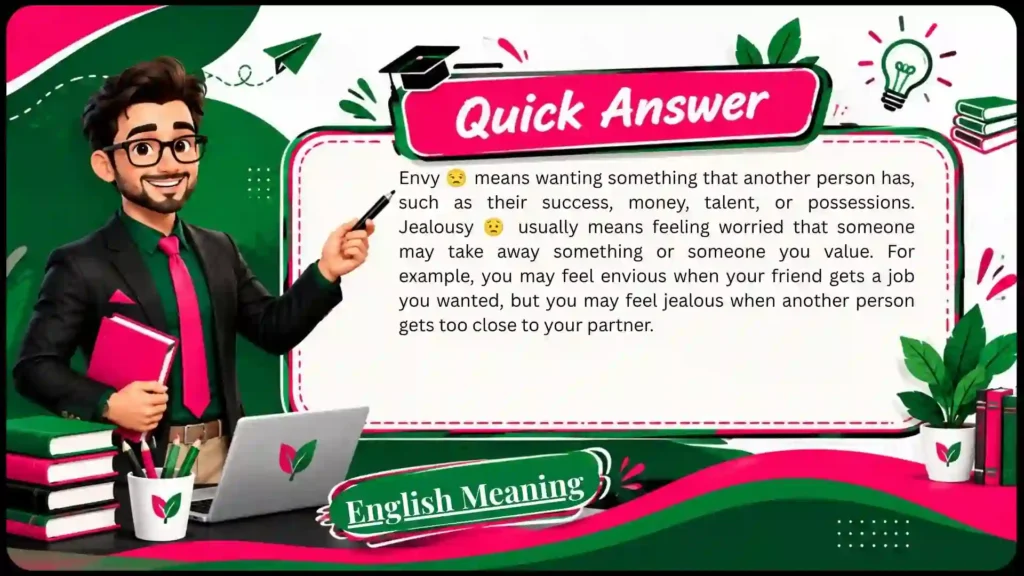
Envy 😒 means wanting something that another person has, such as their success, money, talent, or possessions. Jealousy 😟 usually means feeling worried that someone may take away something or someone you value. For example, you may feel envious when your friend gets a job you wanted, but you may feel jealous when another person gets too close to your partner.
| Envy 😒 | Jealousy 😟 |
| Wanting what someone else has | Fear of losing something valuable |
| Focuses on another person’s advantage | Often involves a rival or threat |
| Common with success or possessions | Common in relationships and attention |
| Adjective: envious | Adjective: jealous |
TL;DR: Envy vs Jealousy
- Envy 😒 means wanting something another person has.
- Jealousy 😟 often means fearing that you may lose someone or something you value.
- Envious is the adjective form of envy.
- Jealous is the adjective form of jealousy.
- People sometimes use jealous when they actually mean envious.
- The easiest memory trick is: envy = “I want what you have,” jealousy = “I don’t want to lose what I have.”
You Might Also Like That: Canceled or Cancelled
What Does Envy Mean?
Envy 😒 describes the feeling you get when you want something that belongs to another person. You may envy someone’s success, money, job, appearance, talent, skills, or possessions. For example, if your friend gets the promotion you wanted, you might say, “I envy her success.” The word does not always describe a strong or harmful feeling. Sometimes, it simply shows that you wish you had a quality or advantage that another person enjoys.
The adjective form is envious. You can say, “I am envious of his new car.” This means you want a similar car or wish you had the advantage he has. In simple terms, envy focuses on what someone else has that you want.
What Does Jealousy Mean?
Jealousy 😟 usually describes the fear that another person may take away something you value. It often appears in relationships, friendships, and situations involving attention or affection. For example, you may feel jealous if your partner gives another person too much attention. You may also feel jealous when a close friend suddenly spends more time with someone else.
The adjective form is jealous. You can say, “She felt jealous when her best friend made a new friend.” Jealousy often includes fear, insecurity, or a perceived rival. In simple terms, jealousy focuses more on protecting something important to you than on wanting something another person already has.
Envy vs Jealousy: Key Differences
The main difference between envy and jealousy comes down to what you want or fear. With envy, you look at another person’s advantage and wish you had it too. With jealousy, you worry that another person may threaten or take something you already value. This simple distinction helps English learners understand the difference between the two words.
| Feature | Envy 😒 | Jealousy 😟 |
| Basic idea | Wanting what another person has | Fear of losing something valuable |
| Main focus | Another person’s advantage | A valued person or thing |
| Common examples | Success, money, skills, possessions | Love, attention, friendship |
| Adjective | Envious | Jealous |
| Simple thought | “I wish I had that.” | “I don’t want to lose this.” |
Envy vs Jealousy Examples
Real-life examples make envy vs jealousy much easier to understand. Imagine that your coworker receives a promotion you wanted. You may feel envy because you want the same success. Now imagine that your partner starts spending a lot of time with another person. You may feel jealousy because you worry about losing their attention or affection.
Here are some simple examples:
- Envy: “I am envious of Maya’s new car.” 🚗
- Envy: “Tom envies his friend’s success.” 🏆
- Jealousy: “Sarah felt jealous when her partner talked to someone else.” ❤️
- Jealousy: “Jack became jealous when his best friend made a new friend.” 👥
Jealous vs Envious: Are They the Same?
Jealous and envious have related meanings, but they are not always the same. Envious usually describes wanting something another person has, while jealous often describes fear of losing something valuable. For example, “I am envious of your success” means you wish you had similar success. “I am jealous of your friendship with her” suggests that you worry about losing your place in that friendship.
However, everyday English often uses jealous more broadly. People may say, “I’m jealous of your new car,” even when they simply mean, “I wish I had your car.” So the traditional distinction helps, but real-world usage can overlap.
Can You Be Jealous of Something You Don’t Have?
Yes, people commonly say they feel jealous of something they do not have. For example, someone might say, “I’m jealous of your vacation,” or “I’m jealous of your new house.” In these cases, the speaker often means envious because they want something another person has. The traditional word choice would be envious rather than jealous.
Still, everyday speakers frequently use jealous this way, and most listeners understand the meaning. So saying “I’m jealous of your car” does not usually confuse people. If you want to make a clear distinction in formal or careful writing, use envious when you simply want another person’s possession, success, or advantage.
Envy vs Jealousy in Relationships
Jealousy ❤️ appears often in romantic relationships because people may fear losing a partner’s attention, love, or trust. For example, someone might feel jealous when their partner spends a lot of time with another person. Envy, on the other hand, can happen when someone wants another person’s relationship, lifestyle, or happiness. These emotions can look similar, but their focus differs.
Jealousy can also appear in friendships and family relationships. A friend may feel jealous when you spend more time with someone else. A sibling may feel jealous when another sibling receives more attention. These examples show that jealousy is not limited to romantic relationships.
Can Envy and Jealousy Be Used Interchangeably?
In everyday English, envy and jealousy can sometimes be used interchangeably. Many people say “I’m jealous of your success” even though envious would describe the traditional meaning more precisely. This happens because the common meaning of jealous has become broader over time.
Still, knowing the traditional distinction helps you choose the better word. Use envy when you want something another person has, and use jealousy when you fear losing something you value. You do not need to correct every casual use of “jealous,” but you should understand the difference when you want precise English.
Envy vs Jealousy: An Easy Way to Remember the Difference
A simple memory trick 🧠 can help you remember the difference. Think of envy as looking at someone else’s advantage and saying, “I want what you have.” Think of jealousy as protecting something valuable and saying, “I don’t want to lose what I have.”
For example, if you want your friend’s expensive phone, that shows envy. If you worry that another person may take the attention of your partner, that shows jealousy. This trick will not cover every use of the words, but it gives you a useful starting point.
Are Envy and Jealousy Always Negative?
Both envy and jealousy can create uncomfortable feelings, but the emotions themselves do not always tell the whole story. Envy may show you something you want to achieve, such as a better job, skill, or goal. You can use that feeling as a reason to improve yourself instead of resenting another person.
Jealousy can also point to a fear or concern that needs attention. For example, someone may feel jealous because they fear losing an important relationship. The important point is to understand the feeling and choose a healthy response instead of allowing it to control your actions.
Common Mistakes With Envy and Jealousy
English learners often make a few common mistakes when using these words. The biggest mistake involves treating envy and jealousy as completely identical or believing they can never overlap. Everyday English does not always follow the traditional distinction.
Keep these points in mind:
- Envy 😒 usually involves wanting what someone else has.
- Jealousy 😟 often involves fear of losing something valuable.
- Envious describes a person who feels envy.
- Jealous describes a person who feels jealousy.
- Jealousy can happen outside romantic relationships.
- Everyday speakers may use jealous to mean envious.
Envy vs Jealousy in a Sentence
Looking at the words in sentences can make the difference clearer. Use envy when you focus on another person’s advantage. For example, “I envy Sarah because she has the job I wanted.” You can also use the adjective envious: “I am envious of Sarah’s success.”
Use jealousy when you focus on protecting something valuable or fearing a rival. For example, “His jealousy caused problems in the relationship.” You can use jealous as the adjective: “He became jealous when his partner started talking to someone else.” These examples show how the words work naturally in everyday English.
Frequently Asked Questions About Envy vs Jealousy
What is the main difference between envy and jealousy?
Envy usually means wanting something another person has, while jealousy usually means fearing that you may lose someone or something you value. For example, you may envy someone’s success, but you may feel jealous when someone threatens an important relationship. The words can overlap in everyday English, so context matters. A simple way to remember them is envy = wanting what someone else has and jealousy = fearing the loss of what you have.
Is envy the same as jealousy?
No, envy and jealousy have different traditional meanings. Envy focuses on wanting another person’s advantage, while jealousy focuses on protecting something valuable from a possible rival or threat. However, people often use jealous to mean envious in casual conversation. That overlap explains why many people confuse the two words. If you want to use the most precise traditional meaning, use envy for wanting and jealousy for fear of losing.
Is it correct to say “I’m jealous of your car”?
Yes, it is common in everyday English. When someone says, “I’m jealous of your car,” they often mean that they wish they had a similar car. In the traditional sense, “I’m envious of your car” gives the more precise meaning because the speaker wants something another person has. However, the casual use of jealous sounds natural to many English speakers, so you should understand both forms.
What is the difference between jealous and envious?
Jealous and envious describe different emotional ideas. Envious usually means that you want something another person has, such as their success, money, talent, or possessions. Jealous often means that you fear losing something or someone you value. For example, you can feel envious of a friend’s new job but jealous when another person receives your partner’s attention. In casual English, however, people sometimes use jealous when they mean envious.
Can jealousy happen outside relationships?
Yes. Although people often connect jealousy with romantic relationships, it can happen in many situations. A person may feel jealous when a close friend spends more time with someone else, when a sibling receives more attention, or when a coworker gets special recognition. The main idea involves a feeling that something valuable may be threatened or taken away. Therefore, jealousy is not limited to dating or romantic relationships.
How can I remember envy vs jealousy?
Use this simple memory trick 🧠: envy means “I want what you have,” while jealousy means “I don’t want to lose what I have.” If you want your friend’s new phone, think envy. If you worry that another person may take your partner’s attention, think jealousy. This shortcut works well for most everyday examples, although real English sometimes uses the two words more loosely.
Final Takeaway
The easiest way to understand envy vs jealousy is to focus on what causes the feeling. Envy 😒 usually happens when you want something another person has, while jealousy 😟 usually happens when you fear losing something or someone you value. The adjective forms are envious and jealous.
Remember that everyday English does not always keep the distinction strict. People often use jealous when they mean envious, especially in casual conversation. Still, knowing the traditional difference helps you choose the right word and communicate your meaning more clearly.